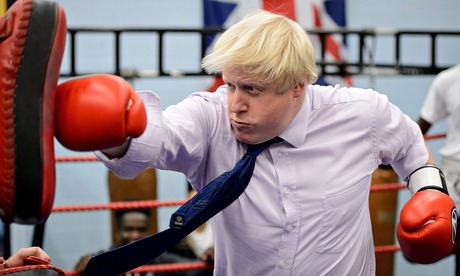
Boris Johnson, you may have heard, is London’s mayor. He is scheduled to do the job until May 2016. What difference would it make if he packed in the job today? In one way, it would matter a great deal: a mayoral byelection would be held and, if the bookies are right, put a Labour candidate in City Hall. In another way, nothing substantial would change. For years Johnson’s opponents have called him a part-time mayor. Lately the jibe is starting to ring true.
Johnson spent last Thursday in Bedford, Corby and Northampton, receiving a “rock star welcome” in key marginal parliamentary seats. He has lately devoted time to writing a biography of Winston Churchill in which is embedded “a wishful self-portrait” of its author, according to a review in the Spectator. It is claimed he took to bunking off on Fridays to complete the manuscript.
At his most recent mayor’s question time, Johnson was challenged to name the date for his affordable housing target to be met. He failed: “As far as I can remember, it’s 2015.” He was asked about a report compiled on his behalf by government assessors into the unusually low number of (not very) affordable homes planned for the massive and controversial redevelopment of Earls Court. Johnson has hailed this as “a landmark scheme”, but his questioner drew a blank. Johnson seemed not to know what she was speaking of.
No mayor can be expected to be on top every detail. It needn’t be a failing for the boss of City Hall to articulate big visions and put others in charge of nuts and bolts – in Johnson’s case, this plays to his strengths. But things are getting past a joke.
Being London’s mayor is a big deal. Formal powers may be limited compared with those of some foreign counterparts, but they are far larger than many people think. Johnson enjoys executive command of an overall annual budget of £17bn. Major planning, housing and transport decisions affecting the lives of the 8.4 million living in Greater London, all who work there and many others far beyond are his to make, along with setting the priorities of the Metropolitan police.
Britain’s capital is crucial to the nation’s economy, and it has become a global giant. The mayor shapes its evolution. For some ambitious politicians, the mayoralty’s allure is stronger than that of all but the most senior national government posts.
There are some parts of being mayor that Johnson does well. At the launch of the London poppy appeal, the actor Brian Blessed, Johnson’s fellow performer on the scene, boomed: “How fortunate we are to have such a mayor! He is colourful! He has imagination!”
Yes, he is and yes, he does. Neither has ever meant he’s been doing a good job. His second term has been increasingly marked by his evangelical belief in laissez faire, a blithe subservience to big money private interests, and a devotion to grands projets while neglecting most Londoners’ more pressing needs. Every judgment is now informed by his adherence to these hardcore orthodoxies. The issue, though, is not the decisions to which Johnson lends his name. It is whether he knows what half of them are.
His clever mind is wandering unacceptably. “He doesn’t run a team,” says one key lieutenant. “He just has people who drop in.” Despite denying that he would seek to be an MP and mayor at the same time, Johnson has booked himself a safe route back to parliament via the Uxbridge constituency. More important, he has declined to rule out also seeking the Tory leadership while remaining London’s political leader.
David Cameron has indicated that Johnson would have to finish his second stint as mayor before being asked to join the cabinet. But if Cameron wants his “star player” to help him remain prime minister he should also insist he gives his current office the attention it deserves. If Johnson won’t do that, he should resign in time for a mayoral byelection to be held on the same day as the general election next year. “Good old Boris” should buck up or step down.