A referendum on the Osaka metropolis plan, which was announced Monday, will serve as a "battle for the fate of the party" for Nippon Ishin no Kai, which is taking a leadership role on the issue. The realization of the Osaka metropolis plan has been a long-cherished wish of Ishin, but some other parties oppose the plan and the result might affect patterns of power even at the national level, including in the ruling coalition of the Liberal Democratic Party and Komeito, and in the alliance of opposition parties.
In a referendum in May 2015, Osaka citizens narrowly rejected the proposal, forcing then Osaka Mayor Toru Hashimoto, the founder of Ishin, to retire from politics. Incumbent Mayor Ichiro Matsui, the current representative of Ishin, has stressed, "If I lose, I don't deserve to be a politician."
Ishin mobilized all its Diet representatives and local assembly members in Osaka Prefecture to gain citizens' approval. A senior member of the party said, "If we win the referendum, we will gain momentum for the party's expansion in the next lower house election."
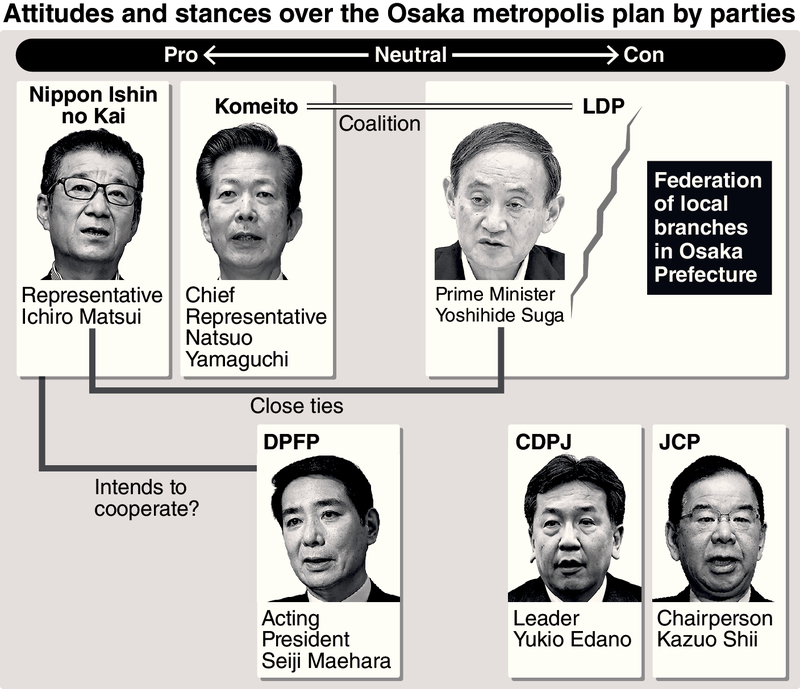
The positive news for Ishin is that Komeito has changed its stance since the 2015 referendum and now endorses the metropolis plan. Komeito, which has incumbent House of Representatives members in four single-seat constituencies in Osaka Prefecture, wants to avoid a confrontation with Ishin.
Therefore, Kazuo Kitagawa, vice representative of Komeito and lower house member from Osaka Prefecture Constituency No. 16, said at a meeting of Komeito's Osaka prefectural headquarters on Saturday that party members should tackle the contest "as if it were your own election."
Meanwhile, the LDP's federation of local branches in Osaka Prefecture opposes the plan. That group faces Komeito as an opponent at the Osaka level even though the LDP and Komeito remain partners in the ruling coalition at the national level.
"If Komeito and Ishin act together, we cannot cooperate [with Komeito] in the next lower house election," an LDP member in the Osaka city assembly said.
However, the LDP's Osaka federation has not been able to organize itself. Some LDP members in the prefectural assembly, including its secretary general, endorse the plan. In September, the secretary general of the assembly received a stern warning.
Prime Minister and LDP President Yoshihide Suga has long maintained close ties with Matsui. "We recognize that [the purpose of the metropolis plan] is to eliminate double administration," Suga admitted. When a senior official of the LDP's Osaka prefectural federation visited the prime minister's office on Thursday, Suga did not express approval or disapproval of the plan, saying only, "Good luck."
The party's headquarters is taking a wait-and-see attitude. It is unlikely that the LDP's Osaka prefectural federation will be able to gain any support from them.
As for the opposition parties, the Constitutional Democratic Party of Japan and the Japanese Communist Party are opposed to the metropolis plan, fearing that Ishin will gain momentum. Yukio Edano, CDPJ leader, visited Osaka to protest the metropolis plan in a street speech before the announcement of the referendum. The opposing campaign will be led by Kiyomi Tsujimoto, CDPJ vice leader and lower house member from Osaka Constituency No. 10. Akira Koike, head of the JCP's secretariat, said Monday at a press conference, "We must deal Ishin a blow, as it is a complementary force of the Suga administration."
However, Seiji Maehara, acting president of the Democratic Party For the People, set forth a plan at a study meeting with Ishin Secretary General Nobuyuki Baba on Thursday. Although the DPFP has yet to clarify its stance on the issue due to differences within the party, it is believed the party intends to cooperate with Ishin in the run-up to the next lower house election.
Read more from The Japan News at https://japannews.yomiuri.co.jp/