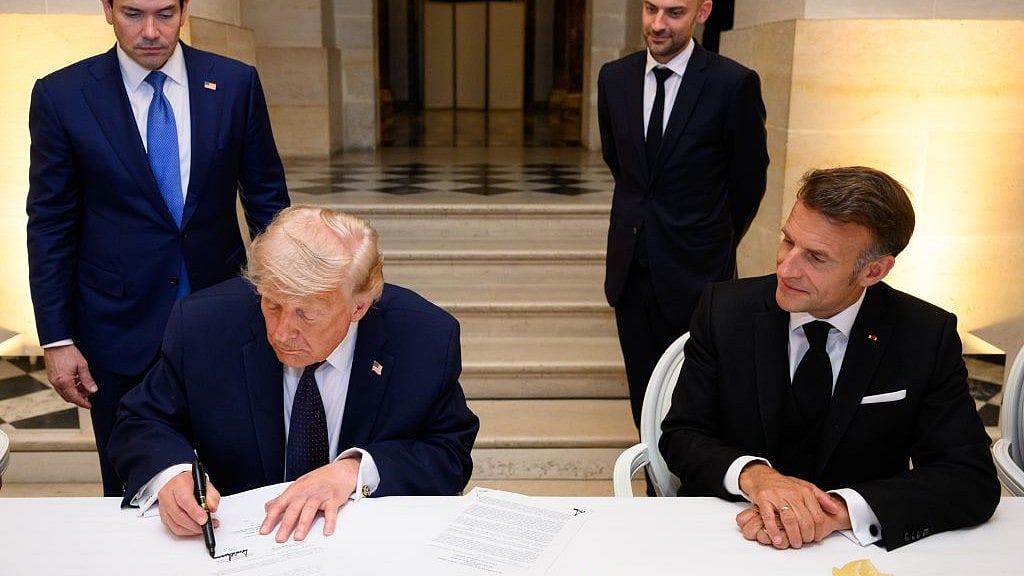
The 14-point US-Iran Memorandum of Understanding (MoU), signed by US President Donald Trump at the Palace of Versailles in France and President Pezeshkian of Iran in Tehran on 17 June, 2026 , clearly indicates that Iran has won the first round of negotiations.
Tehran secured substantial political and economic gains, while questions relating to its nuclear programme were postponed to another round of talks. The agreement, therefore, remains an interim framework rather than a final settlement. Round Two is still to come and is likely to prove both more difficult and crucial.
The Trump Administration had outlined the objectives of the Israel-US military campaign on February 28 when they jointly attacked Iran: destruction of Iran’s nuclear facilities and missile capabilities, regime change, and severing Iran’s ties with its proxies in the ‘Axis of Resistance’, not limited to Hezbollah in Lebanon.
Israel’s ambitions went further still, seeking the Balkanisation of Iran and its permanent disarmament to cement its position as the sole regional hegemon in West Asia.
None of these objectives were achieved.
On the contrary, the decapitation of Iran’s leadership produced the opposite effect, elevating a more hardline and hawkish generation of leaders. The killing of Ali Larijani, one of the last credible moderates within the regime, proved to be the final blow to the possibility of a reformist leader coming to power in Tehran.
The MoU indicates that Iran has received commitments for war reparations — even though they are not called that, but structured as a US $300 billion reconstruction fund. It has also received an immediate waiver from the US Treasury for its oil and petroleum derivatives exports and has been promised the lifting of all US unilateral, UN Security Council and IAEA multilateral sanctions, together with the release of frozen Iranian assets, subject to certain conditions.
No mention is made of either Iranian missile stockpiles or curbs on its proxies. Instead, the MoU explicitly includes Lebanon in the 60-day extended ceasefire.
None of this is music to Israel’s ears.
In addition, the invasion allowed Iran to discover that it already possesses a ‘nuclear weapon’ — effective control over the Strait of Hormuz.
The MoU recognises this by accepting that Iran and Oman will develop a joint management arrangement for the Strait after the ceasefire period. This is likely to include service fees (not tolls) for transiting ships designed in a manner consistent with international law.
In effect, the invasion has handed Iran two lasting forms of leverage — control of the Strait of Hormuz alongside the standing threat of missile strikes on US bases and critical energy infrastructure across the Gulf and Jordan. It has already demonstrated that it can sustain both forms of leverage.
More broadly, Iran has offered a lesson to the Global South: standing up to Donald Trump can safeguard a nation’s interests, while capitulation risks losing far more. Media commentators have argued that Iran’s defiance has reignited global solidarity with Tehran and become, in the eyes of many, a symbol of necessary resistance.
In a profound irony, the war also resolved Iran’s succession crisis.
Mojtaba Khamenei — a figure of enormous behind-the-scenes influence who had rarely appeared in public — became Supreme Leader. According to those within Iran’s corridors of power, several factors accelerated his rise: he had lost family members and was himself wounded in the strikes; he had served as an Islamic Revolutionary Guard Corps (IRGC) fighter during the Iran–Iraq War and maintained close ties with the IRGC; and the killing of Ali Khamenei was rapidly mythologised within Shia tradition, creating a Karbala-like narrative that lent Mojtaba’s ascension an air of sacred legitimacy.
The war also triggered Iran’s own “Gang of Four” moment — a consolidation of hard-line power that has, for the foreseeable future, extinguished any prospect of a Deng Xiaoping-style opening.
The conflict has mobilised and unified the country to an unprecedented degree. Young Iranians, women and ethnic minorities rallied around the nation and its flag; the simmering anger that had nearly boiled over during the January 2026 protests was effectively channelled outwards.
When the US attempted to re-arm the Kurdish minority as a proxy force, they declined. Meanwhile, the Iranian military developed and implemented the “Mosaic Defence” doctrine, a decentralised, resilient strategy designed to sustain operations even under catastrophic leadership losses.
The war has handed the Islamic Revolutionary Guard Corp’s unchecked authority. Unlike the older generation of Iranian leaders, including the previous Supreme Leader, who advocated caution and restraint, the new leadership appears to have concluded that restraint only invited further attacks, territorial violations and assassinations.
Their doctrine has shifted: strike hard enough to regain regional leverage. Political scientist John Mearsheimer has argued that the United States has already lost, or is losing, its conflict with Iran, describing it as a “colossal blunder” and a “Vietnam-style quagmire.”
In a historically unprecedented turn, the world’s sole superpower has found itself on the backfoot, bleeding its own imperial, armaments and financial capacities. Within the war’s first three weeks, US military losses and repair costs were estimated at between $1.4 billion and $2.9 billion.
Iran’s closure of the Strait of Hormuz brought the global economy and its energy security architecture to its knees. Shortages of fertilisers and oil, combined with surging inflation, severely damaged global economic prospects.
As a result, the Trump administration was compelled to permit Iran to continue selling petroleum on international markets and provide a 30-day waiver on the purchase of Russian oil even during the war because the alternative was a global economic catastrophe.
Iran continued selling oil throughout the conflict and may have sold more than before, benefiting from elevated prices driven by regional instability. Meanwhile, the erratic, transactional nature of the Trump administration kept global oil, stock, bond and other markets in a state of sustained anxiety.
The US’s inability to reopen the Strait exposed the limits of American imperial overreach — a moment many analysts have compared to the Suez Crisis of 1956, this time marking a potential turning point for American rather than British power. The war has simultaneously cemented Iran’s status as a major regional power, with lasting consequences for Middle Eastern geopolitics.
The Gulf states have long depended on US military protection and American bases stationed on their soil. Yet rather than serving as a shield, those bases became a liability over the last 100 days as Iran struck them with devastating effectiveness.
Following Iranian strikes on UAE-linked sites, strategic thinkers in the region have called for a reassessment of the American military presence, describing US bases as a burden rather than a strategic asset.
The Gulf monarchies have been forced to confront an uncomfortable truth: without a credible collective security architecture rooted in the region itself, business as usual is no longer viable.
Kamal Malhotra is Distinguished Visiting Professor, NALSAR University of Law, India.
Moin Qureshi is Teaching Fellow, Krea University, India.
Originally published under Creative Commons by 360info™.
Newslaundry is a reader-supported, ad-free, independent news outlet based out of New Delhi. Support their journalism, here.