U.S. intelligence officials reportedly identified threats from Iranian surface-to-air missiles and a potential shoulder-fired missile before President Donald Trump secretly swapped planes after leaving last month’s NATO summit in Turkey.
Iranians also knew specifically where the president was staying during the Ankara trip, down to the floor of the building, according to officials who spoke to The New York Times.
That information appeared to be deemed credible enough for the Secret Service to launch a covert operation to sneak Trump and senior members of his team from Air Force One into a smaller plane in the president’s caravan, while leaving members of the press — and some of his top Cabinet members — in the executive jet, effectively serving as a decoy for potential attacks.
After boarding the older, fortified Air Force One in view of cameras and the press, Trump was secretly moved from the plane inside a catering truck into a smaller Air Force C-32A plane. The president’s actual location, until this week’s reporting by The Washington Post, had been concealed from reporters, the public and senior government officials after that July trip.
“I think actually the plane that I flew on was at greater risk,” Trump told reporters on Tuesday night, breaking his silence on the issue. “I think it was at greater risk because that would be the plane I think that they would be more likely to go for.”
Trump, facing criticism for potentially endangering the lives of passengers on the decoy plane and raising critical questions about security protocols, told reporters that he was following the direction of the Secret Service.
“It’s really just up to Secret Service. I just follow what they like to do,” he said. “They wanted me to go on a different flight, a different plane, equal safety. … I do what they say.”
But it’s unclear why senior Cabinet officials remained on the decoy plane while Trump was accompanied by only a handful of senior White House aides on the other military jet.
He was reportedly joined by White House deputy chief of staff Dan Scavino, Trump’s executive assistant Natalie Harp, and Walt Nauta, the director of Oval Office operations, according to a U.S. official familiar with the operation who spoke to The Washington Post.
They appear to have been inside the catering truck with Trump as it moved them from Air Force One to the Air Force C-32A.
Defense Secretary Pete Hegseth boarded the smaller plane separately.
Trump and administration officials flew to Turkey on a Qatari-gifted Boeing 747-8, which is intended to serve as the “new” Air Force One. According to The Post, that flight manifest included Treasury Secretary Scott Bessent, Secretary of State Marco Rubio, White House deputy chief of staff Stephen Miller, Communications Director Steven Cheung, deputy national security adviser Michael Needham and staff secretary Will Scharf, who this week was promoted to White House counsel.
They all appear to have left Turkey on the older Air Force One, though the White House has not shared details about the passenger list.
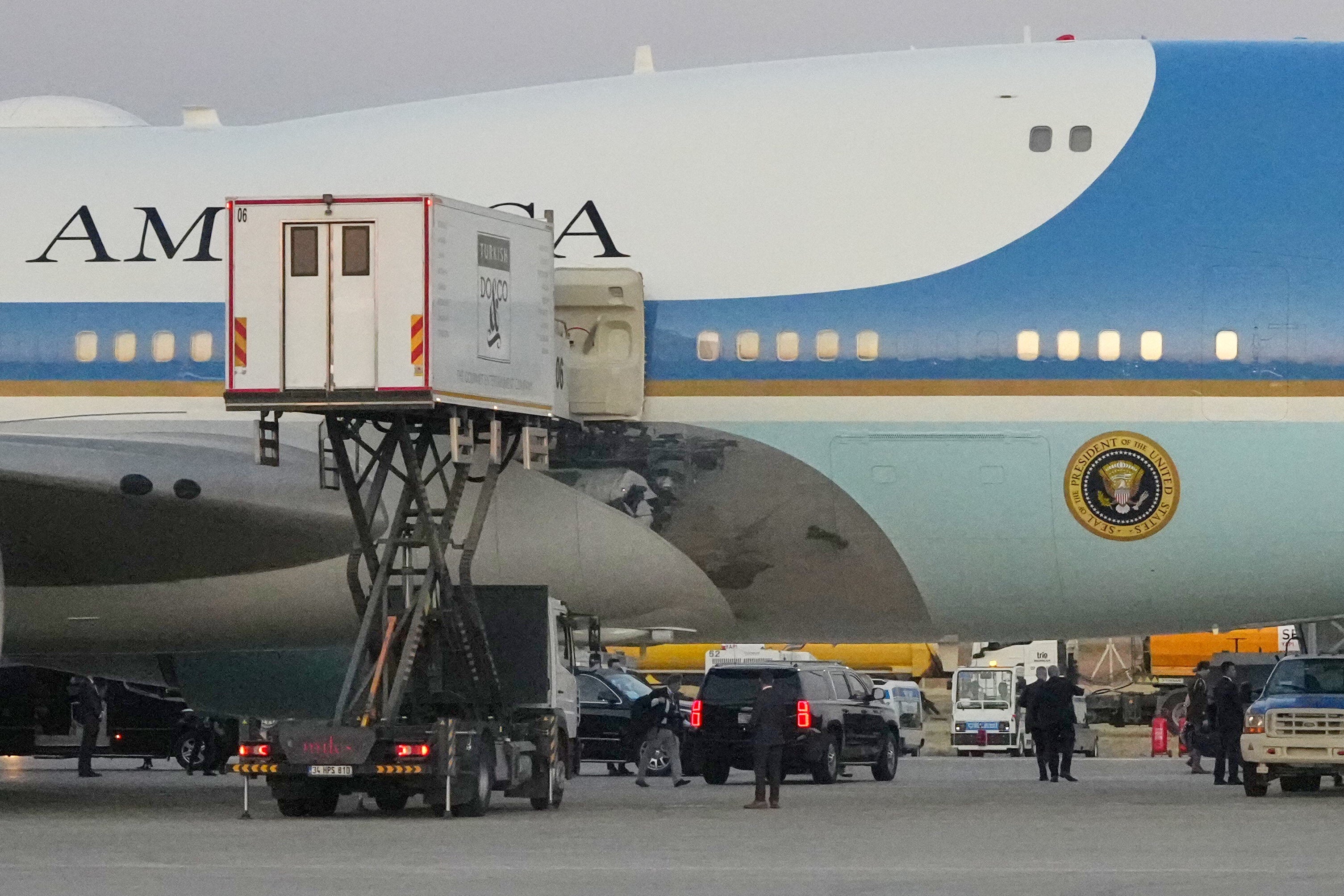
At the time, Trump claimed he was leaving Ankara on the older Air Force One “for old time’s sake” while the new Qatari jet flew to an Air Force base in the U.K. housing U.S. troops.
But that didn’t happen. The new jet left Turkey on the night of July 8, and then Trump then waved goodbye as he boarded the older Air Force One later that evening. An elaborate operation to secretly move the president and his closest aides followed.
The planes touched down in the U.K. later that night; it’s unclear how Trump moved back inside Air Force One after covertly exiting the military plane, but he was seen on camera descending from the executive plane using external stairs.
He then returned to the Qatari jet for the flight back to the U.S.
Asked by reporters whether a potential security concern sparked the plane switch, the president denied there was one. Another reporter asked why they were told to close their window blinds on the flight from Turkey.
“Because you’re probably on a dangerous flight,” Trump replied, seemingly alluding to perceived threats from Iran.
When asked if he was aware of any credible threat by Iran against Air Force One, Trump said, “Well, I have a threat all the time. I’m No. 1 on their list, before you. But if I go, you go. Perhaps someday you want to change professions.”
The president repeatedly stated throughout his remarks at the NATO summit that he believed Iran was trying to assassinate him.
Last year, Trump said Iran would be “obliterated” if he was assassinated by state actors.
“That would be a terrible thing for them to do,” he told reporters in February 2025. “Not because of me. If they did that, they would be obliterated. That would be the end. I’ve left instructions: if they do it, they get obliterated. There won’t be anything left.”
After returning to the U.S., Trump said he left his advisers specific instructions should anything ever happen to him.
“I’ve left instructions,” he told The New York Post last month. “If anything happens, to just literally bomb them at levels that they’ve never seen before,”