Scientists are yet to unlock the mysteries of the third object to have travelled through our solar system, known as 3I/ATLAS.
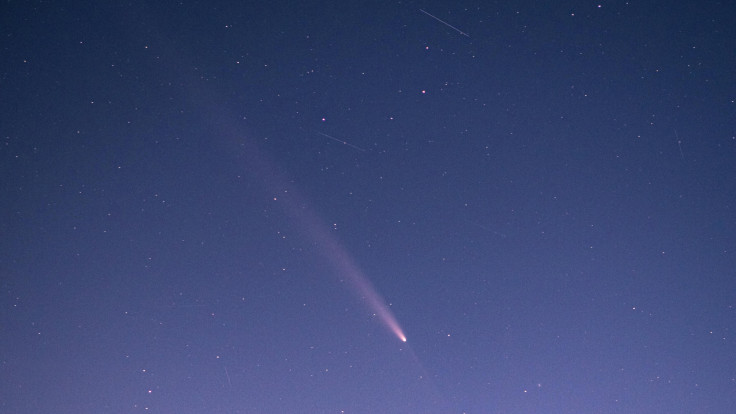
Recent photographs have indicated a tail jet of anti-tail length exceeding 400,000 kilometres that points towards the Sun. It is considerably longer than the characteristics of known comets, and scientists have been baffled by what the particles behind the glow are.
In December 2025, astronomers Toni Scarmato and Teerasak Thaluang, using gradient filters, captured images of the anti-tail, revealing its structure. The very long and thin collimation of the jet indicates that 3I/ATLAS is losing particles that are very different to those found in the fine dust commonly found in solar-system comets.
Dust Particles Defy Expectations
Historically, cometary jets are bright because sunlight is bounced off sub-micron dust particles. These small grains, with large surface area relative to their mass, dominate the visible halo around comets. Calculations, however, reveal that the observed 400,000-kilometre jet of 3I/ATLAS was not possible by such particles.
The pressure from solar radiation at a heliocentric distance of approximately two astronomical units would slow sub-micron-sized particles too rapidly.
To achieve the measured length, the particles ought to be significantly larger, larger than a micron in diameter. This demand would question the belief that 3I/ATLAS would act as a natural comet, since large particles are more difficult to accelerate via gas sublimation.
The Physics Of The Jet
The force exerted by solar radiation on particles is directly proportional to the particle's radius; smaller particles are more easily moved. In the case of 3I/ATLAS, the measured jet length suggests that the particles have radii between one and 100 microns.
The smaller the particles were, below one micron, the greater would have been the velocity required of them, more than that of the gas molecules at that distance in the same direction, which was impossible.
On the other hand, particles bigger than 100 microns would be too incredible to be pulled to the required velocities by outflowing gas. This small window suggests that there is something out of the ordinary in the dynamics, perhaps concentrated jets on a small fraction of the nucleus's surface.
Mass Loss And Jet Density
The James Webb Space Telescope estimated a 3I/ATLAS mass loss on the Sun-facing side of the Sun at 3I/ATLAS of 150 kilograms per second, rising to 500 kilograms per second just before perihelion. This gaseous outflowing density declines and moves away with the distance from the nucleus, and this determines the form of this jet.
The pictures indicate that the anti-tail is locked in a cone of about eight degrees, corresponding to a solid angle of 0.06. Using these values, researchers have obtained the jet's mass density and timescales. These results confirm that particles of the same range of one to a hundred microns are the only ones that can be compatible with the observed jet length and speed.
Anomalous Behaviour
The oddity of the situation is that large particles dominate the jet's glow. In the usual comets, the smaller grains of dust are the best scatterers of sunlight and form the well-known halo. In the case of 3I/ATLAS, the glow is instead caused by larger particles, and the glow's anti-tail is much longer and more collimated than anticipated.
This behaviour casts doubt on 3I/ATLAS being a natural comet. Although the dynamics we observe are explainable in the context of cometary physics, it is impossible to rule out alternative explanations, such as exotic sources of particle ejection. Avi Loeb has observed that only direct spectroscopy of jet velocities will provide indisputable answers.
Implications For Interstellar Science
The example of 3I/ATLAS highlights the abundance of interstellar objects. All visitors provide their own observations of other planetary systems. The atypical particle dynamics of 3I/ATLAS raise the possibility that interstellar comets are not isomorphic to models based on solar system examples.
The Doppler shifts of the jets could be measured in the future with the Webb telescope, thereby refining estimates of the particles' size and velocity. Such information would make it possible to conclude whether 3I/ATLAS is an odd comet or something more.
The 400,000-kilometre anti-tail of 3I/ATLAS is one of the most remarkable aspects that have ever been seen on an interstellar object. The particles in it are too large to be typical cometary dust, and its glow makes current models and theories appear problematic, raising new questions about how interstellar bodies work.
Now that scientists are still trying to uncover its secrets, 3I/ATLAS reminds us that science is not predictable. Still, with every interstellar traveller, there is a chance of redefining the nature of cosmic phenomena.