

Intel has confirmed several details about its next-generation Xeon 7 CPUs, codenamed Diamond Rapids, which are now officially slated to launch in 2027. Announcing its E-core-only Xeon 6+ chips at Computex, Intel teased that Diamond Rapids will support PCIe 6.0, pack 50% more cores than Xeon 6, and double the memory bandwidth. Intel is building Diamond Rapids chips on the Intel 18A-P node, which is a refined version of 18A that Intel demoed just last month.
Although Intel never formally announced a release window for Xeon 7, we originally expected to see the chips this year – a timeframe that became increasingly unlikely as news about Diamond Rapids dried up. Now, Intel has officially confirmed Diamond Rapids is arriving next year, meaning AMD will have a head start with its next-gen EPYC Venice CPUs built on the Zen 6 architecture, which are still (at the moment) slated for release this year.
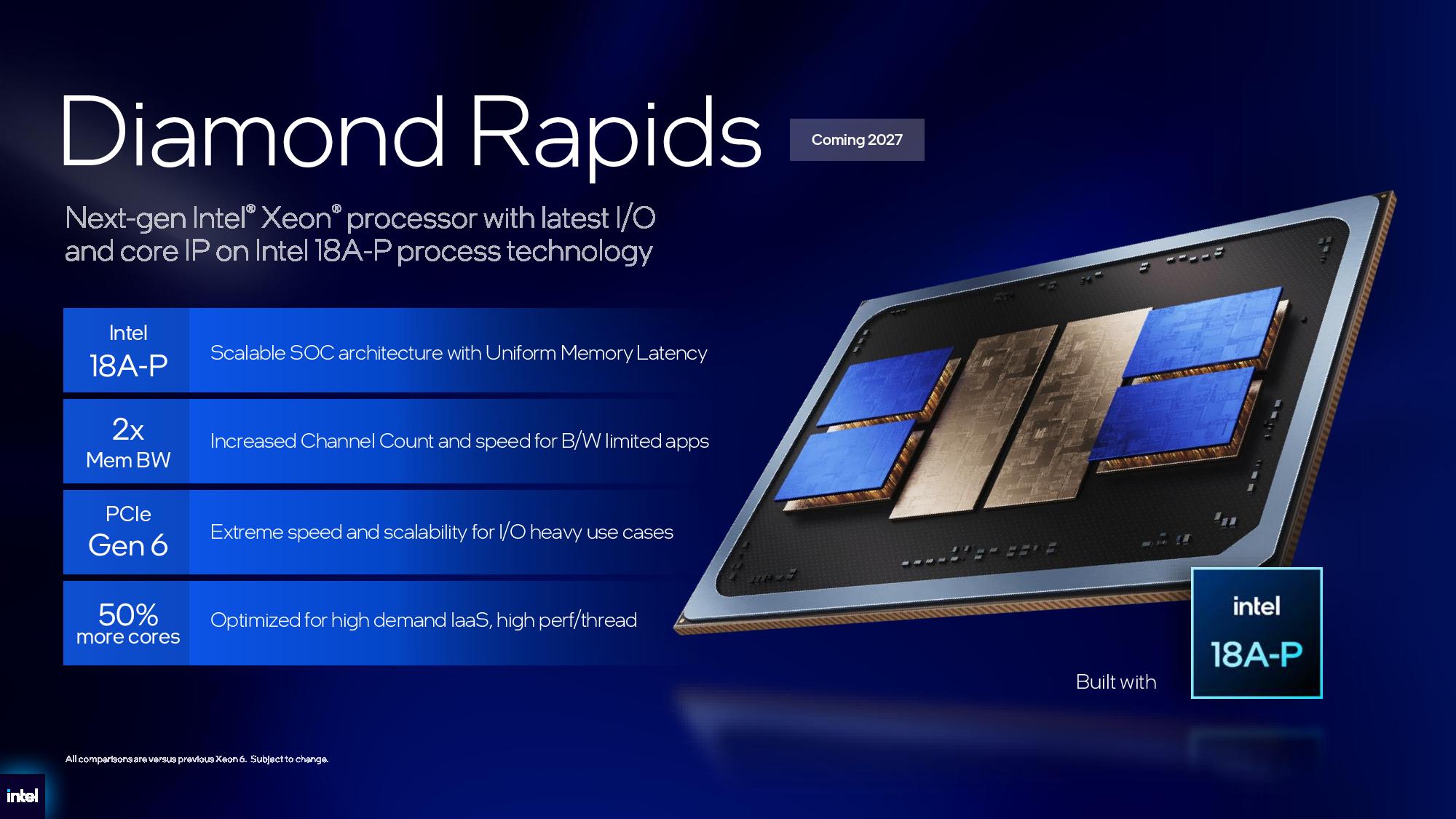
Like Venice, Intel has confirmed Diamond Rapids will support PCIe 6.0, as well as double the memory bandwidth of Granite Rapids. Last year, Intel confirmed it canceled an 8-channel memory variant of Diamond Rapids to focus exclusively on the 16-channel design. Granite Rapids-AP (12-channel) topped out at 614 GB/s of memory bandwidth, while Granite Rapids-SP (8-channel) topped out at 409 GB/s. Depending on the comparison point — Intel didn’t clarify — you’re looking at topline memory bandwidth of at least 1.2 TB/s or 818 GB/s, respectively. Second-generation MRDIMM support, however, means that bandwidth could climb to upwards of 1.6 TB/s.
We can do similar math with core counts, looking at the top-end 6980P from Granite Rapid-AP at 128 cores. A 50% increase in core count brings us to 192 cores. Diamond Rapids has been rumored to climb up to 256 cores, with a 512-core dense version planned later. Intel is suggesting those rumors are false, though no hard specifications are confirmed yet.
The big question is what microarchitecture those cores will use, and if they’ll support Hyper-Threading. Intel removed Hyper-Threading from the Lion Cove P-cores in Lunar Lake and Arrow Lake, and kept it out of the Cougar Cove P-cores in Panther Lake. Naturally, if Xeon 7 uses either of those P-core microarchitectures, we’d also expect the chips to lack Hyper-Threading. Adding to the speculation were some comments Intel made in its January earnings call, where it said that it “will also reintroduce multi-threading back into our data center road map.”
Recently, however, Intel documents have suggested Diamond Rapids will use Panther Cove, an as-of-yet unreleased microarchitecture. We should know for sure what’s going on under the hood of Diamond Rapids soon. "We expect to share more on Diamond Rapids in the late summer at Hot Chips, so stay tuned there,” an Intel spokesperson shared in a Q&A with Tom’s Hardware.
Perhaps the most significant reveal in this tease is that Diamond Rapids is using Intel 18A-P. We’ve known for a while that the first 18A CPUs in the data center would be Xeon 6+, which Intel has now officially launched. 18A-P is a revision of 18A, but Intel has already demonstrated that it’s quite a significant revision.
Intel claims 18A-P delivers 9% higher performance at the same power as 18A, or an 18% power reduction at the same performance level. Intel says it also improved reliability and tweaked voltage behavior, making 18A-P a much more mature revision of 18A, likely in a bid to attract external customers for Intel Foundry.
Intel is facing off against AMD’s Zen 6 Venice CPUs, which we expect to learn more about at AMD’s Advancing AI event in July. So far, AMD has confirmed that Venice will launch with up to 256 cores, 1.6 TB/s of memory bandwidth per socket, and a 70% jump in gen-on-gen performance. There’s still a lot we don’t know about Venice and Diamond Rapids, but from the initial teases, Team Red is looking like the leader.
That would make sense. Although Diamond Rapids is a significant release for Intel, the company has continually reiterated the importance of Coral Rapids, the generation that will follow Xeon 7 on Intel’s road map. We expect to see Coral Rapids in 2028, featuring SMT, and Intel has said that it’s looking into ways to accelerate the Coral Rapids rollout.