Google arrived at its annual I/O developer conference with a message that it does not plan to fall behind in the escalating artificial intelligence race. As OpenAI and Anthropic continue grabbing attention with massive valuations and rapid model development, Google unveiled a new wave of Gemini tools designed to make AI faster, cheaper and far more personal.
At the center of the announcements were Gemini 3.5 Flash, a new lightweight AI model, and Gemini Spark, an AI agent built to actively assist users across apps and services. The company also introduced Gemini Omni, a video-focused model that can edit and transform footage through simple conversation prompts. The updates signal Google’s biggest push yet to turn AI from a search tool into a constant digital assistant.
Why is Google pushing harder into AI now?
Google used its I/O developer conference to showcase an aggressive expansion of its AI ecosystem as pressure grows from rivals OpenAI and Anthropic. Both companies are reportedly preparing for public offerings, while investors continue pouring billions into advanced AI development, as per several reports by Google, CNBC and Engadget.
The centerpiece of Google’s latest strategy is Gemini, its growing family of artificial intelligence models and tools. During the event, CEO Sundar Pichai introduced Gemini 3.5 Flash, describing it as “remarkably fast.”
According to Google, the model delivers frontier-level AI performance at a significantly lower price than competing systems. The company said Gemini 3.5 Flash can operate at roughly half — and in some cases one-third — the cost of comparable AI models currently on the market.
Google also confirmed that Gemini 3.5 Flash will now become the default model powering both the Gemini app and AI Mode in Search globally.
“You no longer have to trade quality for latency,” Google said in a blog post while discussing the updated system.
The company added that the model has improved cybersecurity protections and is now “less likely to generate harmful content and mistakenly refuse to answer safe queries.”
What makes Gemini 3.5 Flash different?
Google is positioning Gemini 3.5 Flash as its strongest agentic and coding model so far. The company said the model performs especially well in long and complex workflows that previously required heavy human involvement.
According to Google, 3.5 Flash can rapidly plan, build and iterate on tasks ranging from software development to financial document preparation.
The company also claimed the model performs four times faster than other frontier AI systems when measuring output tokens per second, as per several reports by Google, CNBC and Engadget.
Google said the balance between speed and performance makes Gemini 3.5 Flash especially useful for AI agents that need to complete multi-step assignments under supervision.
The company noted that developers can already access the model through Google Antigravity, Gemini API in Google AI Studio, Android Studio and Gemini Enterprise services.
Meanwhile, Google confirmed that Gemini 3.5 Pro, its heavier and more advanced version, is currently being used internally and will launch more broadly next month.
What is Gemini Spark designed to do?
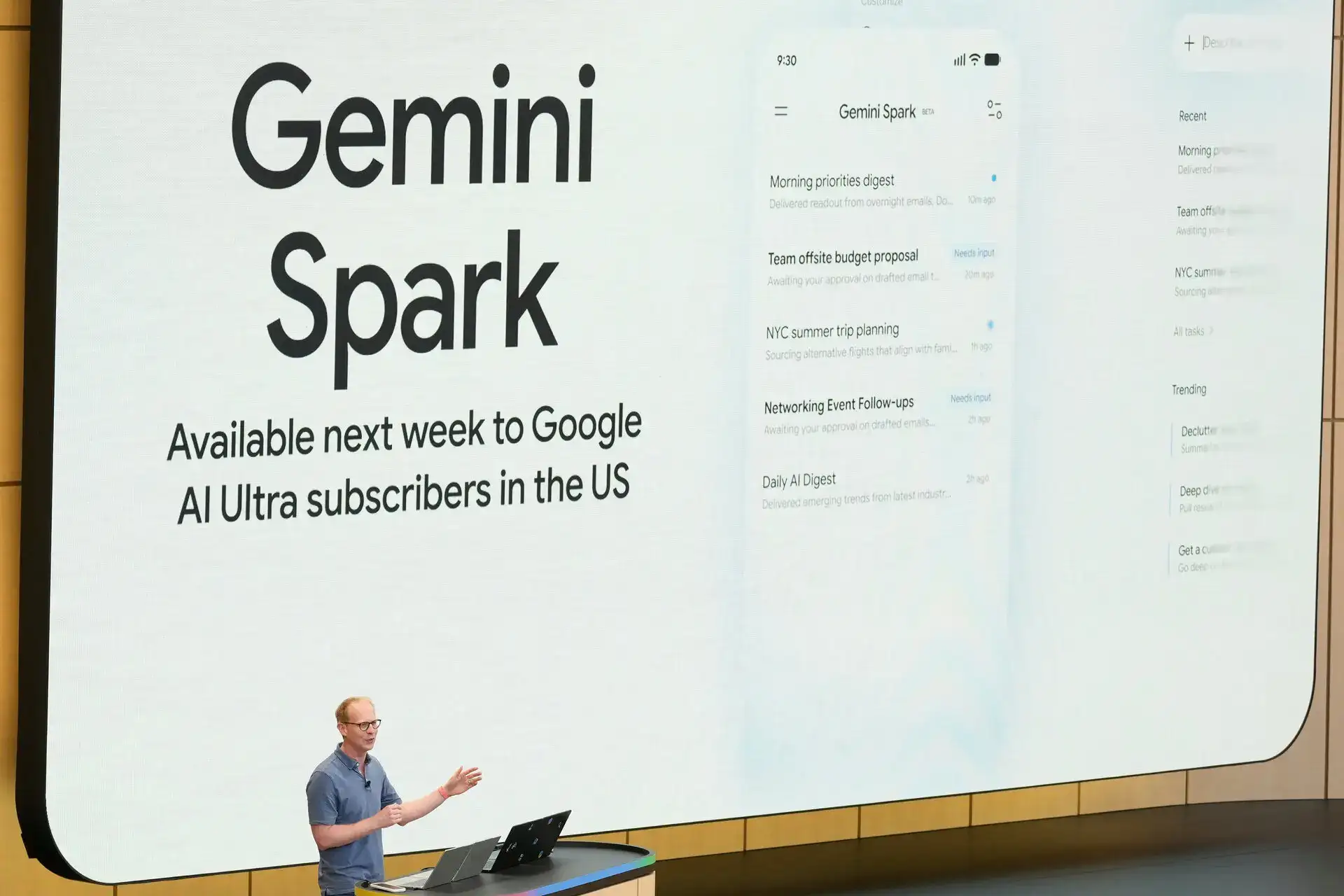
One of the most closely watched announcements from the event was Gemini Spark, Google’s new personal AI agent. The company described Spark as a general-purpose AI assistant capable of reasoning across connected applications while helping users manage digital tasks.
Google said the system is meant to “take action on your behalf while under your direction.”
Spark runs on Gemini 3.5 Flash and is designed to remain active continuously, helping users navigate their online lives with minimal input.
The feature is initially launching in beta form for trusted testers and Google AI Ultra subscribers in the United States starting next week.
As more users shift toward chatbot-based experiences instead of traditional web search, Google appears focused on turning Gemini into a deeper everyday assistant rather than just a search enhancement.
How does Gemini Omni edit videos?
Google also introduced Gemini Omni, a new AI model focused heavily on video generation and editing.
The company described Omni as a “world model” capable of simulating physical environments and predicting realistic actions based on user prompts.
Unlike earlier systems that mainly relied on text prompts, Gemini Omni can work using images, audio, video and text together.
ALSO READ: China wouldn't let Marco Rubio in, so he did something nobody in US politics has ever done
Google said users can upload a real video and simply ask Omni to change what happens inside it.
“Take a video you shot and just ask Omni to change what’s happening,” Google explained. “Edit the action, add in new characters or objects.”
The company said Omni better understands concepts like gravity, fluid dynamics and motion physics, allowing scenes to appear more realistic.
Google also claimed the tool can generate educational explainers and storytelling visuals using short prompts.
Initially, Omni Flash is rolling out to Google AI Plus, Pro and Ultra subscribers globally, while YouTube Shorts and YouTube Create users will begin receiving access this week.
Google said all AI-generated videos created with Omni will include its SynthID digital watermark system for identification purposes.
The company acknowledged ongoing concerns surrounding AI-generated content and said some advanced editing functions involving speech and audio are still being tested “responsibly.”
While Google made ambitious promises about realism and creativity, the company also faces skepticism from users who often criticize AI video tools for producing “uncanny valley” results.
Still, the latest announcements, Google is no longer treating AI as an experimental side project. With Gemini Spark, Gemini Omni and Gemini 3.5 Flash, the company is trying to reshape how people search, create, work and interact online every day.
FAQs
What is Gemini Spark?
Gemini Spark is Google’s new AI agent that can take actions across connected apps under user direction.
What does Gemini Omni do?
Gemini Omni can create and edit videos using text, audio, images and video inputs.