NEW ALBANY, Ind. — Fat snowflakes were landing softly in the parking lot of Bearno’s Pizza here on the night of Dec. 13, presaging a heavy accumulation that would blanket this southern Indiana town in a couple of hours. Inside, about 60 Indiana fans gathered around buckets of Miller Lite and large pies for a night unlike any other in these parts.
As usual, college basketball was on many of the restaurant’s TVs. But several others were tuned to the Heisman Trophy broadcast, which had begun its long preamble toward bestowing the award to the nation’s best college football player.
Those TVs showed Indiana quarterback Fernando Mendoza, looking a bit nerdy—his crimson tie was slightly askew, and his large hands hung awkwardly at his sides. He and coach Curt Cignetti were interviewed. The crowd cheered. Then the bathroom line backed up during the brief break in the action.
At 7:51 p.m., the Indiana-Kentucky men’s basketball game tipped off and the sound switched to that broadcast. In the history of both states, it is a high holy day when the Hoosiers and Wildcats face off on the hardwood. They first met 101 years ago, and the two blueblood programs, winners of a combined 13 NCAA championships, battled every winter from 1969 to 2012. When the games were played in the RCA Dome in Indianapolis in the 1980s and ’90s, crowds regularly surpassed 35,000 and occasionally were larger than 40,000.
This game marked the regular-season resumption of that dormant series, an overdue meeting that stirred souls on both sides of the nearby Ohio River. And yet, here, it was the second-biggest sporting event of the moment.
At 7:58 p.m., with Indiana holding an 8–3 lead, the audio in Bearno’s switched back to the Heisman telecast. Shortly after 8 p.m. Mendoza was announced as the first winner of the award in Indiana history. The place erupted.
“Heis-Mendoza! Heis-Mendoza!” The Indiana faithful chanted.
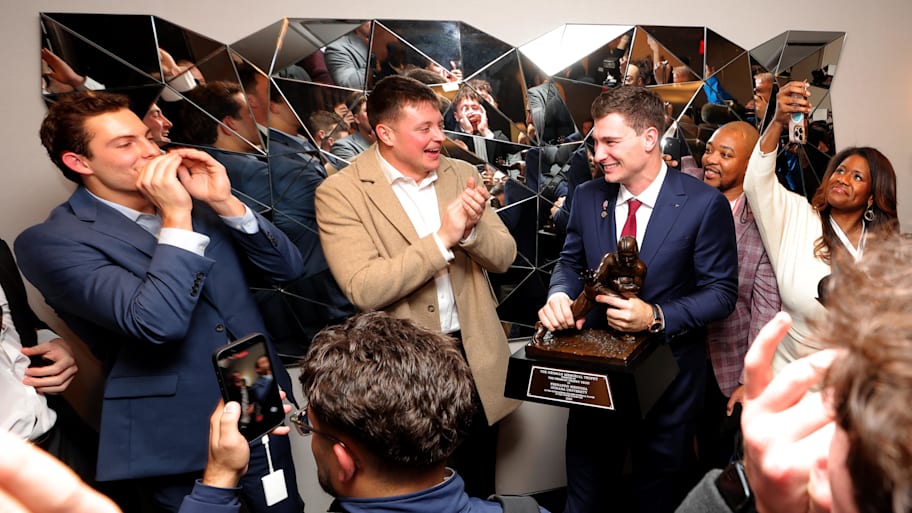
Then Bearno’s went silent as Mendoza gave a poised, passionate, gracious acceptance speech. An old man wiped tears from his eyes. Younger faces beamed. In the silent background on a few TVs, Indiana and Kentucky played the sport that has always defined them.
Nobody noticed.
“It’s something I never thought I would see in my lifetime,” says Greg McMinoway, an Indiana native and Gulf War veteran who lives in New Albany. “It feels like it’s surreal. I mean, seriously, it just feels like it’s a dream come true. I’m happy for every Indiana fan that’s always been through the crappiest. We were the worst Power 4 team of all time, and now we’re the No. 1 overall seed and our quarterback just won the Heisman.”
This was the moment when something impossible happened—a gridiron accomplishment completely overshadowed a circle-the-date basketball game. For the first time, Indiana can call itself a football school.
Rick Bozich went to school at Merrillville Junior High one day in 1967 proudly wearing a new button. His father, Alex, a boilermaker at Inland Steel in East Chicago, Ind.—not to be confused with a Purdue Boilermaker—had gone to the Indiana University Northwest campus bookstore in Gary and purchased it for his son:
“We’re Rose Bowl Bound.”
After decades of football futility, the Hoosiers had finished in a tie for first in the Big Ten with Minnesota and Purdue. They were awarded the Rose Bowl spot via league tiebreaker—the school that had gone the longest time without playing in the game got the bid, and the Hoosiers had never been in their history.
Indiana lost 14–3 to a USC powerhouse led by O.J. Simpson. As for the whereabouts of the button?
“I lost it,” Bozich says. “And after I lost it, I figured I don’t need it. It’s never going to happen again.”
Fifty-eight years later, it’s happening again.
Bozich went to Indiana, graduated in 1975 and had a decorated career as a sports writer before retiring in July. On more than one occasion, while watching the Hoosiers lose yet again from the Memorial Stadium press box, Bozich pantomimed the dribbling and shooting of a basketball—his way of saying that it’s time to turn the page to the sport that mattered most.
“I learned at an early age not to expect much [from the football program] and be happy for what you got,” Bozich says. “It was almost like they were always going through the motions. It’s like there was never any urgency to fix it. I mean, if Wisconsin’s good and Iowa’s good and Northwestern’s good, why is Indiana 2–9?”
The biggest reason is the five national championship banners that sway in the mysterious breezes of Assembly Hall.
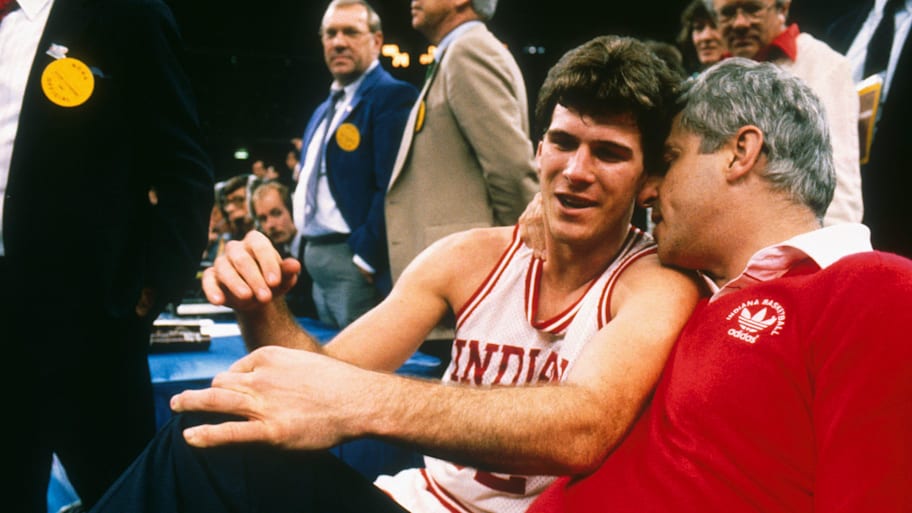
The state was an early and enthusiastic adopter of basketball, which served as a popular winter activity for Indiana boys in the early 1900s after farm crops had been harvested in the fall. Hoosier Hysteria, the fabled high school state tournament, became a very big deal very quickly. Butler Fieldhouse, which opened in 1928 with a seating capacity of 15,000, was the largest gym in the country for decades, and it became the epicenter of that tournament. Fans came from every corner of the state to fill those seats.
Around the same time, Purdue was emerging as a national basketball power with a hard-edged guard named John Wooden. Indiana was also rising under coach Everett Dean, then Branch McCracken led the Hoosiers to the second NCAA tournament championship, in 1940.
The athletic culture of the state coalesced around the roundball. The path to athletic glory for both schools was indoors, not outdoors. Football fever was primarily confined to the Catholic college up in South Bend. For decades, one of the most common fan types in the state was those who rooted for Notre Dame in football and Indiana in basketball.
The football-as-an-afterthought dynamic became even more pronounced at Indiana after the arrival of Bob Knight in 1971. Three national titles and a cult of personality ensued. The more he won, the bigger his presence became—and the less football seemed to matter.
“A lot of it was because of Knight,” Bozich says. “I think people were just so enraptured with basketball and Knight and the power of Knight’s personality that they didn’t really care about football. It was sort of tolerated.”
Ironically, it took a former Knight student manager to make the move that changed football at Indiana.
Scott Dolson was an Indiana graduate who went to work in the athletic department not long after receiving his diploma. He saw every kind of football coach come and go: solid Bill Mallory had several good seasons but ran out of gas in the mid-1990s; Cam Cameron was a former Indiana quarterback with NFL experience who didn’t translate; Gerry DiNardo had three very bad seasons; Terry Hoeppner had the program headed in the right direction before being felled by cancer; Bill Lynch and Kevin Wilson were just more of the same, winning less than 40% of their games.
By the time Dolson was promoted to athletic director in 2020, Tom Allen was midway through his tenure and showing promise with back-to-back winning records in 2019 and ’20. But three straight losing seasons ensued, and Dolson bit the bullet on a sizable buyout to make a change. At that point, with an FBS-record 715 all-time defeats, there was nothing left to lose.
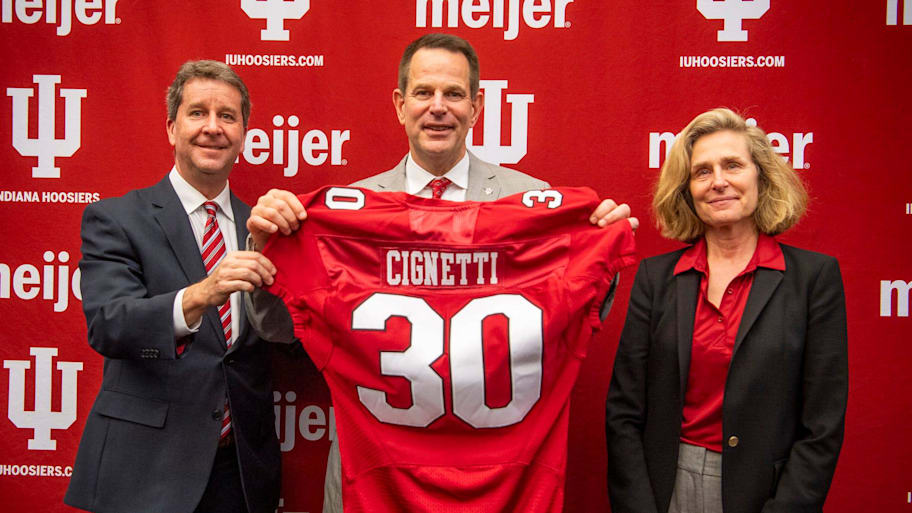
Predecessor Fred Glass had begun bringing Indiana’s facilities up to par in the Big Ten. Dolson knew he needed to nail the coaching hire, and had done a deep study on what kind of coaches succeeded at basketball-first schools like Duke, North Carolina, Kentucky and Kansas. His checklist of attributes:
- Head coaching experience and a winning record.
- Consistency and continuity in staffing.
- An offensive-minded coach, preferably with experience developing quarterbacks.
- Recruiting coordinator experience.
The Venn diagram matching those needs with Curt Cignetti’s résumé at James Madison and elsewhere was almost a complete overlay. He was the guy.
“Cig checked every box,” Dolson says. “He was everything we wanted. We wanted someone who really had a plan, not a one-hit wonder. And so from the minute I first talked to him on the phone, it was like he had our blueprint that we put together.”
What came next was the barrage of bluster that first made people pay attention to him. Cignetti declared that he was going to take Indiana to the Big Ten title game in a year. He took the microphone in Assembly Hall at a basketball game to declare that “Purdue sucks. But so do Michigan and Ohio State.” He dropped his most famous line: “I win. Google me.”
Eyes rolled at the loudmouth nobody talking up a dead-end program.
“I laughed,” Bozich says. “Does he really know where he’s at? Aren’t you supposed to underpromise and overdeliver? Some of my friends were like, ‘This guy’s an idiot.’”
But Cignetti did get the fans’ attention, which quickly turned into admiration after a 4–0 start in 2024. Still, admiration hadn’t quite translated to action. Indiana fans, especially the students, were infamous for partying like rock stars at the pregame tailgates but either never entering the stadium or leaving at halftime. These were the same students who would line up for hours to get into Assembly Hall for big basketball games.
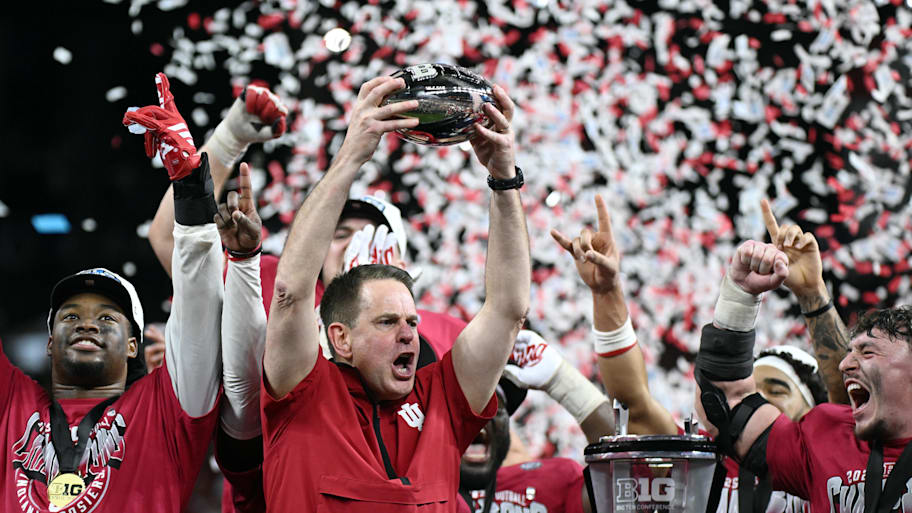
Prior to Indiana’s 2024 Big Ten home opener against Maryland, Cignetti sent an email to the students requesting that they not only attend the game, but stay for the entirety.
“We need you there for the opening kick,” he wrote. “We need you there in the stands being loud in the first quarter. And the second quarter. And in the third. And, most importantly, in the fourth.
“When the clock hits zero and we’re 5–0, I want you there to be able to celebrate a historic win with us.
“The tailgates can wait. The parties can wait. If you need to study, that can wait, too.”
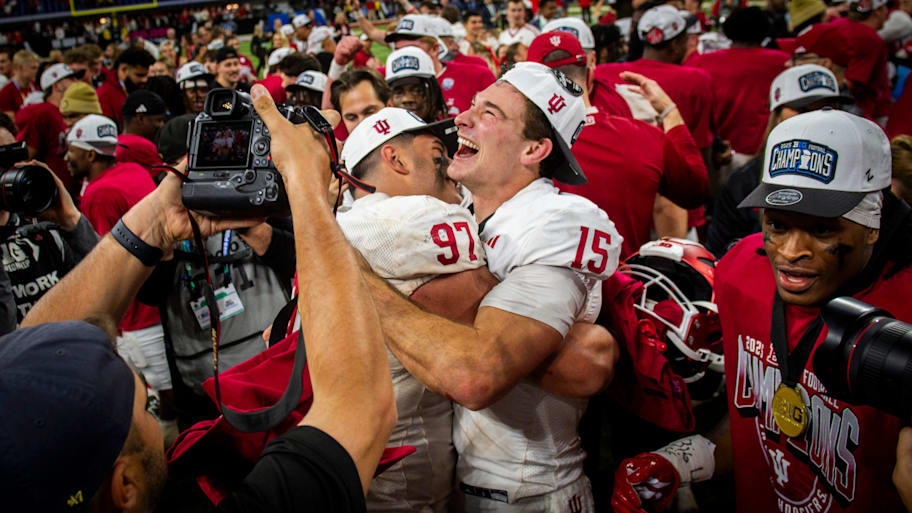
Indiana beat the Terrapins 42–28, and a bond with the student body was forged.
“The students all showed up and it was raining,” says Don Fischer, Indiana’s radio play-by-play man since 1973. “And they all stayed. From that point forward, it’s just been banzai bananas. Football in Indiana has never been like this and I hope it doesn’t end anytime soon.”
One of the truest measures of the changing priorities came last spring, when Indiana did its annual meet-and-greet speaking engagement with fans at Huber’s in Starlight, Ind. The event is timeless in many aspects, with hundreds of fans turning out at a sprawling rural farm to hear from the program’s most prominent coaches. The order of the speakers has never varied—the men’s basketball coach always is the headliner and always goes last.
This year, even with a new basketball coach in Darian DeVries, the headliner was the football coach.
“Cignetti closed the deal and stayed around,” Bozich says. “People wanted to take pictures of him.”
The program’s ascension, dizzying last year, has only accelerated this year. It has upset the natural order of things at Indiana to the point that, if constructing a Mount Rushmore of Hoosier athletes, a celebrated men’s basketball figure has got to go to make room for Mendoza. He steps in alongside nine-time Olympic gold medalist swimmer Mark Spitz and probably two of the following three all-time basketball greats: Isiah Thomas, Steve Alford and someone from the undefeated 1975–76 team, probably Scott May.
“These guys will be sainted there forever,” Bozich says. “If they end up winning it, it’s the most improbable story in the history of college football. And nothing else is close.”
More College Football from Sports Illustrated
Listen to SI’s college sports podcast, Others Receiving Votes, below or on Apple and Spotify. Watch the show on SI’s YouTube channel.
- Oregon vs. Texas Tech: Three Bold Predictions for College Football Playoff Clash
- Former USC Football Players Sound Off After Trojans' Stunning Alamo Bowl Loss to TCU
- Ohio State vs. Miami: Three Bold Predictions for New Year’s Eve’s CFP Cotton Bowl Bout
- Nick Saban Calls Out Lack of ‘Proper Respect’ for Indiana Ahead of CFP Clash vs. Alabama
This article was originally published on www.si.com as Indiana’s Improbable Rise As a Football School After a Century in Basketball’s Shadow.