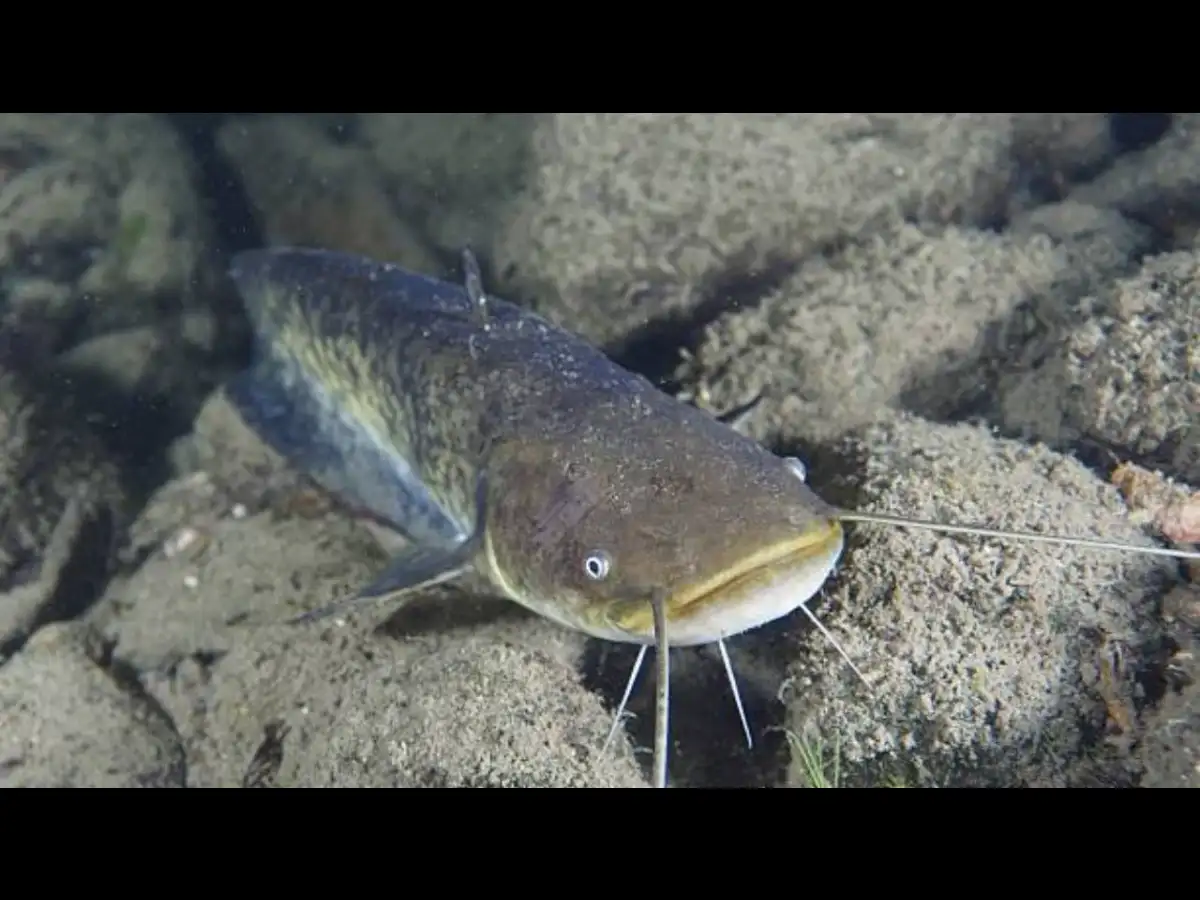
For years, strange black growths on brown bullhead catfish in Lake Memphremagog puzzled anglers and biologists. The lake, which stretches roughly 30 miles across Vermont and Quebec, is known for its trout, salmon and other fish. But its brown bullheads have developed something far more unusual.
The dark lesions, found on the fish’s fins, gills, lips and even eyes, were identified as melanomas. Now, genetic evidence suggests the cancer may be spreading from one catfish to another, potentially making it the first transmissible cancer documented in a fish species.
“It looks like black tar on the skin—not very pretty,” Peter Emerson, a fisheries biologist with the Vermont Fish & Wildlife Department, tells NPR’s Ari Daniel.
This report is based on a study published in the journal Nature- Curd, E.E., Hart, S.F.M., Lubkowitz, J. et al. Brown bullhead catfish melanoma represents a novel transmissible cancer. Nature (2026).
How did the strange tumors begin?
The problem was first noticed more than a decade ago, when anglers and biologists began seeing the unusual black growths on brown bullhead catfish in the lake. Melanomas are cancers involving the uncontrolled growth of melanocytes, the cells responsible for producing the pigment melanin, as per a report by Smithsonian Magazine.
Such cancers are exceedingly unusual in catfish. Yet today, roughly one-third of the lake’s bullheads carry the lesions. A study published July 22 in Nature by Emerson and colleagues offers a striking explanation. The researchers found that the tumor cells were genetically almost identical to one another, while being genetically different from the individual fish carrying them.
That finding is important because cancer normally develops from mutations within an animal’s own cells. A tumor is generally made up of descendants of the host’s cells and therefore shares much of the host’s genetic identity.
The catfish tumors appeared to tell a very different story.
Julie Dragon, a geneticist at the University of Vermont and co-author of the study, initially suspected that something had gone wrong with the analysis.
“I said, ‘We made a mistake. This can’t be right,’” Dragon tells the New York Times’ Carl Zimmer.
The researchers repeated the analysis from the beginning and reached the same conclusion. Their results suggested that the tumors descended from an ancestral cancer cell that first developed in a single catfish. That original fish has long since died, but its cancer cells may have continued moving through the population.
Could the cancer really be spreading between fish?
The researchers believe the cancer may spread during spawning season, when adult catfish gather closely together in shallow water. Dragon explains the possible route of transmission to NPR: “They aggregate into these big clusters, flop around on top of each other, and they have these spines behind their pectoral fins that are pretty sharp. And we think that they actually accidentally scratch each other, and that is one potential avenue for the cancer cells to invade a new host," Dragon tells NPR.
The idea of a contagious cancer is extraordinarily rare. Previously documented examples include the facial cancer affecting Tasmanian devils, a transmissible venereal cancer in dogs and transmissible leukemia affecting several marine shellfish species, including clams, cockles and mussels.
The suspected catfish cancer would be especially unusual because it appears to be spreading through freshwater. Michael Metzger, a contagious cancer expert at the Northwest Research Institute who was not involved in the research, tells the New York Times that cells typically need salty fluids to survive.
“It makes us rethink how these things work,” he says.
Is everyone convinced it is contagious?
Not completely. Vicki Blazer, a fish pathologist formerly with the U.S. Geological Survey who was involved in the research before leaving the team, disagrees with the study’s conclusion.
Blazer points to tissue samples taken before the fish developed full tumors. Those samples showed cellular stress and inflammation associated with pollutants such as arsenic, which was found at unusually high concentrations in the fish.
She believes environmental toxins could be the primary cause, although pollution could also weaken the fish’s immune systems and make them more vulnerable to a contagious cancer.
“I am not on board yet with the transmissible tumor,” she says. “That’s why I took my name off the paper.”
Other experts are more confident in the genetic evidence.
Elizabeth Murchison, a contagious cancer expert at the University of Cambridge who was not involved in the research, tells Science that the results leave “no question” that a transmissible cancer is responsible.
“It is a clone, a single clone that’s spreading through the population,” she says.
The mystery surrounding Lake Memphremagog’s black-tumored catfish therefore remains focused on one extraordinary possibility that a cancer that began in a single fish has survived and spread through an entire population.
For now, the genetic findings point toward a rare contagious cancer, while questions about environmental pollutants remain part of the debate.
Strange black tumors have affected roughly one-third of brown bullhead catfish in Lake Memphremagog, Vermont and Quebec. Genetic testing suggests the melanomas may have originated from one ancestral cancer cell and spread between fish. Researchers believe spawning-season contact could transmit the cancer, though some scientists remain skeptical.
FAQs
Is the catfish cancer contagious?Researchers believe it may spread between fish.
How might it spread?
Scientists suspect scratches during spawning could transfer cancer cells.