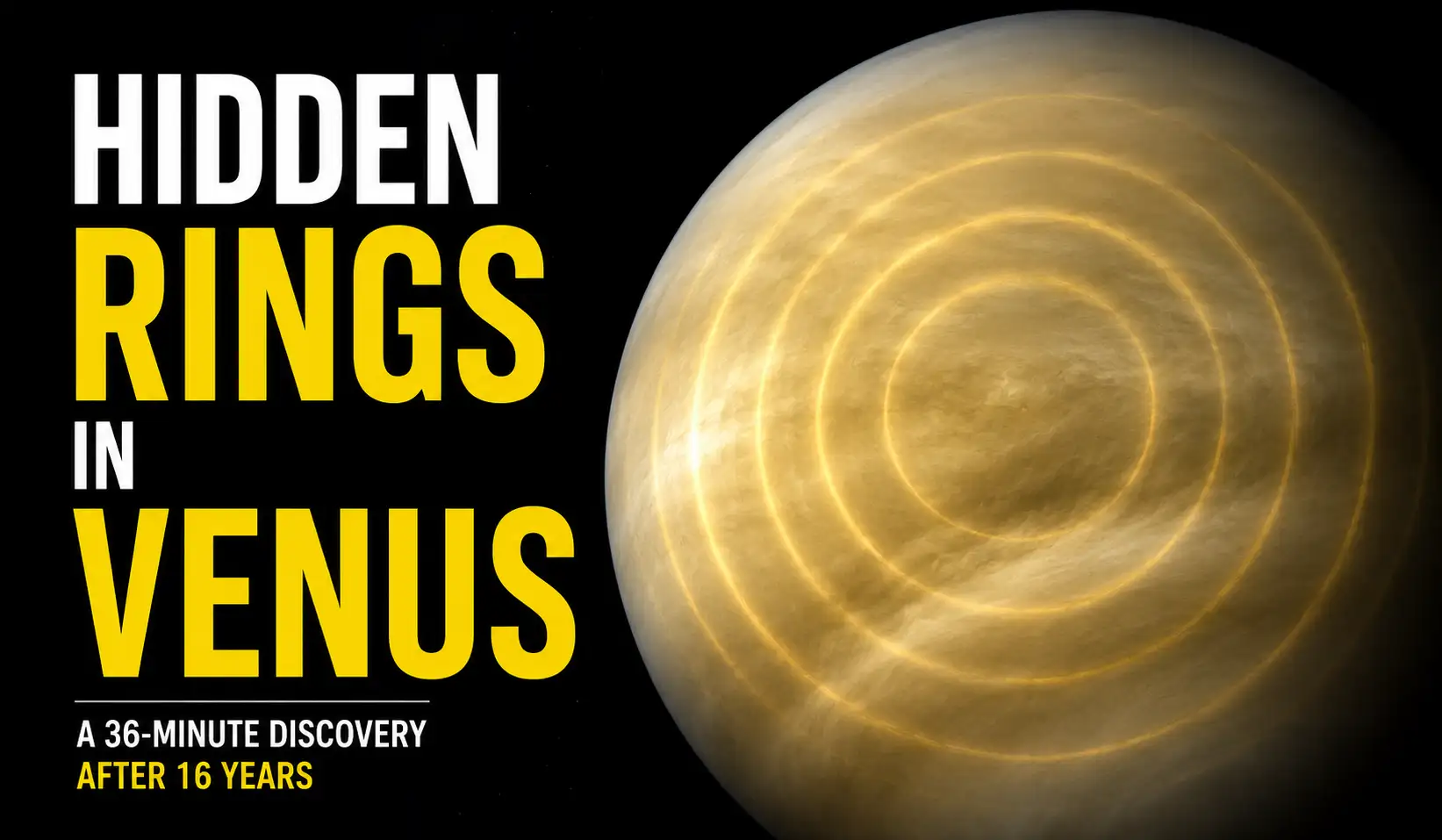
In 2026, Dutch researchers analyzing archived 2010 observations from the William Herschel Telescope in the Canary Islands discovered planetwide rings on Venus. Polarized light simulations showed 5% to 10% gas density variations from atmospheric gravity waves during a brief 36-minute observation window, marking a candidate discovery.
How a routine 36-minute Venus observation led to an unexpected discovery
Some of astronomy's biggest discoveries happen by accident. That appears to be the case with a short 36-minute observation of Venus taken in 2010 at the William Herschel Telescope on La Palma in Spain's Canary Islands. At the time, scientists were simply waiting for sunset before beginning another observing program focused on distant stars and dust disks around young stellar systems.
The Venus images were never expected to become important. They were archived and largely forgotten.
More than a decade later, researchers from the Netherlands revisited those files and found something no one had noticed before—faint planet-wide rings spread across Venus' upper atmosphere.
Their findings have now been published in The Planetary Science Journal (2026).
Why the mysterious rings stayed invisible for 16 years
The rings could not be seen in ordinary telescope photographs.
Instead, the research team analyzed observations taken with ExPo (Extreme Polarimeter) , an instrument designed to measure polarized light —light whose waves vibrate in a particular direction after interacting with particles in an atmosphere.
Scientists compared standard images with polarized images collected through several visible-light filters.
Out of the archived observations, three images revealed a series of faint concentric rings surrounding the planet. The pattern disappeared completely in normal photographs but became visible once the polarized light signal was isolated.
That explains why the unusual feature remained hidden inside the archive for so many years.
Computer models linked the Venus rings to giant atmospheric waves
Finding the rings was only the beginning.
To understand what produced them, researchers created computer simulations that modeled how sunlight travels through the gases above Venus' thick cloud layer.
The simulations showed that relatively small gas-density variations of about 5% to 10% could reproduce the same ring patterns seen in the observations.
The study also demonstrated why previous observations had missed the phenomenon.
According to the researchers, these density changes would not appear in ordinary total-light observations , making polarized imaging essential for detecting them.
Could the hidden rings be enormous gravity waves?
Based on the simulations, scientists believe the rings are probably linked to planet-wide atmospheric gravity waves .
Despite the name, gravity waves are not the same as gravitational waves detected by observatories such as LIGO.
Atmospheric gravity waves form when gravity restores displaced layers of gas, creating ripple-like patterns similar to waves spreading across the surface of a pond after a stone is dropped into it.
On Venus, these waves may travel through the upper atmosphere and produce subtle density variations large enough to create the observed concentric rings.
If confirmed, they would represent one of the largest atmospheric wave patterns ever detected on the planet.
Scientists remain cautious despite the remarkable discovery
The researchers stress that the rings themselves were directly observed, but the explanation behind them is still an interpretation based on computer modeling.
For that reason, the study describes the finding as a candidate detection , not definitive proof of a previously unknown atmospheric phenomenon.
Adding to the challenge, the ExPo instrument has since been dismantled , meaning no identical observations can currently be repeated using the same system.
For now, the archived 2010 dataset remains unique.
Future Venus missions and advanced polarimetric instruments may eventually determine whether these mysterious rings are a permanent feature of the planet's atmosphere or an exceptionally rare event captured during an otherwise ordinary 36-minute telescope session .
FAQs:
1. What is polarized light, and why were the rings invisible in standard telescope images?
Standard sunlight vibrates in all directions, creating a bright glare that masks subtle cloud features in normal photos. Polarized light , however, vibrates along a single plane. When sunlight scatters off gas particles in Venus's upper atmosphere, its polarization shifts depending on the local air density. Isolating polarized light strips away the overwhelming surface glare, exposing faint contrast patterns—like these concentric rings—that normal imaging completely misses.
2. Are atmospheric "gravity waves" the same as deep-space "gravitational waves"?
No, they are completely different phenomena:
- Gravitational waves are ripples in the fabric of space-time caused by massive cosmic events, such as colliding black holes.
- Atmospheric gravity waves are physical fluid waves in a planet's air. They form when buoyancy pushes a pocket of air upward, and gravity pulls it back down—creating ripple-like density variations similar to waves on the surface of water.
3. What is an H alpha filter, and why was it key to detecting these waves?
An H-alpha filter is a specialized optical tool that isolates a very specific wavelength of red light at 656 nanometers. In planetary astronomy, this narrow band cuts through heavy upper-atmosphere haze better than broad visible light. Capturing polarized light at this exact wavelength allowed the ExPo instrument to pick up the tiny 5% to 10% gas density shifts driving the wave patterns.
4. Why do researchers call this a "candidate detection" instead of a confirmed discovery?
In observational astronomy, a finding isn't considered fully confirmed until independent observations verify it. Because the ExPo instrument was dismantled years ago and no other active telescope is currently capturing Venus in high-sensitivity polarized light, scientists cannot re-observe the planet to double-check the data. Until a new instrument replicates the result, it remains a strong candidate rather than a proven fact.