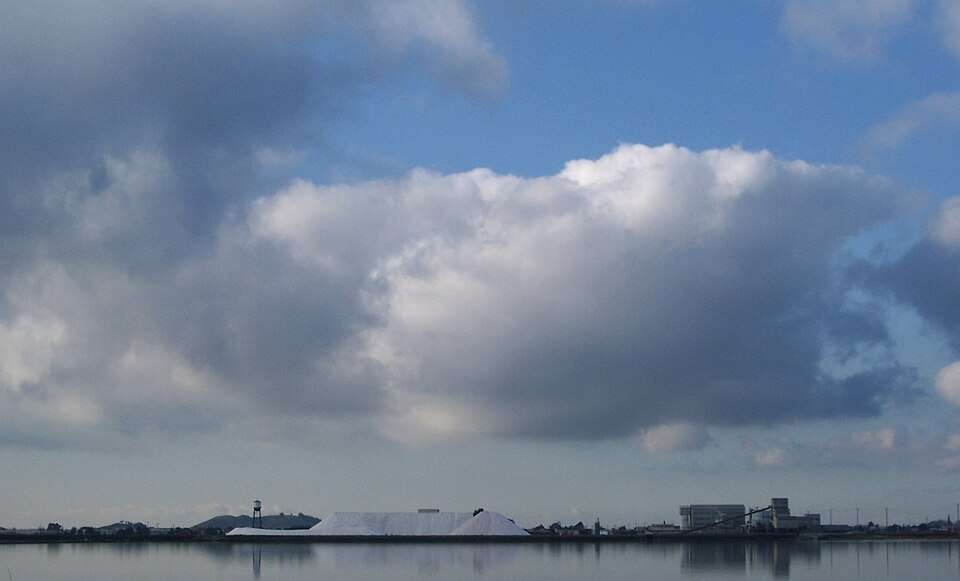
For more than a century, the southern edge of San Francisco Bay was reshaped by an industry that depended on keeping seawater out. Large stretches of tidal wetland were enclosed behind levees and converted into evaporation ponds, creating the distinctive geometric landscape of salt ponds visible across the South Bay.
Get breaking news anytime, anywhere. Download the TOI app now!
According to the South Bay Salt Pond Restoration Project , state and federal agencies and private foundations acquired about 15,100 acres of former commercial salt ponds from Cargill in 2003 for restoration. More than two decades later, restoration partners breached the levees around the 435-acre Mountain View Pond A2W, allowing San Francisco Bay tides to flow into the former salt pond. The project also includes a 1.2-mile public-access trail, five bird-nesting islands and a half-mile habitat slope.
The current project is part of the South Bay Salt Pond Restoration Project, which aims to restore a large former industrial site to tidal wetlands and other habitats. According to project partners, more than 3,700 acres have been made available for Bay tidal flows more than a quarter of the total restoration area.
From tidal wetlands to a landscape of salt ponds
The history of the South Bay helps explain why restoring these areas is such a large undertaking. San Francisco Bay once contained extensive tidal marshes, mudflats and shallow wetlands. Beginning in the 19th century, many of these areas were diked, drained, filled or converted into salt evaporation ponds. The ponds were deliberately engineered landscapes, with levees controlling water movement and evaporation concentrating salts for harvesting.
The 2003 acquisition changed the long-term purpose of a substantial portion of the landscape. South Bay Salt Pond Restoration Project also notes that state and federal agencies and private foundations acquired 15,100 acres of commercial salt ponds from Cargill for $100 million that year. The project was established to restore and enhance a mix of wetland habitats while providing wildlife-oriented public access and recreation and maintaining flood protection in the South Bay. This distinction matters because the project is not trying to return the land to its exact pre-saltworks condition. Former ponds may be converted to tidal marshes, but other parts may stay as they are or be made into open water habitat.
What happens when the tides return
Levee breaching is perhaps the most obvious element of the process; however, it is not sufficient to transform a salt pond into a fully developed marsh right away. Once the levees are breached, tides start bringing in water, sediment and organisms into the former pond. Sediment can accumulate, channels can form, and wetland plants can begin to establish themselves. In cases when the former salt ponds have subsided below the necessary levels for the growth of marsh plants, the process tends to be rather slow. For this reason, the restoration project combines natural and engineering elements.
According to Ecological Engineering , research on breached salt ponds in the northern San Francisco Bay found that restored sites could accumulate sediment and begin developing vegetation, but the trajectory depended on the starting elevation and sediment conditions. The study followed three large breached ponds and examined how sedimentation and colonisation by Pacific cordgrass changed after tidal reconnection. That evidence helps explain why the Mountain View project is designed for gradual transformation rather than an immediate conversion. The 435-acre Pond A2W has now been reconnected to the Bay, but the wetland that eventually develops there will emerge through continuing tidal and sediment processes.
A restoration project that is also about people
The return of tides is only one part of the latest Mountain View work. The project also created a public trail, benches, interpretation features and wildlife-viewing opportunities. A sloped habitat transition zone was designed to connect the marsh with higher ground, while the project incorporated features intended to help wildlife move away from high tides. That mix reflects how wetland restoration around San Francisco Bay now serves both ecological and public uses. Restored marshes can provide habitat, but they are also part of a wider effort to improve the resilience of communities located beside a densely developed shoreline.
According to Marine Geology , sediment availability is an important consideration in the South Bay because some former salt ponds have subsided substantially and may require large amounts of sediment to reach elevations suitable for tidal marsh development. The study found that sediment movement through the southern reach of the Bay is strongly influenced by exchanges around Dumbarton Narrows, highlighting why restoration depends partly on the physical processes of the wider estuary.
It also shows the limits of what restoration can accomplish on its own. Wetlands can provide valuable habitat and contribute to shoreline resilience, but their ability to keep pace with future sea-level rise depends on factors including sediment supply, elevation, tidal processes and the rate at which the Bay changes. For now, the breaching of Mountain View Pond A2W marks another step in a long-term restoration effort. An industrial salt-production landscape is being reshaped by the same tidal waters that were kept behind its levees for generations.
A mature tidal marsh takes time to develop, and scientists will continue to watch how sediment, vegetation, wildlife and water levels respond. Each breached levee lets another part of the former salt-pond landscape return to the tides of San Francisco Bay.