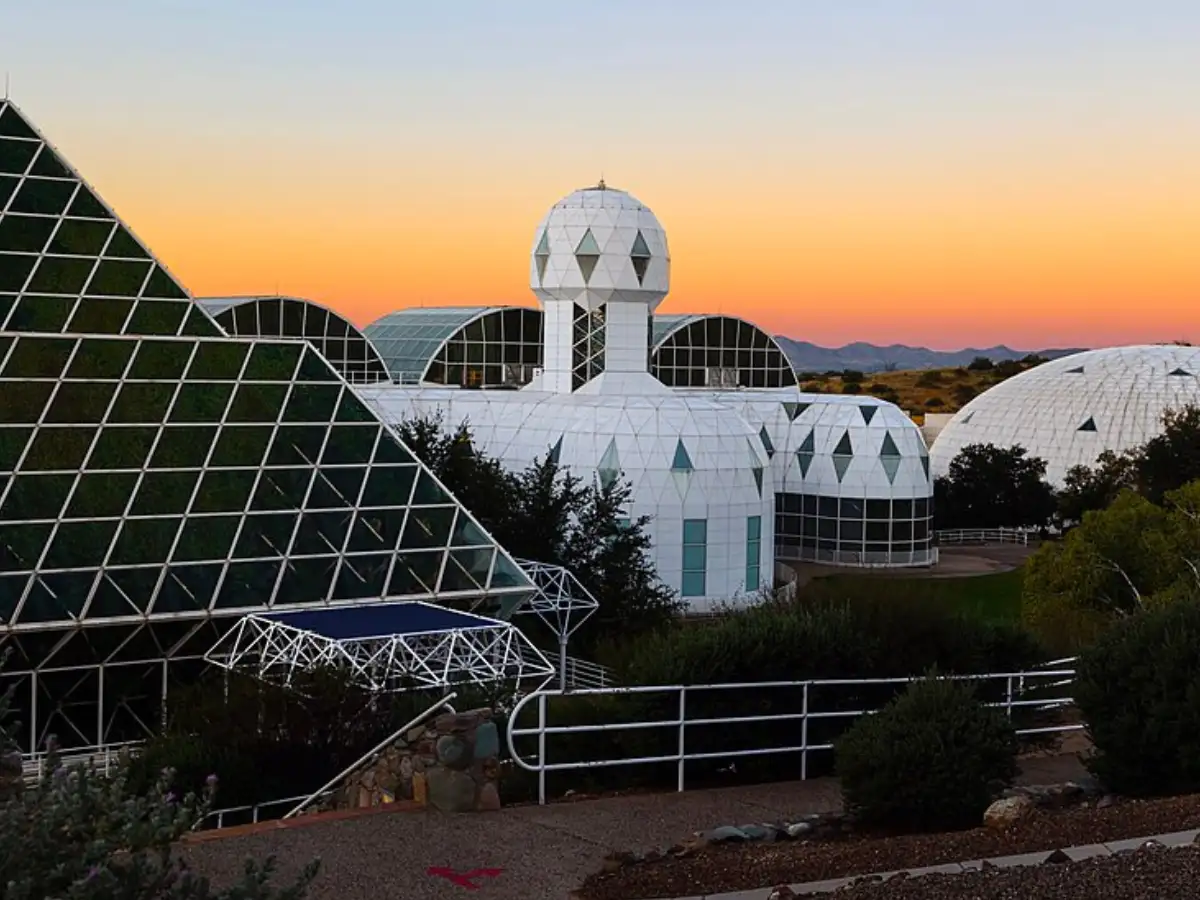
Eight people walked into a huge glass-and-steel building in Oracle, Arizona, on September 26, 1991, and locked the door behind them. They were not coming out for the next two years.
The facility was a 3.14-acre (1.27-hectare) airtight structure built to be a self-contained world, with a rainforest, an ocean with a coral reef, mangrove wetlands, a savannah grassland, a fog desert, farmland, and human living quarters. It's the largest closed ecological system ever created. The eight-man crew was to live off the system's production, breathing its air, drinking its recycled water, and growing their own food: a test run, in effect, for long-term human life in space.
According to a 2008 paper, ‘Tightly closed ecological systems reveal atmospheric subtleties – experience from Biosphere 2’ by engineer William F. Dempster, published in Advances in Space Research, the greatest engineering achievement of Biosphere 2 was not its artificial rainforest or tiny ocean, but how well it contained air. The facility had a volume of 200,000 cubic meters and a leak rate of less than 10 percent per year, making it one of the most airtight non-pressurized enclosed structures ever built. That tightness, it seems, changed what science could detect.
The oxygen that started disappearing
A few months into the mission, something strange started to happen. Oxygen levels within the dome began to fall, slowly, steadily, silently.
Oxygen started at the normal ambient level of 20.9 percent and fell to around 14.4 percent some 475 days later, in mid-January 1993, according to the Dempster 2008 study. The average rate of decline was about 140 parts per million per day for the first 16 months of closure.