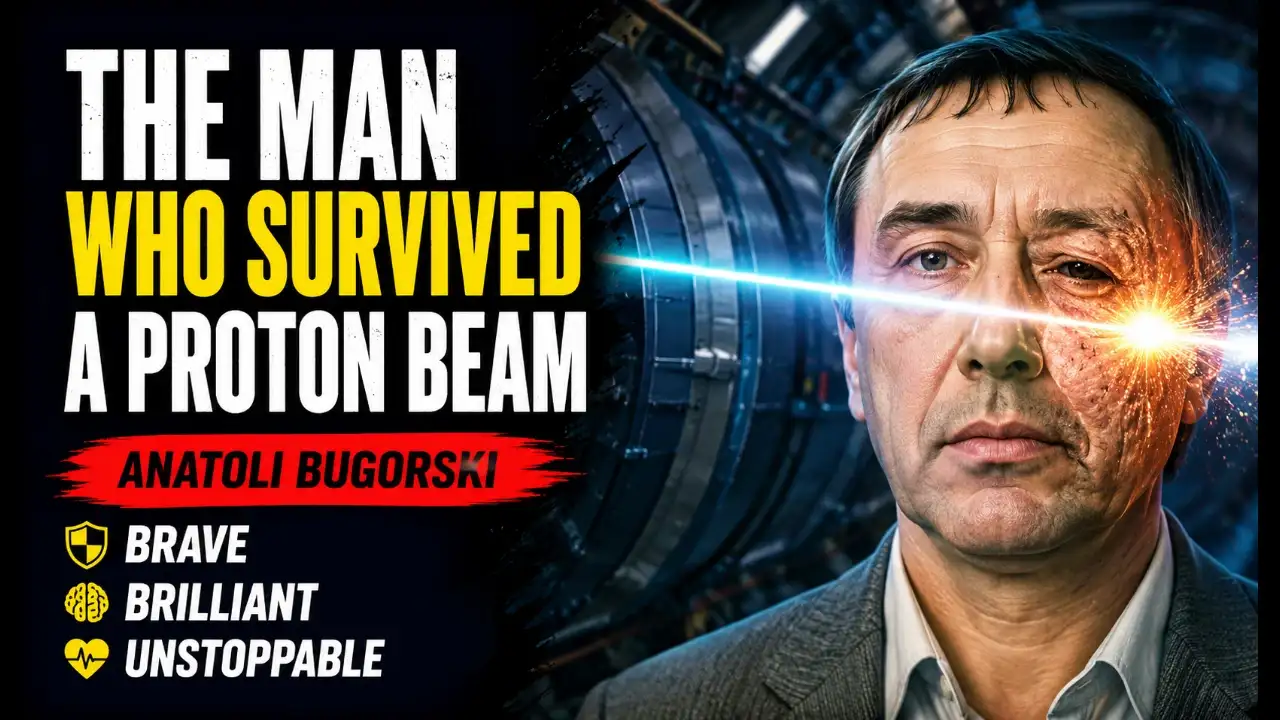
A proton beam powerful enough to pass through a human head sounds like the kind of thing that should end in seconds. For Soviet physicist Anatoli Bugorski, it became one of the strangest survival stories in the history of particle physics. On July 13, 1978, while working at the Institute for High Energy Physics in Protvino, he accidentally placed his head in the path of the U-70 accelerator's proton beam. The beam went through his head, yet Bugorski lived and eventually returned to scientific work.
The story is often told as if Bugorski simply stuck his head into an accelerator out of curiosity. That is not what happened. He was inspecting malfunctioning equipment, and the safety system failed while the accelerator was operating. The U-70 was no ordinary machine, either. CERN records that the accelerator reached a world-record proton energy of 76 GeV in 1967, making it one of the most powerful machines of its time.
The 1978 Accident That Sent a Proton Beam Through His Brain
Bugorski was working with the U-70 synchrotron at the Institute for High Energy Physics in Protvino, a major Soviet research center near Moscow. He was checking equipment when his head moved into the path of the proton beam. According to accounts of the accident, several safety mechanisms had failed, allowing the beam to remain active when he was in a dangerous position.
The proton beam was traveling at a speed extremely close to the speed of light. Bugorski later reported seeing an intense flash when the beam passed through him, although he did not feel immediate pain. The beam entered through the back of his head, traveled through parts of his brain and passed through the left side of his face. It was a remarkably concentrated exposure rather than radiation spread evenly across his entire body.
What makes the story even stranger is what Bugorski did immediately afterward. He understood that he had been hit by the accelerator beam, but the lack of immediate pain made the event feel different from what someone might expect after such a serious injury. Later accounts describe the beam's path through his head as involving the back of the skull, parts of the brain and the left middle ear before exiting near his nose.
The injury soon became impossible to ignore. The left side of his face swelled severely, and the tissue along the beam's path was badly damaged. Doctors treated him in Moscow and watched closely because they expected the radiation injury could prove fatal. Instead, Bugorski survived the acute phase and began a recovery that would surprise the people treating him.
What Happens When a High-Energy Proton Beam Hits the Human Body?
This is where the story needs more care than the usual internet headline gives it. Popular accounts often repeat very large radiation-dose estimates for Bugorski, sometimes converting them into comparisons with a "lethal dose." The exact dose, however, is difficult to establish with the certainty those comparisons suggest, so it is better not to treat every number repeated online as a precise medical measurement.
The more important point is that the exposure was highly localized. A narrow proton beam deposited enormous energy along a particular path through his head instead of exposing his entire body uniformly. That distinction matters enormously when discussing radiation injuries, because the biological consequences depend on which tissues receive the energy and how widely the exposure is distributed.
Bugorski was still seriously injured. His survival should not be confused with evidence that a particle beam is somehow harmless to people. His case was extraordinarily unusual, and the damage was permanent. What scientists and physicians could learn from it was how a very concentrated radiation injury can differ from a whole-body radiation exposure.
Bugorski eventually lost hearing in his left ear and developed tinnitus. Nerve damage also left the left side of his face paralyzed. He experienced seizures after the accident as well, although accounts indicate that his intellectual abilities were largely preserved. The Institute of Physics' educational resource IOP Spark describes the lasting effects as including facial radiation scarring, hearing loss, facial paralysis and occasional seizures.
That is an important part of the story because the accident did not leave Bugorski completely untouched. He was not a man who walked away from an enormous radiation exposure without consequences. He lived with neurological and sensory problems for years afterward, even as he managed to continue his scientific career.
He went back to Physics
Perhaps the most remarkable part came later. Bugorski completed his PhD after the accident and continued working as a particle physicist. His experience did not end his career, and he remained connected with the same research environment where the accident had occurred. IOP Spark notes that he continued working at the facility after completing his doctorate.
That detail gives the story a very different ending from the one suggested by its shocking opening. Bugorski was not simply a radiation victim who happened to survive. He remained a scientist and continued contributing to particle-physics work. Accounts also describe him eventually serving as an experiment coordinator for the U-70 accelerator.
The U-70 was a serious machine
To understand why the accident was so dangerous, it helps to understand what the U-70 actually was. The accelerator was commissioned in 1967, and CERN's historical account says it reached 76 GeV proton energy that same year, setting a world record at the time. The machine became a major part of high-energy physics research at Protvino and remains associated with the institute's long history.
Modern readers may hear "particle accelerator" and immediately think of the Large Hadron Collider at CERN. The machines are different in scale and design, but the basic idea is familiar: charged particles are accelerated to enormous energies and directed into controlled experimental systems. The danger comes from the beam and the energy it carries, which is why accelerator facilities use shielding, controlled areas and safety systems to keep people away from active beam paths.
This was not a case of a human body becoming a shield
One common misunderstanding about Bugorski's story is that the proton beam somehow exploded inside his head or left a giant tunnel like a science-fiction laser. That is not a useful way to picture what happened. A high-energy proton beam interacts with matter through particle interactions that can deposit energy and produce secondary radiation and damage along its path.
The injury was severe, but it was also concentrated. That helps explain the strange combination of outcomes in Bugorski's case: significant damage to particular tissues, permanent hearing and facial problems, and yet no complete loss of brain function. His survival cannot be separated from the unusual geometry of the exposure.
Bugorski's accident is fascinating because it sits at the intersection of physics and medicine. Particle physicists normally study what happens when energetic particles collide with carefully prepared targets. In Bugorski's case, the target was accidentally a human head, giving doctors and scientists an extraordinarily rare real-world example of what an intense proton beam can do to living tissue.
It also shows why radiation stories can become misleading when they are reduced to one dramatic number. Saying that someone received "hundreds of times the lethal dose" without explaining whether that means a localized or whole-body exposure leaves out the most important part of the science. Bugorski survived because the circumstances were unusual, not because such radiation exposure is normally survivable.
More than four decades later, Anatoli Bugorski remains one of the most extraordinary figures connected with particle-accelerator accidents. A malfunctioning piece of equipment placed him directly in the path of a 76-GeV proton beam, leaving him with permanent injuries but not taking his life. He then did something almost as surprising as surviving: he finished his doctorate and went back to physics.