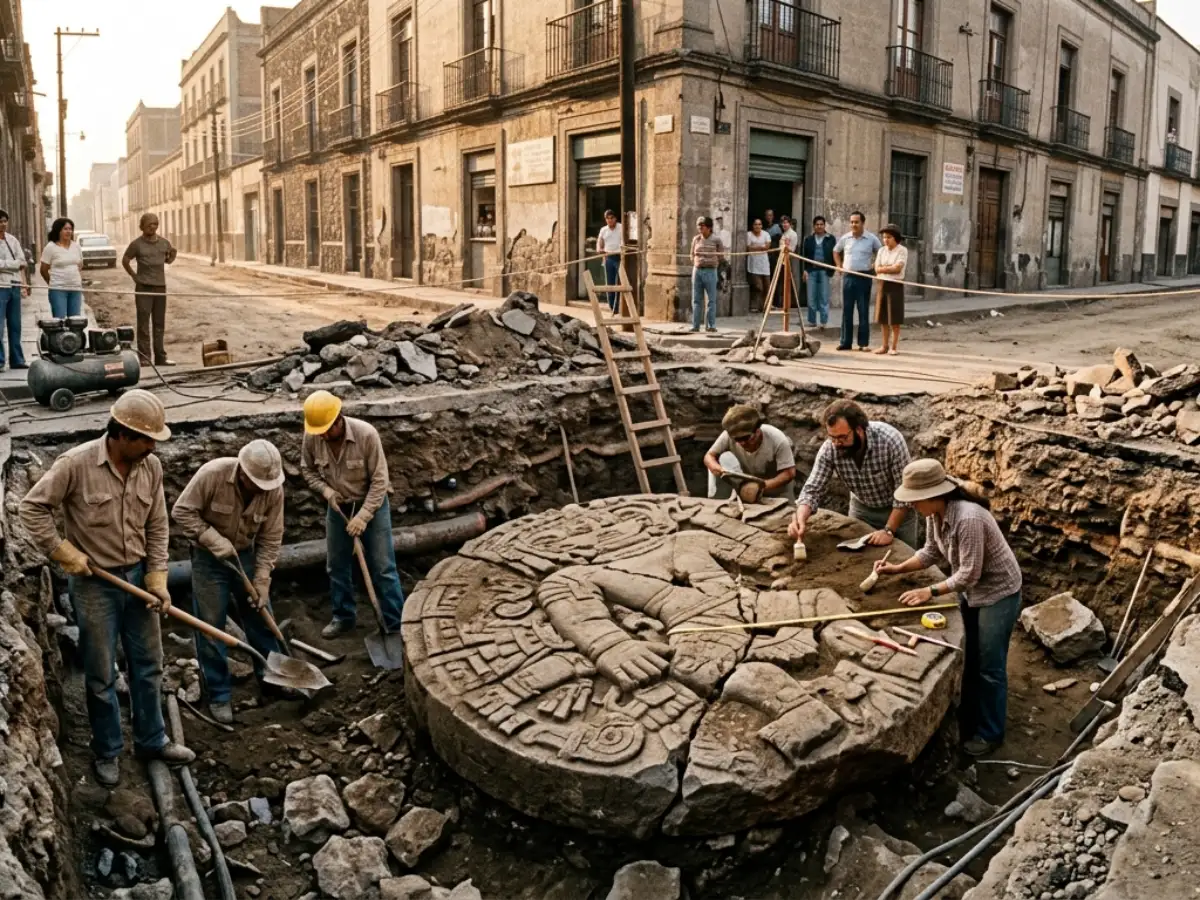
It all started with routine urban activity. On February 21, 1978, workers laying underground power lines below the streets of central Mexico City stumbled upon something large that had been buried there for centuries. Initially, it looked like just another carved stone hidden below all that urban development, but as the object became increasingly exposed to view, it was determined that these were, in fact, some of the most important archaeological discoveries ever made of a Mexica monument in situ.
The large round stone, carved in high relief, represented the dismembered goddess Coyolxauhqui and played an important role within one of the main sacred stories of the Mexica people. According to Britannica and INAH, which is the official cultural body of Mexico, the stone once belonged to the foot of the central ceremonial pyramid of Tenochtitlan, known as the Templo Mayor.
This finding transformed everything from that point on. Prior to this finding, archaeologists had found traces of the Aztec ceremonial area through excavations carried out in the 20th century. However, this particular finding provided evidence of the site of an important sacred region with extreme accuracy.
The Coyolxauhqui Stone, which spanned over 10 feet in diameter, was found next to the ruins of the Templo Mayor structure in one of the most densely populated cities today. As per Britannica, this stone provided significant evidence to corroborate the historical information regarding the architecture of rituals below the staircase of the temple.
The timing was also significant from a historical perspective. For much of the period of colonial rule, vast parts of Aztec Tenochtitlan were destroyed or buried beneath Spanish structures following the conquest of 1521. As decades passed, the remnants of the city became buried under churches, roads, public buildings, and growing residential communities. It was believed that the center of the Aztec capital had been almost completely obliterated by then.
The discovery in 1978 proved otherwise. As per UNESCO and INAH records, the Coyolxauhqui Stone proved that significant parts of the sacred district remained intact under the streets of modern-day Mexico City. The ordinary street excavation work turned out to be the first step toward an iconic urban archaeological expedition.
The giant stone became the key to reconstructing the Aztec ceremonial center
However, its significance went much farther than that of the monument alone. The stone discovery itself prompted the initiation of the current Templo Mayor excavations headed by archaeologist Eduardo Matos Moctezuma. The Britannica Encyclopedia mentions that within a short time, this excavation campaign yielded a number of findings related to stairways, offerings, construction stages, sculptures, and layers connected with the capital of the Mexicas. The ruins unearthed beneath the contemporary city were found to be part of a complex sacred landscape.
The religious and political significance of the stone’s iconography was immense. Coyolxauhqui was believed to be the moon deity who was killed and mutilated by her brother Huitzilopochtli, the sun god and war deity representing the Mexica nation. It is thought that the installation of the disk below the temple steps probably signified the merging of sacrifice, politics, war, and cosmology in a single symbolic image.
According to the literature reviewed via JSTOR and INAH resources, the ceremony conducted around the Templo Mayor might have deliberately imitated the legendary murder of Coyolxauhqui depicted on the stone itself. The excavation was crucial for the history of Tenochtitlan since archaeologists were able to examine the central part of the ceremonial complex in space rather than rely on historical records alone.
It turned out that the Templo Mayor had undergone multiple reconstructions in different periods during the expansion of the Mexica Empire. Buried under the building were various materials such as shells, obsidian, sculptures, animal bones, and ritualistic items imported from the whole Mesoamerican area.
Researchers also realized that modern Mexico City still physically sits on top of enormous portions of the former Aztec capital. The buried city was not gone in the complete sense many imagined. Instead, much of it remained preserved beneath colonial and modern development, waiting to be identified piece by piece, carefully.
The discovery permanently changed how people view Mexico City itself
What makes the Coyolxauhqui find so interesting is its location. Archaeological finds are often made in arid deserts, dense jungles, and other abandoned sites far from civilization. This particular artifact was found underground, in the heart of a bustling metropolis where streets buzz with traffic, shops offer a wide variety of merchandise, utility services run through the city, and the population numbers in the millions.
The difference between ancient Tenochtitlan and modern-day Mexico City became apparent during the excavations. As stated by UNESCO, the Templo Mayor site is one of the most notable cases of stratified urbanism in the world today. It is hard to imagine how colonial cathedrals, modern facilities, and Aztec ceremonial architecture coexist in the same space in a bustling city center.
Another aspect that gives the story its significance is its unexpected nature. The utility workers were not looking for a lost civilization; they simply happened upon a huge sculpted image of the moon goddess under the streets as they carried out their normal duties. However, that one item would end up shifting the trajectory of Aztec archeology for decades to come.
It took only one stone to turn the streets of a major metropolis into a doorway leading to the ritual center of an immensely important civilization in the pre-Columbian era. Even today, the Coyolxauhqui Stone is a symbol of the discovery at Templo Mayor. Even more significantly, the stone redefined our understanding of Tenochtitlan itself. Much of its sacred geography remained intact.