Imagine a stretch of central Bulgaria, a rolling countryside between mountain ranges, the region is said to contain more than 1,500 Thracian mounds. This is the region that archaeologists now refer to as the Valley of the Thracian Kings: a region so awash with royal tombs that it has been likened to Egypt's Valley of the Kings.
Get breaking news anytime, anywhere. Download the TOI app now!
The Thracians were an ancient people who lived in much of what is today Bulgaria, parts of Greece, Romania, Turkey and Macedonia from about 4,000 BC until they were gradually absorbed into the Roman and later Slavic cultures. They lived on the margins of Greek and Roman civilisations, often mixing and clashing with more dominant cultures, and they left little written record of their own. We know very little about them, except what they put in their graves.
But what they buried was incredible.
The man who opened a kingdom
In August 2004, Bulgarian archaeologist Dr Georgi Kitov and his team entered a burial mound near the town of Shipka. What they found out overnight changed the picture of the Thracian civilisation.
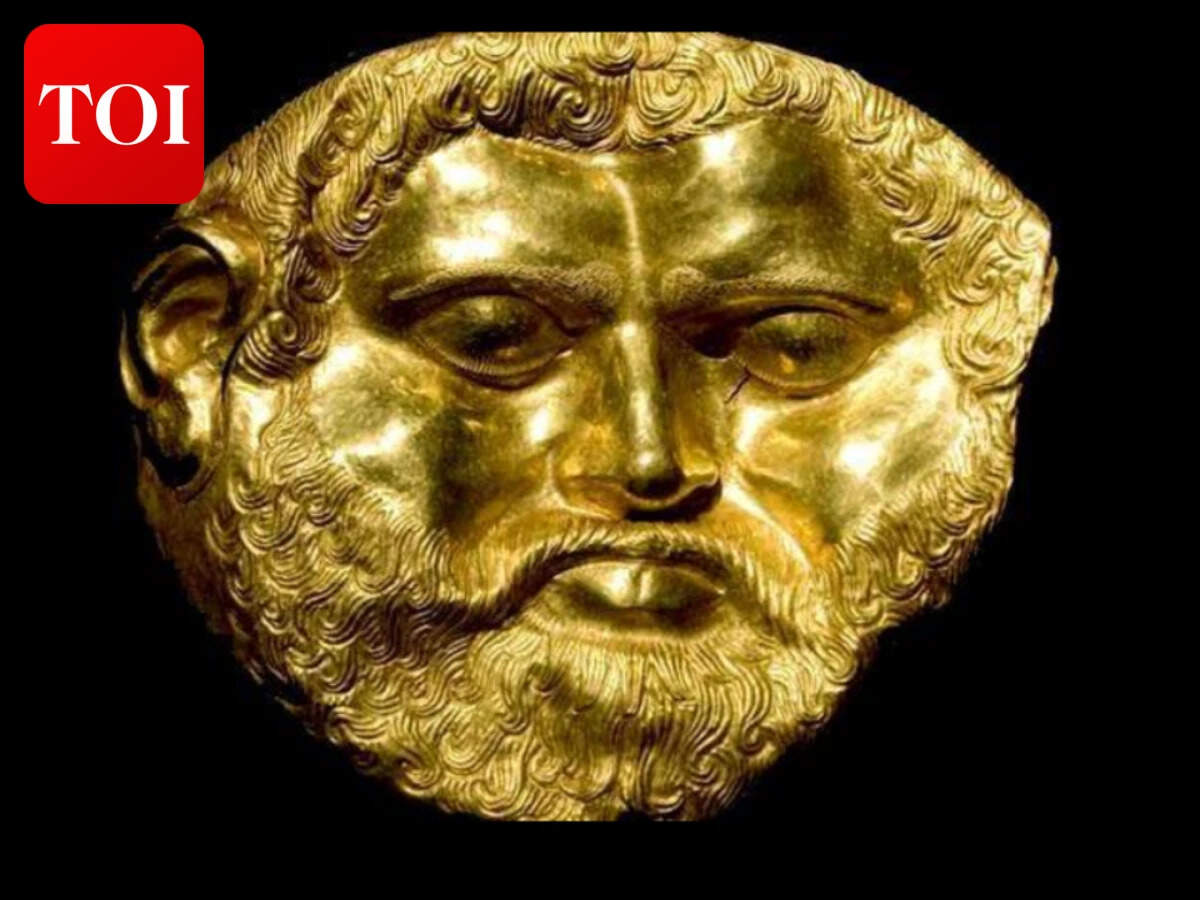
Some reports linked the mask to a Thracian ruler; the nearby Golyama Kosmatka tomb is linked to Seuthes III a Thracian king who ruled in the late 4th century BC and is the first solid-gold mask to be discovered in the country.
There was a sword, a double axe, large amphorae that probably once contained wine, bronze and silver vessels, and the mask, all the things a king might need in the afterlife. The grave was undisturbed. It was complete.
The mask would have been worn during royal drinking ceremonies described by ancient Greek authors, Kitov said. After a Thracian leader drank wine from a golden vessel bearing his likeness, he would have placed the mask on his face to demonstrate his power to those present.
This was more than treasure. It was a theatre. And it had waited underground for more than two thousand years.
Valley of the Kings
The Golyama Kosmatka tomb is believed to be one of the most elaborate ever found in the region and is believed by many scholars to be the resting place of Seuthes III, king of the Odrysian Kingdom from about 331 to 300 BC. According to UNESCO's description of the Golyama Kosmatka tomb, it has an impressive facade, an unusually long entry corridor of 13 meters and three large rooms one after the other, the largest of which is circular with a dome. Inscriptions on the helmet and silver vessels, “ΣΕΥΘΟΥ” - “of Seuthes” - and coins of Seuthes III found at the site, support the identification of the burial as his.
Archaeologists believe they have discovered the tomb of the greatest Thracian king, Seuthes III, whose capital city, Seuthopolis, was located near Kazanlak, according to the UNESCO World Heritage Centre .
In the Valley of the Thracian Kings alone, there are estimated to be over 1,500 ancient Thracian burial mounds, of which some 300 have been excavated by archaeologists. Most are still there.
And gold was how they talked
The Thracians saw precious metal as more than a sign of wealth. It was a language. These objects expressed rank, divine favour, and the right to be remembered.
A ruler buried with a solid-gold mask, a wreath and a sacrificed horse was making a statement, not just to the living, but across time. The work was beautifully done. The bronze head of Seuthes III, found outside the facade of the tomb, is regarded as a masterpiece of Hellenistic realism, and scholars believe it may have played a major role in the spiritual practices of the Odrysian Thracians.
The finds show Thracian elites were part of a sophisticated political and ritual world.
Why this is important now
The Thracians receive little mention in most Western history curricula. Greek and Roman records often dominate the wider story of the ancient Balkans. But beneath Bulgaria, there is evidence of a very different tale, a tale of a sophisticated, powerful culture with its own rituals, its own royal identity, its own way of leaving its mark on the world.
If you grew up with the idea that ancient history meant Athens or Rome, the Valley of the Thracian Kings is a gentle correction. There are the kings. The gold's there. The tombs are still broken open.
But it took us this long to start paying attention to it.