A summer job at NASA’s Jet Propulsion Laboratory in 1961 led a UCLA graduate student into a problem that was much bigger than the assignment on his desk. Michael Minovitch had been asked to study how a spacecraft could travel between two points while falling through the Sun’s gravitational field. It was a difficult trajectory problem, but it was still a defined one. Then he started asking what would happen if a planet’s gravity became part of the journey. That question changed the possibilities for interplanetary travel.
Minovitch worked on the problem outside his assigned duties and developed calculations showing how a spacecraft could make a close planetary flyby and emerge on a very different path around the Sun. The spacecraft would not get energy from nowhere. Instead, it could exchange orbital energy with a moving planet, gaining or losing speed relative to the Sun without firing its engines during the encounter. NASA now describes gravity assists as a basic tool of planetary mission design.
From a UCLA Graduate Student’s Idea to Deep Space
When Minovitch arrived at JPL in June 1961, his summer assignment was not to invent a new propulsion system. He was working on the mathematics of a free-fall spacecraft traveling between two specified points under the Sun’s gravity. The problem involved calculating the possible trajectories and determining the conditions a spacecraft would need to follow one of them. It was the kind of work that could easily consume an entire summer on its own.
Instead, Minovitch became interested in the harder three-body problem sitting beside it. What if the spacecraft passed close enough to a planet for that planet’s gravity to alter its trajectory? He began using JPL’s IBM 7090 computer to investigate those encounters and continued developing the idea beyond the limits of his original assignment. His own historical account identifies August 23, 1961, as the date of a 47-page technical paper describing the work.
The trick was already hidden in the solar system
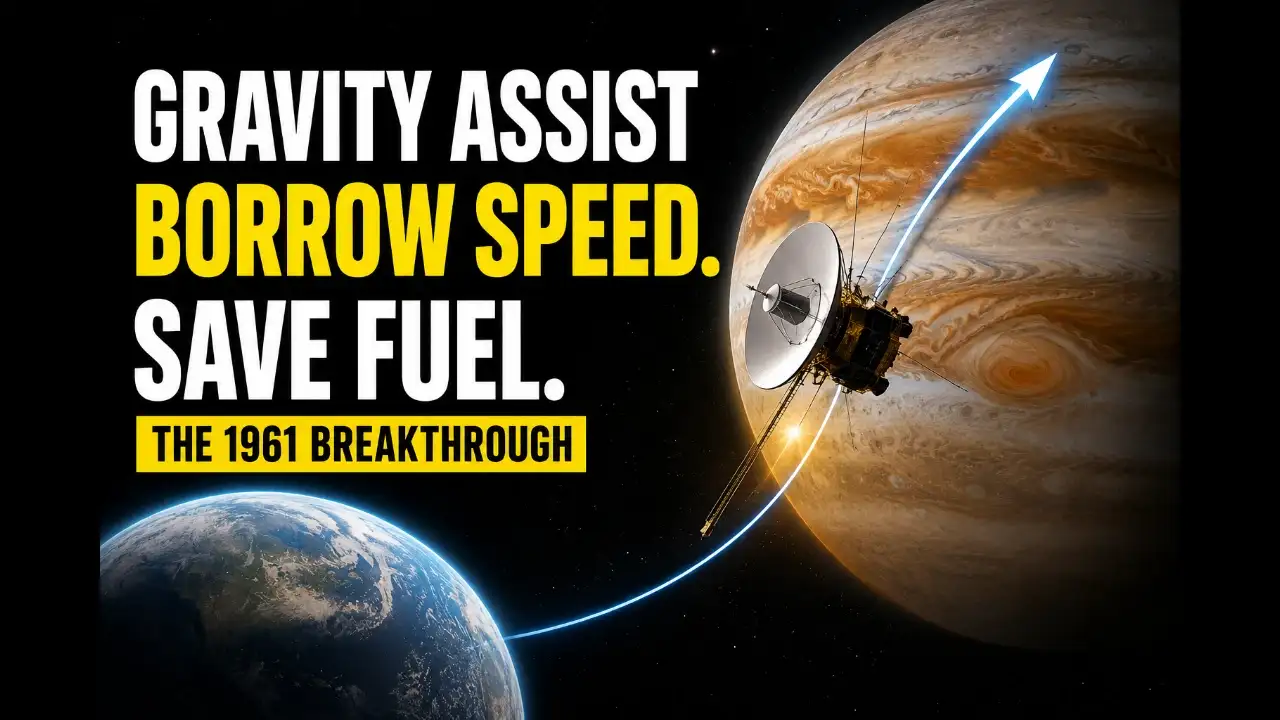
The basic physics sounds almost too simple when explained without the mathematics. A spacecraft approaches a planet that is already moving around the Sun. The planet’s gravity pulls on the spacecraft, bending its trajectory as the spacecraft swings past. From the planet’s own frame of reference, the spacecraft does not simply receive a magical burst of speed. The important change appears when the encounter is viewed from the Sun.
Because the planet itself is moving, the spacecraft can leave the encounter with a different velocity relative to the Sun. Depending on the approach and departure geometry, that can add energy to the spacecraft’s solar orbit or take energy away. NASA uses the term “gravity assist” for this maneuver, and the effect can dramatically reduce the propellant needed for an interplanetary mission.
Why that mattered more than another Rocket Engine
The problem facing early planetary missions was not simply getting a spacecraft away from Earth. Once a probe was on its way, engineers also had to give it enough velocity and put it on the right path to reach another world. Carrying enough chemical propellant to make every major change with onboard engines would make a spacecraft heavier, and launching that extra mass would require more launch energy.
A gravity assist offered another option. Instead of carrying all the energy required for the trip, mission planners could choose a trajectory that allowed a planet to do some of the work. NASA later noted that this approach could avoid the need for additional fuel and a larger launch vehicle. It also opened mission designs that would have been much harder to achieve with conventional propulsion alone.
Minovitch’s work was not the entire origin story
There is an important detail that often disappears in simplified versions of this story. Minovitch should not be described as the first human to ever realize that gravity could alter a spacecraft’s path. The underlying gravitational phenomenon had been understood long before the Space Age, and earlier researchers had considered related ideas for spaceflight.
His contribution was more specific and more useful. He developed a practical mathematical treatment for planetary encounters and showed how those encounters could be incorporated into interplanetary trajectories. His 1961 work helped turn an old gravitational phenomenon into a serious mission-design technique. Later researchers built on that work and used it to search for actual planetary routes.
The idea eventually reached Mercury
It took more than a decade before a planetary mission put the technique into practice in the way Minovitch had envisioned. NASA’s Mariner 10 launched from Kennedy Space Center on November 3, 1973, carrying a particularly ambitious destination: Mercury. Getting there required a carefully designed route through the inner solar system.
Mariner 10 flew past Venus on February 5, 1974, and used the planet’s gravity to change its speed and trajectory. That maneuver placed the spacecraft on a path toward Mercury. NASA identifies Mariner 10 as the first spacecraft to use an interplanetary gravity assist to change its trajectory and reach another planet.
The larger payoff came when engineers began looking beyond individual planetary flybys. In the 1960s, JPL researcher Gary Flandro studied the possibility of using favorable planetary alignments to send one spacecraft past several outer planets. The geometry was rare, but when the planets were positioned correctly, one encounter could help set up the next.
That approach became part of the thinking behind the famous outer-planet missions. Gravity assists eventually allowed spacecraft such as Voyager 2 to make a journey that would have been extraordinarily difficult using conventional rocket propulsion alone. The spacecraft could use a planet’s gravity to reshape its trajectory and continue toward the next destination instead of trying to supply every bit of the required velocity with its own engines.
The Spacecraft does not get a free tank of fuel
There is one phrase worth correcting because it can make the science sound more mysterious than it really is: a gravity assist does not give a spacecraft “free energy.” The spacecraft is taking advantage of the orbital motion of a planet, and the total energy of the system remains conserved.
Think of the planet as an enormous moving object that can slightly change the spacecraft’s motion. The planet loses or gains an extremely small amount of orbital energy, while the spacecraft can gain or lose a much larger amount because its mass is tiny compared with the planet. For the spacecraft, the practical result can be enormous. It can arrive at its next destination having used very little propellant for the gravity-assist portion of the trip.
More than 60 Years later, Engineers still use it
That is what makes the 1961 story worth remembering. Gravity assist is not an outdated trick from the early days of space exploration. NASA and other space agencies still build planetary trajectories around the same basic physics because carrying fuel remains one of the hardest constraints in spacecraft design.
NASA’s Mariner 10 mission is the clearest early example, but the technique has since appeared in missions involving the Moon, Venus, Earth, Mars, Jupiter and other bodies. NASA’s mission records specifically identify gravity assists as a way to change spacecraft trajectories while conserving propellant. The same mathematics has become part of the routine toolkit used when engineers work out how a spacecraft should move through the solar system.
A Summer calculation changed how we think about space travel
Minovitch’s story is compelling because the breakthrough did not begin with a new engine. It began with someone looking at a narrow mathematical problem and deciding to push it further. His original assignment concerned a spacecraft falling through the Sun’s gravity. His curiosity led him to ask what another moving body could do to that trajectory.
The answer became one of the most important tools in robotic exploration. Planets could be destinations, but they could also become part of the spacecraft’s propulsion strategy. A spacecraft could arrive at the right place, at the right speed and from the right direction, and let gravity reshape the rest of the journey.
That idea helped turn missions to distant worlds from a question of simply carrying more fuel into a question of finding better routes. And that is the practical detail worth remembering: when you read about a spacecraft making a close planetary flyby, look at what happens after the encounter. The flyby may be doing far more than providing a spectacular photograph — it may be the maneuver that makes the next leg of the mission possible.