In 1920, a farmer in Namibia was plowing his land, thinking about his crop, definitely not about space. Then the plow stopped. Not because of a tree root or a buried stone, but because of something much stranger. Something that wouldn't move.
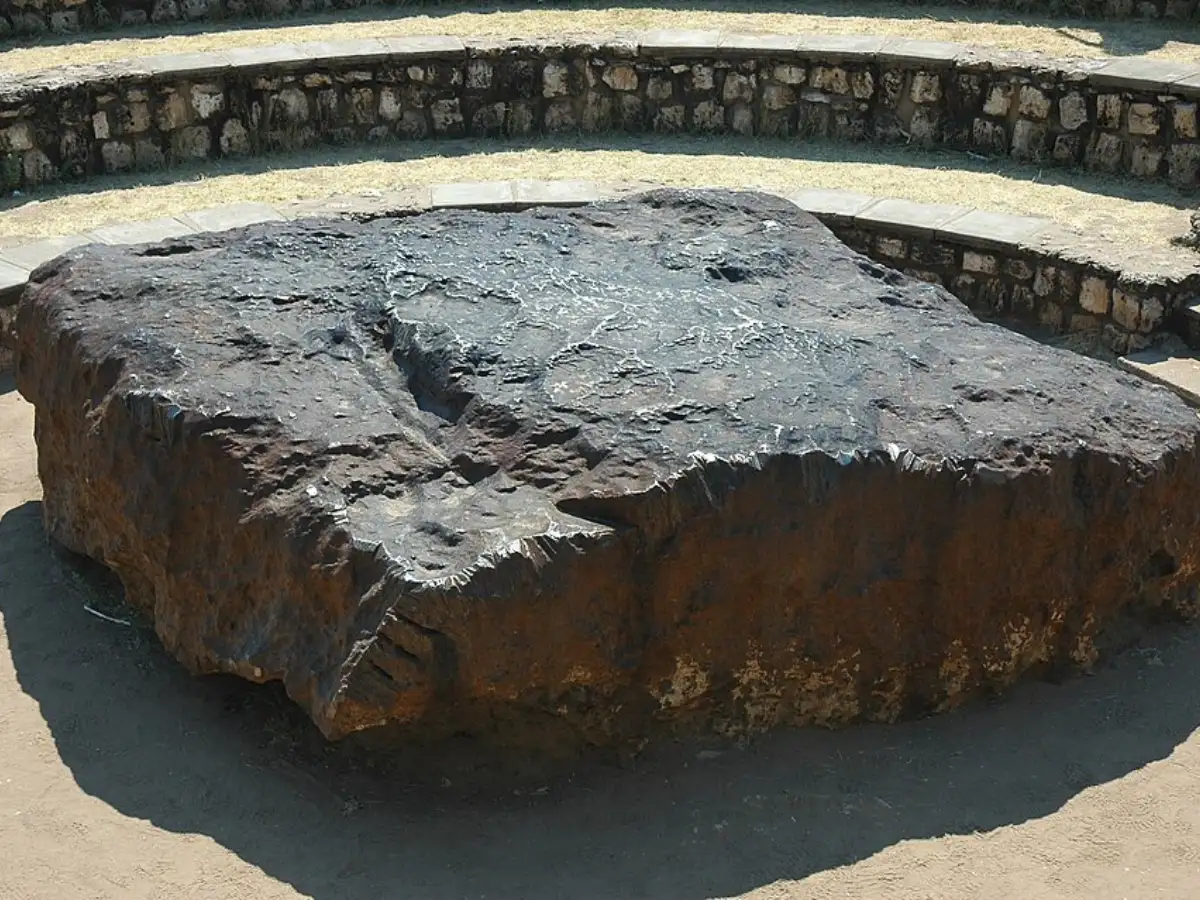
What he'd hit was Hoba, the largest meteorite ever discovered on Earth. Unlike the Hollywood dramatic version of space rocks hitting our planet with fire and fury, this one had been quietly sitting in a field, totally hidden, until a plow snagged it on an ordinary morning.
It’s the kind of story that sounds made up, but it's not.
Not your typical space rock
Most of us were brought up to believe in meteorite impacts as disasters, with football field-sized craters, debris flying for miles, the whole cinematic package. Hoba completely rewrites that script.
Not only is Hoba the largest meteorite ever found on Earth, but it left behind virtually no crater, which, scientifically speaking, is kind of a big deal, according to the Smithsonian's National Museum of Natural History. The prevailing theory is its shape: wide and relatively flat, almost like a giant iron slab, which probably meant it slowed down and skimmed into the ground rather than punching straight through.
The science that keeps scientists up at night
This is where it gets really interesting for anyone who likes their facts a little weird. Something this big, estimated at over 60 tonnes, coming from space and not blasting a crater into existence, is against most people’s mental model.
Researchers still use the Hoba to study how the shape and angle of entry of a meteorite can totally alter the result of an impact. The Smithsonian notes that there are good reasons to believe its flat shape may have caused the strange landing, but scientists are cautious about treating this as a definitive answer. Planetary science almost never works so cleanly.
For American audiences conditioned to think about space in terms of NASA launches and Mars rovers, Hoba is a handy gut-check: the cosmos is not always arriving dramatically. Sometimes it just stays there, waiting for someone to find it.
It never left; that's the whole point
That is what makes Hoba so special from nearly all of the other famous meteorites: it never moved. The most important space rocks end up behind glass in museums, the Smithsonian, the American Museum of Natural History, places where scientists can poke and prod them under controlled conditions.
Hoba still lies where it fell. It is now a national monument in Namibia, and people come from all over the world to stand beside it, touch it, and wrestle with the fact that they are looking at something that formed before the Earth was here.
There’s something quietly profound in that. This is no specimen in a case. It’s a site. The ground around it wasn’t just where a meteorite landed. It was where the meteorite lived.
Why this story hits differently now
There is something almost grounding about the Hoba story in a culture that is always online and always overstimulated. A giant chunk of the solar system, older than anything living today, had been hiding in plain sight on a working farm for perhaps tens of thousands of years, and only surrendered itself because someone was doing a job.
No satellite photos. No AI detection. Just a plow and a very surprised farmer. The biggest rock from space on Earth wasn’t in a museum, or a crater, or a government facility. It was in a field, waiting.