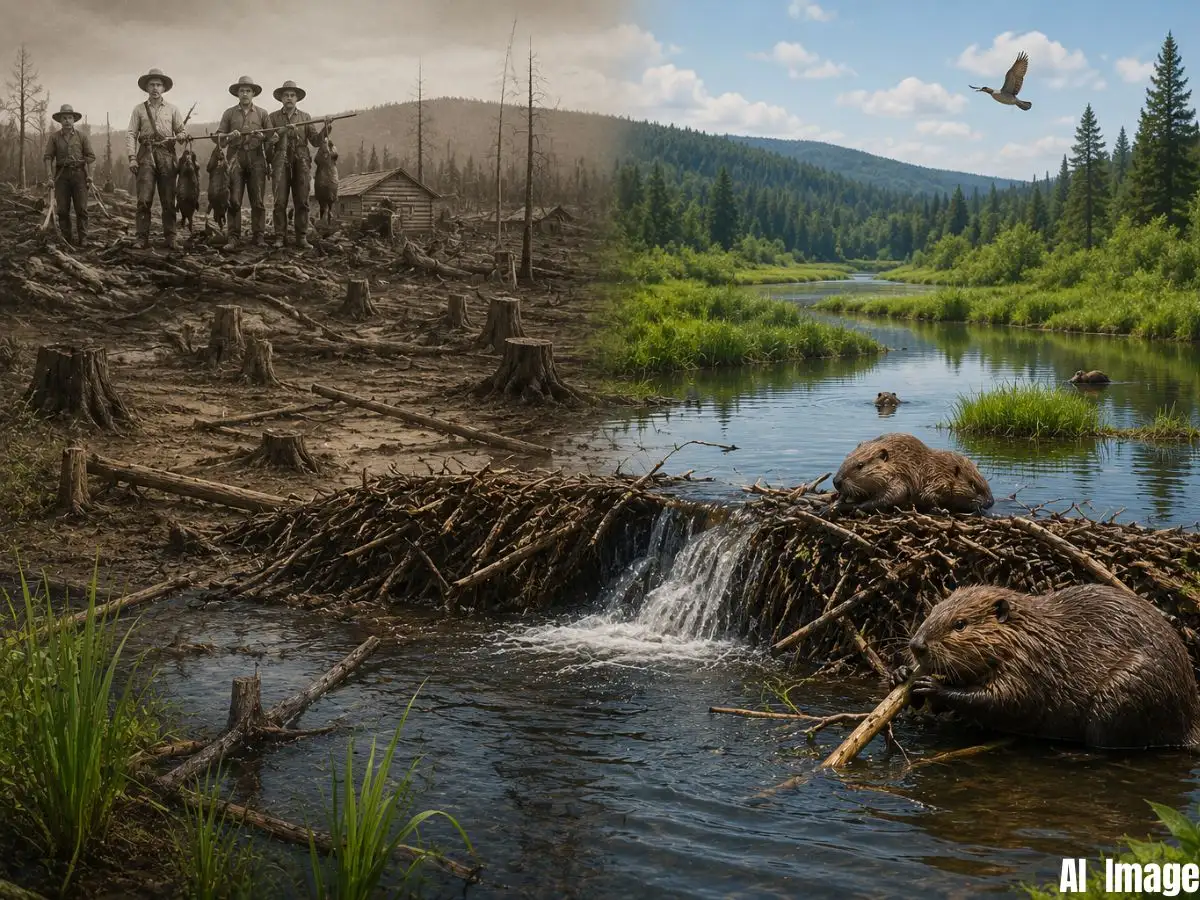
From a population crash of nearly 100 percent to a full-blown ecological comeback, the strange, occasionally airborne story of how North America's biggest rodent came back from the edge. Here's a number worth sitting with: at one point, North America was home to somewhere between 60 million and 400 million beavers. By the turn of the 20th century, that number had crashed to roughly 100,000. Not a typo. A wipeout on a scale most endangered species never even approach, and one that happened almost entirely because European fashion houses wanted felt hats.
Also Read: Snakes once had legs: Here's how they lost them 100 million years ago
More than a hundred years later, the story has quietly flipped. Beavers are back, not everywhere, not without friction, but in numbers and places nobody expected a generation ago. And along the way, scientists have discovered something the animal's critics never anticipated: this stocky, buck-toothed rodent might be one of the cheapest, most effective tools humanity has for fighting drought, wildfire and flooding, all without a single engineer's fee.
How a continent lost its beavers
The collapse traces back to the fur trade, which ran for roughly two centuries starting in the 1600s. Beaver pelts were felted into hats worn across Europe and the American East Coast, and the trade was so lucrative it quite literally funded the exploration of the American West, trappers pushed into unmapped territory chasing beaver colonies the way later prospectors chased gold. The hunting was relentless and unregulated. "By 1900, the continent's beaver population had plummeted to as few as 100,000", a decline so severe that in places like New York's Adirondacks, only a couple of known colonies remained by the 1890s.
What actually saved the species, oddly enough, wasn't conservation policy, it was fashion. Silk top hats replaced beaver felt as the height of European style, demand collapsed, and the pressure on wild populations eased just long enough for numbers to stabilise. States began passing trapping bans around the same period, buying the animals a little more breathing room.
Losing the beavers, it turned out, cost far more than anyone realised at the time. "Without beavers maintaining their dams, rivers that once stored water in wide, slow ponds began flowing faster and flashier during floods, with far less water left over during dry spells". Wetlands that had existed for thousands of years simply drained away and vanished within a generation.
A beaver named Geronimo, and a plane full of parachutes
Nowhere does the recovery story get stranger than in Idaho, in the summer of 1948. As people moved into the state's backcountry after World War II, they kept running into beavers whose dam-building was flooding orchards, roads and irrigation systems. Trucking the "problem" beavers out to remote wilderness by mule was slow, and the animals kept dying of heatstroke in transit. So a Fish and Game officer named Elmo Heter came up with a solution that still sounds made up: crate the beavers, strap surplus wartime parachutes to the boxes, and drop them out of an aeroplane.
"On August 14, 1948, a twin-engine aircraft carried eight beaver crates over Idaho's Chamberlain Basin", releasing them over meadows officials had scouted as beaver paradise. The test subject for the whole operation was a patient old male the team nicknamed Geronimo, who was dropped, retrieved, and dropped again to perfect the crate design before earning a spot on the real flight. "Of the 76 beavers eventually parachuted into the wilderness, 75 survived the landing", promptly built dams, raised families, and, by most accounts, never looked back. It remains one of the odder chapters in American wildlife management, and footage of it still resurfaces online every few years to general disbelief.
From Times Square to the Bronx River
The comeback has shown up in far less remote places too. Manhattan itself once sat atop beaver-built wetlands, the animal is even stamped on the official seal of New York City, before "trapping, pollution and development wiped beavers out entirely by the early 1900s". In 2006, a wild beaver turned up on the Bronx River for the first time in roughly two centuries. Locals named him Jose, after the congressman who had championed the river's clean-up, and his arrival became a small symbol that decades of restoration work were actually paying off.
Today, beaver colonies are re-establishing themselves from Oregon and Colorado to New York, spreading into suburban creeks nobody expected to see them in again.
The unpaid climate engineers
What's changed the conversation around beavers most isn't nostalgia, it's data. Ecohydrologist Emily Fairfax, who has spent years studying beaver-shaped landscapes from the air and on the ground, admits she didn't expect to be won over. "I thought beavers were just this weak animal that didn't do anything particularly impressive," she has said of her early assumptions. Her research since has told a very different story.
Fairfax's work has shown that land around beaver dams stays measurably greener and wetter through droughts than comparable land without them, because the dams slow water down and force it to soak into the surrounding soil instead of rushing downstream. During several major Western wildfires, satellite imagery showed beaver-dammed stretches of river staying green and largely unburned while the vegetation around them turned to ash, an effect researchers now describe as a kind of fire refuge built entirely by rodents. Conservation groups have started building "beaver dam analogues," rough human-made copies of beaver dams made from staked branches, in streams where the animals haven't yet returned, essentially mimicking the engineering until the real engineers move back in.
None of this makes beavers universally popular. In New Mexico's centuries-old irrigation networks, and in farming communities anywhere a flooded field means a lost crop, beaver dams remain a genuine headache, and wildlife managers now spend real effort balancing coexistence against property damage. But the broader shift in attitude is hard to miss. An animal that was trapped to the edge of extinction for the felt on its back is increasingly being treated as a low-cost, self-replicating flood and drought defence system, one that, unlike most infrastructure, has been quietly rebuilding itself for free every time humans have simply gotten out of its way.