Amid the scorching heatwaves in the US, AC has become an everyday necessity. But the story of who invented air conditioning is far more fascinating than many people realize.
While Willis Carrier is widely known as the father of modern air conditioning, the journey actually began decades earlier with a Florida doctor who believed cooler air could save lives. The invention of air conditioning wasn't originally meant to make people comfortable. But it was created to solve medical and industrial problems.
Before Willis Carrier, John Gorrie tried to cool hospital rooms
Long before modern AC systems existed, John Gorrie, a physician working in Florida during the early 1840s, noticed that patients suffering from yellow fever became more comfortable in cooler environments, according to History.com.
Instead of accepting the intense heat, Gorrie designed a simple cooling device that blew air over buckets of ice before circulating it through hospital rooms. His goal was straightforward: help patients recover by lowering room temperatures.
ALSO READ: Sam Altman says ‘we are now in the singularity’
However, imported ice was expensive and difficult to obtain in Florida and to solve this issue, Gorrie built his own ice-making machine, receiving a patent for it in 1851.
Although he never managed to commercialize either invention, historians consider his work one of the earliest milestones in both refrigeration and air conditioning technology. His ideas laid important groundwork for future inventors.
Breakthrough in 1902
In 1902, Willis Carrier solved a printing company's frustrating problem. Engineer Willis Carrier was asked to solve a serious issue at the Sackett & Wilhelms Lithographing and Printing Company in Brooklyn, New York.
During humid summers, moisture in the air caused printed pages to expand unevenly. As a result, ink smeared and colors became misaligned, leading to expensive production problems.
He engineered a system that passed air over coils filled with cold water, removing moisture while also lowering the room's temperature. The innovation transformed the printing process and became the world's first modern air conditioning system. Carrier received a patent for the technology in 1906 before establishing the Carrier Engineering Corporation.
The invention of air conditioning quickly spread beyond factories
Once businesses realized the benefits of controlled indoor temperatures, demand for air conditioning grew rapidly. During the early 1920s, Carrier introduced a centrifugal air conditioner, commonly called a chiller. These systems first became popular in movie theaters, giving people a cool escape during hot summers.
Soon afterward, department stores, offices, restaurants, hotels and other public buildings began installing air conditioning systems.
The technology even reached the highest levels of government. In 1928, Carrier's company installed air conditioning inside the US House of Representatives, followed by the US Senate in 1929.
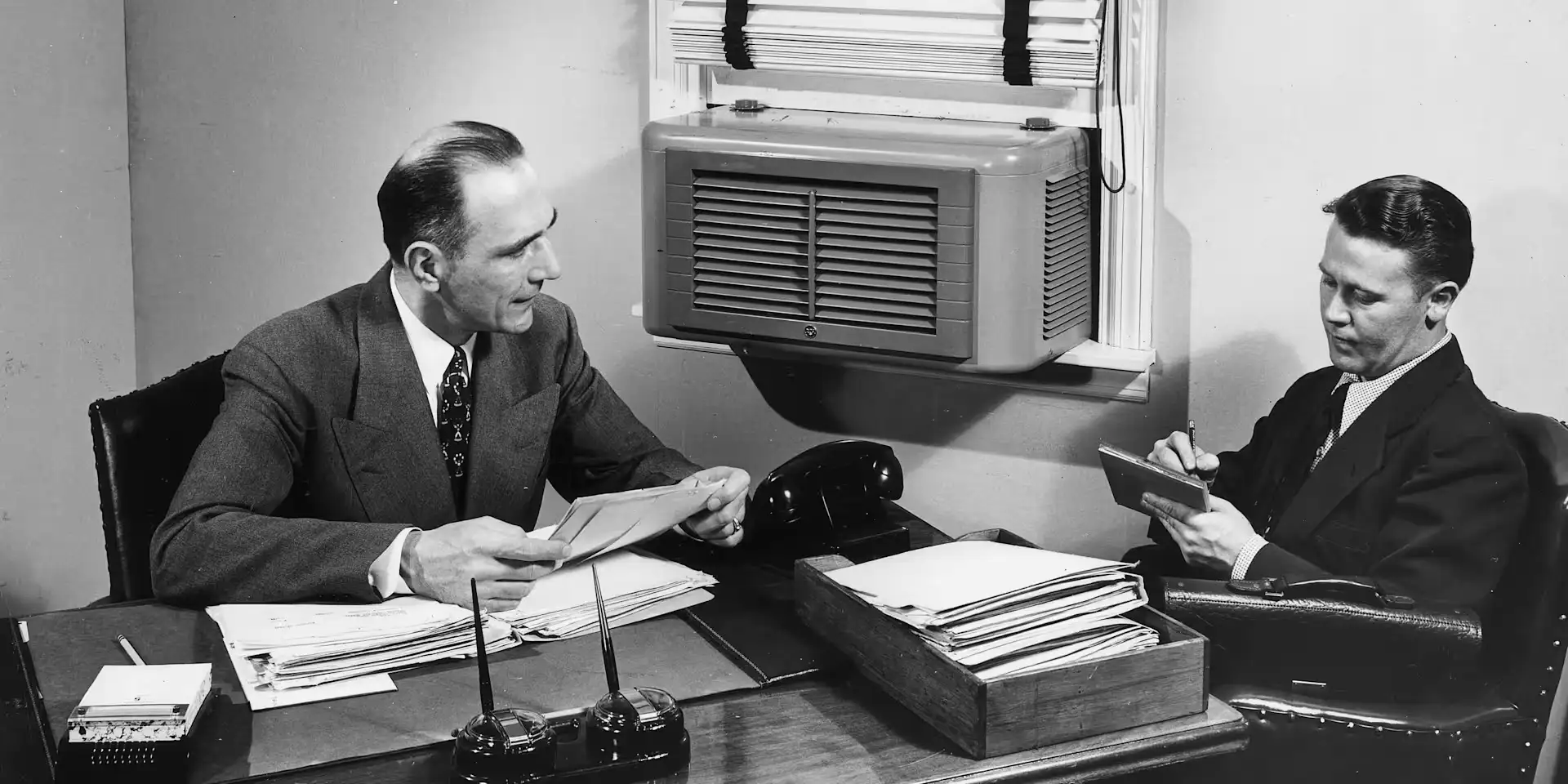
How window air conditioners made AC available to millions
The earliest air conditioning systems were enormous, expensive and suitable only for commercial buildings. That changed in 1932, when inventors H.H. Schultz and J.Q. Sherman introduced the first window air conditioner for consumers.
A year later, Carrier unveiled another improved design featuring:
- A belt-driven condensing unit
- Mechanical controls
- An evaporator coil
- A blower system
Remarkably, these same core components continue to be used in modern air conditioners today, although today's systems are far more energy-efficient and compact.
Air conditioning's growing climate challenge
While air conditioning protects millions of people from dangerous heat, it also presents a growing environmental challenge.
Modern cooling systems consume significant amounts of electricity and many rely on refrigerants that contribute to global warming if released into the atmosphere. As climate change drives temperatures higher, demand for cooling continues to rise, creating what UNICEF has described as a "cooling dilemma."
Researchers and manufacturers are now focusing on developing cleaner refrigerants, energy-efficient cooling systems and sustainable technologies that can reduce environmental impact while keeping people safe.
The legacy of two inventors
The invention of air conditioning wasn't the work of a single person. John Gorrie first imagined cooling as a medical tool that could improve patients' health, while Willis Carrier transformed that vision into a practical technology that reshaped industries and daily life.
More than a century after Willis Carrier invented modern air conditioning in 1902, his innovation remains one of the most influential engineering achievements of the modern era—keeping billions of people comfortable while inspiring the next generation of sustainable cooling technologies.