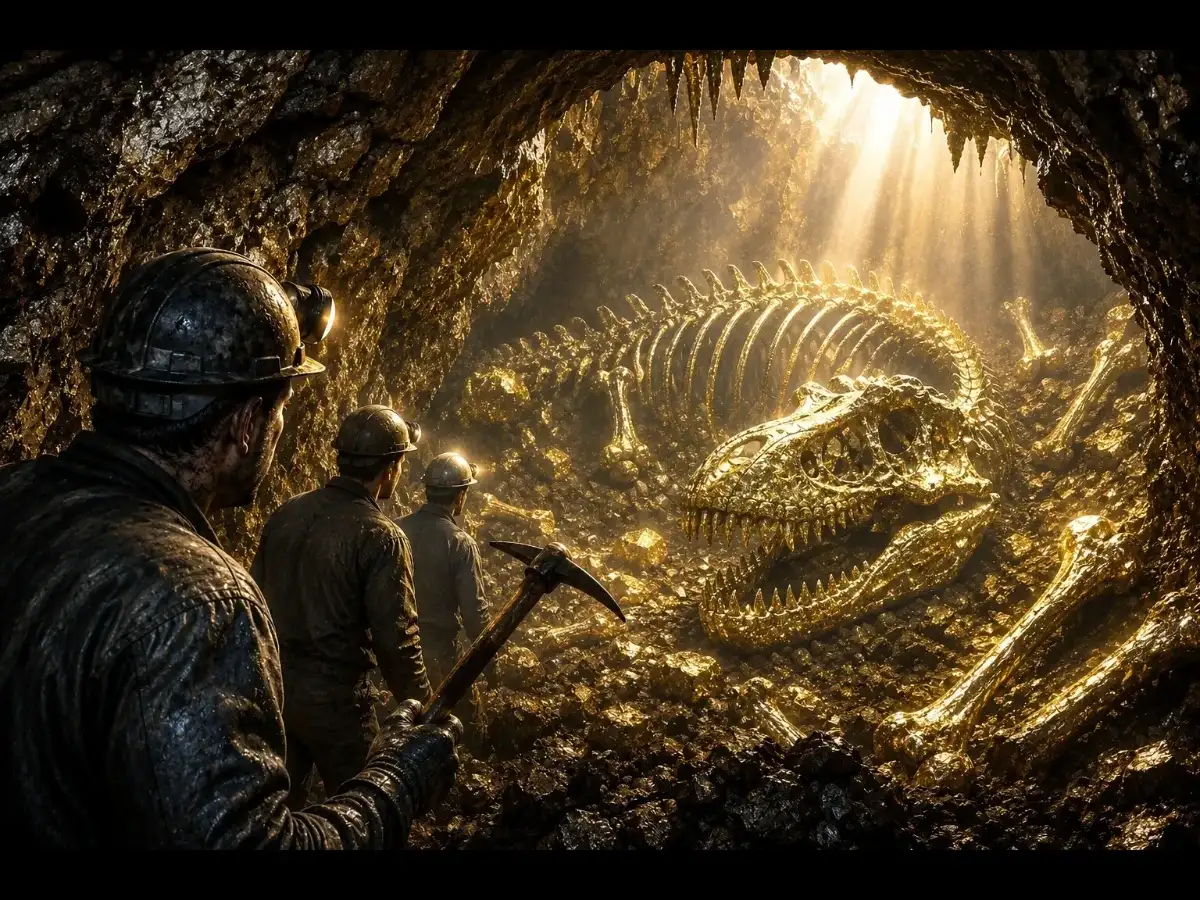
Beneath the ground of Belgium, workers in 1878 were conducting their regular activities in the industrial sector when they stumbled across a phenomenon that was out of the ordinary. Within the coal seam, there were bones that appeared to have a glow similar to that of pyrite, causing them to look like fool's gold. However, what these workers discovered was much more remarkable than fool's gold.
The Bernissart Mine Shaft unearthed one of the most significant paleontological discoveries of all time.
As reported by the Royal Belgian Institute of Natural Sciences, this discovery gave rise to many skeletons of the Iguanodon species, which were located together under the ground. This was one of the largest paleontological discoveries ever recorded, as it occurred during an activity related to the extraction of coal, not the excavation of fossils.
Now, the Bernissart Fossils stand as one of the most crucial moments in paleontology, as they redefined dinosaurs.
Bones in the darkness
It is particularly eerie for fossil hunting purposes to think about the discovery made at Bernissart. Usually, the places where dinosaurs used to roam are either in deserts or near cliffs, which means that the fossil deposits would be uncovered, making it easier to search for them on the surface. Not so for Bernissart.
First of all, the place where the fossils were found was deeply hidden under a modern industrial landscape.
As mentioned by the Royal Belgian Institute of Natural Sciences, the miners digging deep underground at the site of Bernissart discovered a deposit rich in fossils very quickly, which turned out to be larger than first estimated. The important part is that there were several skeletons present among those fossils.
The presence of both modern mining activities and the long-lost prehistoric era creates an incredible feeling about the discovery.
Why Iguanodon mattered so much
In addition, the dinosaur discovered at Bernissart was already well-known in the scientific world.
This is because the species was one of the first dinosaurs named and featured extensively in scientific literature decades before the discovery. However, as explained in Encyclopedia Britannica, previous interpretations of Iguanodon were based on fragmented fossils and bones. In other words, scientists were attempting to piece together what must have been an enormous creature using small amounts of fossilized remains.
Bernissart was a game-changer for this process.
As pointed out by the Royal Belgian Institute of Natural Sciences, the discovery led to a revision in many aspects of Iguanodon’s biology. For example, scientists began to reconsider their understanding of the dinosaur’s posture, leg structure, and the purpose of its distinctive thumb spike.
Importantly, dinosaur studies were still evolving quickly during this period. Prior to the discovery of specimens at Bernissart, many dinosaurs were little more than incomplete concepts. Bernissart provided paleontologists with access to more complete specimens than ever before.
A turning point for dinosaur science
However, what made Bernissart more significant than merely a successful paleontological dig was the new approach it heralded for examining prehistoric life.
What made the discovery at Bernissart so significant was not just the number of bones found buried deep within the ground. What mattered more was that all of the bones discovered were part of the same body and could be compared with one another. It is from this comparison that the scientists were able to create an image of what the animal really looked like.
According to the Royal Belgian Institute of Natural Sciences, Bernissart revolutionized scientific understanding about Iguanodon. This revolution did not end with the science community; it also had implications for the general population.
With the assembly of the bones into the dinosaur’s skeleton, the general population was no longer left to imagine dinosaurs only as large beasts with strange names, but could now visualize their appearance.
The discovery that still fascinates today
One reason Bernissart remains relevant even today is the unusual nature of its circumstances.
The notion that miners mining for coal end up digging out fossils from the past has a sort of otherworldly quality to it. But according to the Royal Belgian Institute of Natural Sciences and Britannica, that is precisely how paleontologists made one of their most important discoveries.
These men were not seeking to rewrite the course of paleontology in general or the understanding of dinosaurs in particular; their task was simply to dig for coal as part of an ordinary industrial operation under Belgium’s surface. What the result of their work accomplished was something else entirely.
That is why Bernissart stands out as such an important milestone – because it changed the practice of dinosaur paleontology from theory into fact.
It all started underground, in the dark, with miners looking for coal.