Graham Platner is now out as the Democratic nominee in Maine. The allegation-plagued oysterman ended his campaign on Wednesday evening with a defiant video where he said he would file papers to withdraw his name from the ballot and then on Friday did just that.
“My name may not be on the ballot, but that ballot belongs to the people of Maine,” he wrote in his letter to the Maine Secretary of State’s office, an image of which he posted to X.
“As such, please consider this notice as my official withdrawal from consideration for this office.”
The secretary of state’s office confirmed receipt of the letter and that he had sent such notice before Monday’s deadline to do so and would be removed from the ballot.
Now begins the replacement process. Democrats have until July 27 to replace Platner on the ballot. Other than that, according to the Maine secretary of state’s website, the criteria is fairly open, saying only that the vacancy be filled by a “qualified person.”

Former Maine Senate president Troy Jackson, Secretary of State Shenna Bellows, former Maine Center for Disease Control director Nirav Shah and Maine Beer Company co-founder Dan Kleban have all now jumped into the race.
The reasons are obvious: winning back the Senate for Democrats is nearly impossible if Republican incumbent Sen. Susan Collins wins reelection. There’s also the fact that Platner mobilized an army of supporters who will have a big say in this election.
All of this feels very similar to two years ago when Democrats removed Joe Biden as their nominee for president and replaced him with Vice President Kamala Harris. That didn’t go the way they hoped, but it stemmed the bleeding from what have been a massacre.
Still, Platner’s troubled campaign may not have been in vain since it showed that taking on Collins is doable. Before Politico dropped its report that Platner had allegedly sexually assaulted an ex-girlfriend, which he vehemently denied, polling showed Platner running only a few points behind Collins.
— Graham Platner for Senate (@grahamformaine) July 10, 2026
As The Independent reported last year, after Collins’ stunning win in 2020, by 8 points despite Joe Biden winning Maine by 9 points, Democrats had trouble fielding a credible challenger to the five-term incumbent.
Now, ironically, many of the Democrats who were too afraid to run against Collins are jumping back in. Jackson, Bellows and Shah all opted to run for governor and lost last month while Kleban briefly ran for Senate before he dropped out to endorse Gov. Janet Mills, the favorite of Senate Majority Leader Chuck Schumer.
“I think that the fundamentals, some basic structural fundamentals, are the same regardless of who the Democratic candidate are,” David Farmer, a Maine Democratic consultant, told The Independent. Farmer pointed out that Trump lost the state three times.
“As we saw in the primary, Democratic enthusiasm is going a lot further,” he said. The data backs up Farmer’s claim. Days before the Politico report, a Fox News poll showed that while Collins led also showed that 76 percent of Democrats were highly motivated compared to 61 percent of Republicans in Maine.
“And I think Democrats are even more fired up to get involved in the campaign moving forward,” he said.
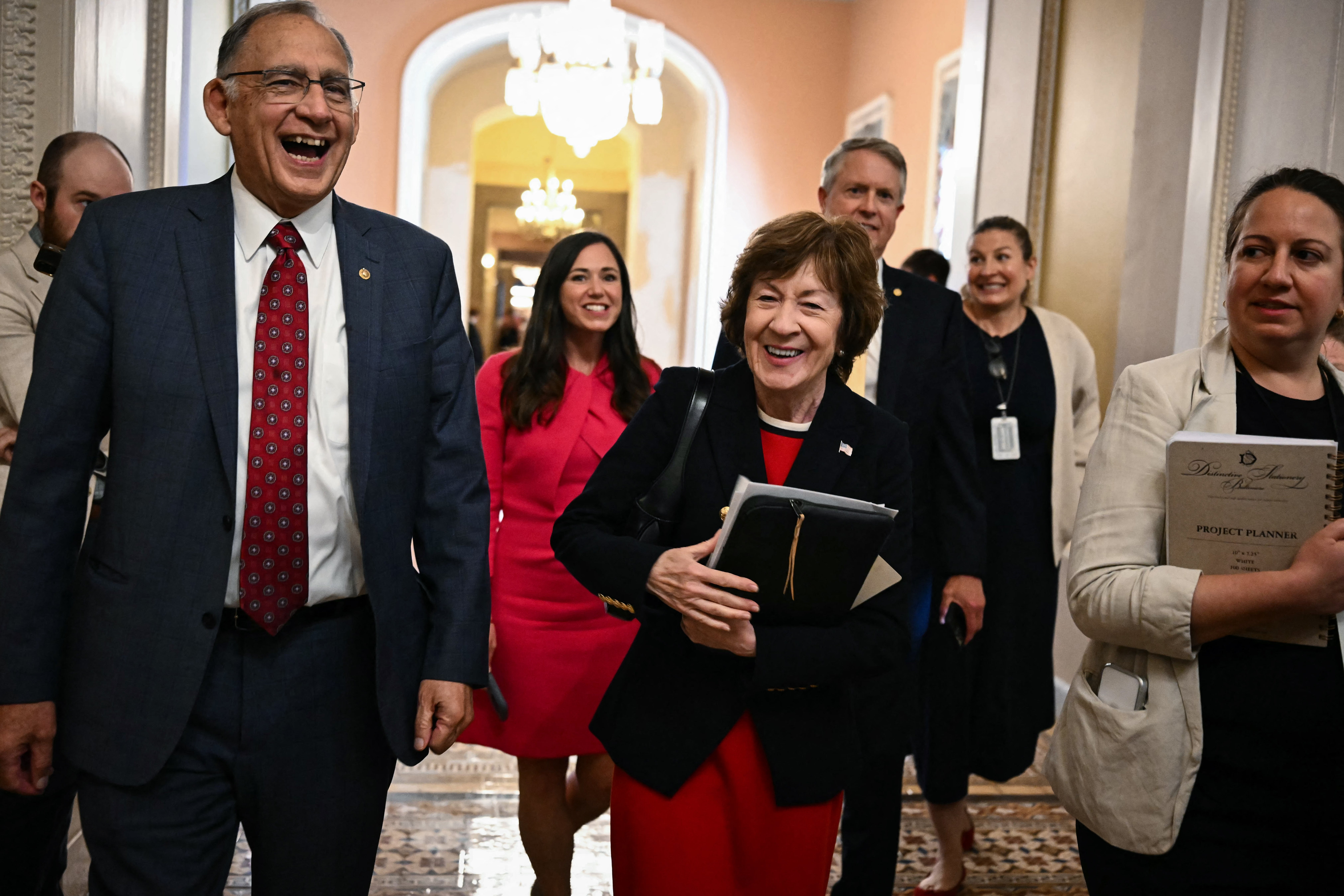
If anything, by removing Platner from the picture, the race now becomes more about Collins. In 2020, some Mainers likely elected her as a check on Biden. Now, they do not see her as a check on Trump.
“This is no longer going to be about Graham Platner, it’s back to being a referendum on Susan Collins,” one national Democratic strategist told The Independent.
While Democrats railed against Collins in Trump’s first term after she voted to confirm Brett Kavanaugh to the Supreme Court, she did distance herself at times from Trump. She voted against Betsy DeVos as Education secretary and she joined fellow moderate Sen. Lisa Murkowski (R-Alaska) and Sen. John McCain to tank the Republican repeal of Affordable Care Act. In the weeks before the 2020 election, she also voted against confirming Amy Coney Barrett to the Supreme Court.
This time, Collins is more aligned with Trump.
While she voted against confirming Defense Secretary Pete Hegseth, she voted to confirm some of Trump’s most hardline nominees, including Health and Human Services Secretary Robert F. Kennedy Jr., former Director of National Intelligence Tulsi Gabbard and Homeland Security Secretary Kristi Noem. She voted against Trump’s “One Big, Beautiful Bill” because of the cuts to Medicaid, but has rarely diverged elsewhere.
In addition, during Trump’s first presidency, Roe v. Wade, which guaranteed the right to an abortion, remained the law of the land and Collins could run as a pro-choice Republican. She has less cache there after 2022 Dobbs v. Jackson decision killed Roe.
That does not mean there are massive perils in a switchout convention process. For one, there will likely be a cohort of diehard Platner supporters who will feel disaffected by his exit.
“Once they think the system is rigged against them, they don’t show up to vote,” one Maine-based Democratic strategist told The Independent on background to speak candidly.
That might favor someone like Jackson, who ran a populist race for governor and earned an endorsement from Sen. Bernie Sanders (I-Vt.). But it also comes at a risk given that Jackson campaigned heavily with Platner.
And if Maine Democrats were to nominate a more mainstream-minded Democrat, they risk angering Platner backers.
“Are Democrats better off today than they were a week ago? We still have a fighting chance? Yes. Is it a slam dunk? No. Is it a foul shot? No,” they said. “I think it’s two steps beyond the top of the key.”
And New England sports fans have had a rough go at it since the Boston Celtics lost Jaylen Brown to Philadelphia.
Still, they are in a slightly better spot. During the Senate race, Rep. Alexandria Ocasio-Cortez (D-N.Y.), a disciple of Sanders, declined to back Platner.
But after Platner’s exit, Ocasio-Cortez started following the Maine Democrats’ account on X.