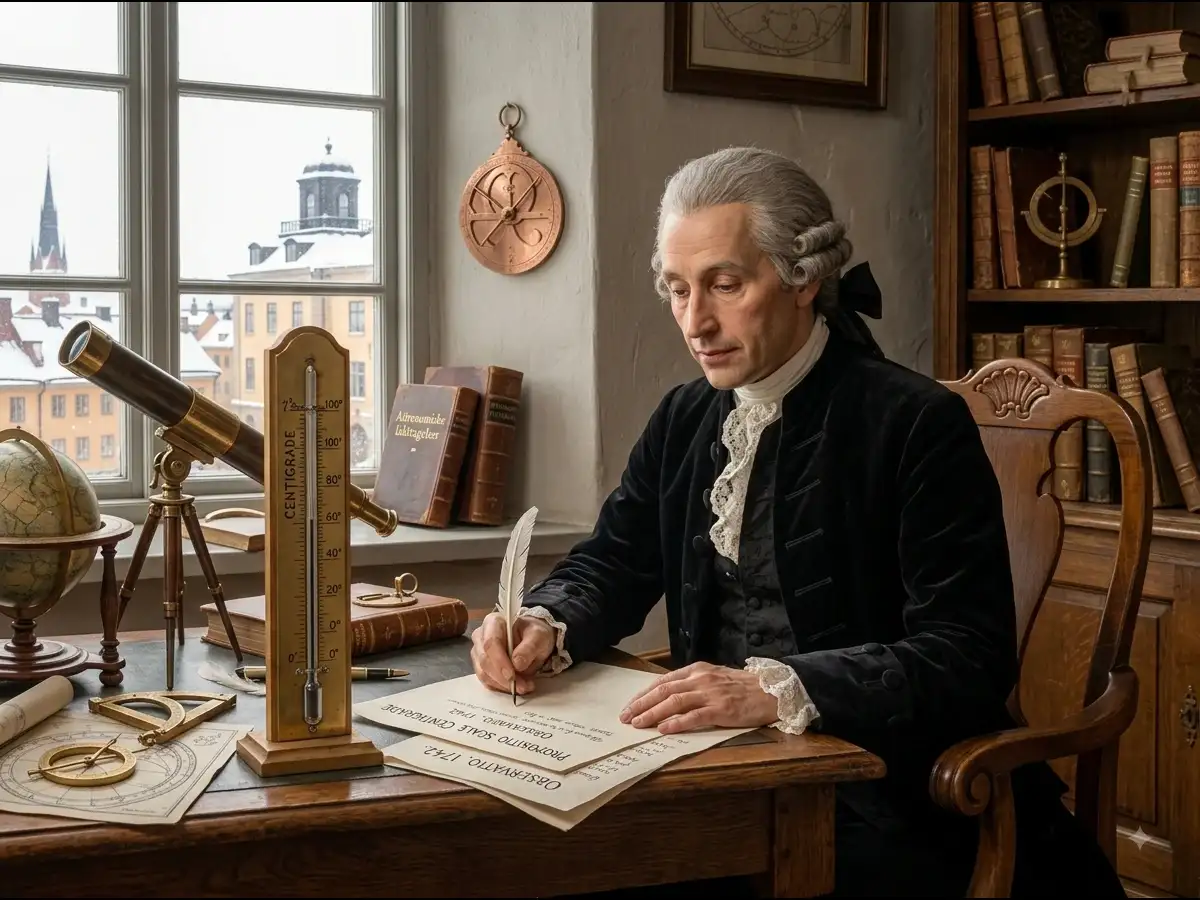
In 1742, a Swedish astronomer proposed the centigrade temperature scale simplifying global scientific communication, weather tracking and metric alignment. Anders Celsius presented a thermometer scale based on two fixed points of water. His method placed the boiling point at 0 degrees and the freezing point at 100 degrees. The scale was reversed after his death and became the temperature system used today. Celsius was also an astronomer who studied the northern lights, Earth's magnetic field, stars and the shape of Earth. His work in astronomy and measurement helped establish his place in the history of science.
How Anders Celsius' invention changed the world?
Temperature measurement is now part of science, weather forecasting, medicine, engineering and daily life. The Celsius scale gives people a common way to describe temperature.
The scale is based on the freezing and boiling points of water. In its modern form, water freezes at 0 degrees Celsius and boils at 100 degrees Celsius under standard atmospheric pressure. The system also fits with the decimal structure used by the metric system. This made temperature calculations easier to use alongside other measurements.
What is the invention?
Anders Celsius proposed a centigrade temperature scale in 1742. The word centigrade refers to a scale divided into 100 degrees between two reference points. Celsius developed the scale for use with mercury thermometers. He wanted a way to make temperature observations more consistent.
His original arrangement was different from the scale used today. Celsius placed the boiling point of water at 0 degrees and the freezing point at 100 degrees.
After Celsius died, the scale was inverted. The freezing point became 0 degrees and the boiling point became 100 degrees. This is the arrangement used today. The temperature scale later became known as the Celsius scale in recognition of its inventor. Since 1948, Celsius has been the commonly used name for the scale.
Why and how was it invented?
Celsius worked with astronomical observations and also kept meteorological records. He found that the thermometers available during his time did not provide the accuracy he wanted. A reliable temperature scale was important for recording weather conditions and making scientific observations. Celsius therefore developed a scale with two fixed points that could be reproduced using water.
The choice of 100 divisions gave the system a simple structure. It allowed temperatures to be expressed using a scale that could work with scientific measurements. Celsius presented his thermometer design to the Royal Swedish Academy of Sciences in 1742. His work became part of the development of standardized temperature measurement. The later reversal of the scale produced the system that is now familiar around the world.
Who invented it?
Anders Celsius invented the Celsius temperature scale. He was born on November 27, 1701, in Uppsala, Sweden, and died on April 25, 1744, in Uppsala at the age of 42. Celsius came from an academic family. His father was an astronomy professor and his grandfather was a mathematics professor. He studied at the University of Uppsala and became secretary of the Uppsala Scientific Society in 1725.
In 1730, Celsius succeeded his father as professor of astronomy at Uppsala University. He held the position from 1730 to 1744. Celsius travelled through Europe to study astronomy and meet other scientists. He visited Germany, Italy, France and England. During his travels, he gained experience with observatories and astronomical research.
His scientific work was not limited to temperature. He studied the northern lights, stars, Earth's shape and the distance between Earth and the Sun.
Celsius and the northern lights
In 1733, Celsius published a collection of 316 observations of the aurora borealis, or northern lights. The observations were made by Celsius and other observers between 1716 and 1732. Celsius noticed a connection between displays of the northern lights and changes in Earth's magnetic field. His observations were among the early scientific efforts to connect the aurora borealis with magnetism.
Later research developed the explanation further. Scientists now understand that the northern lights are linked to charged particles from the solar wind interacting with Earth's upper atmosphere. Earth's magnetic field guides these particles toward the polar regions. Celsius never had the opportunity to observe the corresponding phenomenon around the southern magnetic region.
His work on Earth's shape
Celsius also took part in a scientific expedition to Lapland in 1736. At the time, scientists disagreed about the shape of Earth. Isaac Newton argued that Earth was somewhat flattened at the poles and wider around the equator. René Descartes had proposed a different explanation.
French astronomer Pierre Louis de Maupertuis supported Newton's theory and organized an expedition to measure an arc of a meridian in northern Sweden. Celsius joined the expedition.
The measurements from Lapland were compared with measurements from another scientific expedition near the equator. The results supported Newton's theory that Earth is slightly flattened at the poles. Celsius gained recognition from his work on the expedition. After returning to Uppsala, he received authority and funds to establish an observatory.
The Uppsala Observatory and other research
Celsius established the Uppsala Astronomical Observatory. Work on the observatory began around 1740, and it was completed in 1741. The observatory became part of his scientific work in Uppsala. He also developed a photometric method to measure the intensity of starlight. He recorded observations of hundreds of stars.
His research included a study on determining the distance between the Sun and Earth. He also published work based on observations used to study the shape of Earth. These activities show that the Celsius scale was one part of a wider scientific career.
Key dates in Anders Celsius' scientific work
- 1701: Anders Celsius was born on November 27 in Uppsala, Sweden.
- 1725: He was elected secretary of the Uppsala Scientific Society.
- 1730: He became professor of astronomy at Uppsala University.
- 1733: He published 316 observations of the aurora borealis.
- 1736: He joined the Lapland expedition to measure a meridian arc.
- 1740: Work on the Uppsala Astronomical Observatory was underway.
- 1741: The Uppsala Astronomical Observatory was completed.
- 1742: Celsius presented his thermometer scale to the Royal Swedish Academy of Sciences.
- 1744: Anders Celsius died on April 25 in Uppsala.
- 1948: The Celsius name became the commonly accepted name for the temperature scale.
How did it help the world?
The Celsius scale gave scientists a common reference for recording temperature. Its two fixed points made it possible to compare observations made in different places. The system became useful for meteorological records and weather tracking. It also became part of scientific measurements in laboratories and other fields.
The decimal structure of the scale made it compatible with metric measurement. A difference of 10 degrees can be expressed directly without using fractions between unrelated reference points.
Today, Celsius is used in weather reports, scientific research, education, household thermometers, cooking and many other activities. The scale also provides a common language for temperature in many countries. Scientists can record and compare measurements without creating a separate temperature system for each location.
Why was the scale reversed?
Celsius originally placed water's boiling point at 0 degrees and its freezing point at 100 degrees. The arrangement was later reversed. The reversal happened after Celsius died in 1744. Swedish scientist Carolus Linnaeus is associated with the inverted arrangement, although the history of the change involves work by other scientists as well.
The reversed system placed freezing at 0 degrees and boiling at 100 degrees. This is the format used by the modern Celsius scale. The change did not remove Celsius' contribution. His original proposal established the 100-degree framework that became the basis of the temperature scale used today.
Quick facts about Anders Celsius
- Full name: Anders Celsius
- Born: November 27, 1701
- Birthplace: Uppsala, Sweden
- Died: April 25, 1744
- Age at death: 42
- Profession: Astronomer and professor
- University: Uppsala University
- Temperature scale: Proposed in 1742
- Original scale: 0 degrees for boiling water and 100 degrees for freezing water
- Modern scale: 0 degrees for freezing water and 100 degrees for boiling water
- Main subjects of study: Temperature, astronomy, northern lights, stars, meteorology and Earth's shape
- Observatory: Uppsala Astronomical Observatory
Why Anders Celsius remains important?
Anders Celsius is remembered mainly for the temperature scale that carries his name, but his scientific work covered several areas. His observations of the aurora borealis helped connect the phenomenon with Earth's magnetic field.
His participation in the Lapland expedition contributed to the evidence supporting Newton's theory about Earth's shape. His astronomical observations included measurements of stars and studies of the Sun-Earth distance.
His temperature scale addressed a practical problem in scientific observation. By creating a system based on fixed points and 100 divisions, Celsius provided a method that could be repeated and compared.
The later inversion of his original scale produced the system used in modern temperature measurement. The Celsius scale is now part of everyday weather tracking and scientific communication.