Many Japanese people have probably come across plaster replicas of sculptures from classical civilization, seeing them in their art classrooms at school. From the Meiji era (1868-1912) onward, these items were introduced all over the country for use in drawing lessons. Japan developed its own unique approach to these plaster figures, inspiring some people today to highlight the role they have played in the nation's art education.
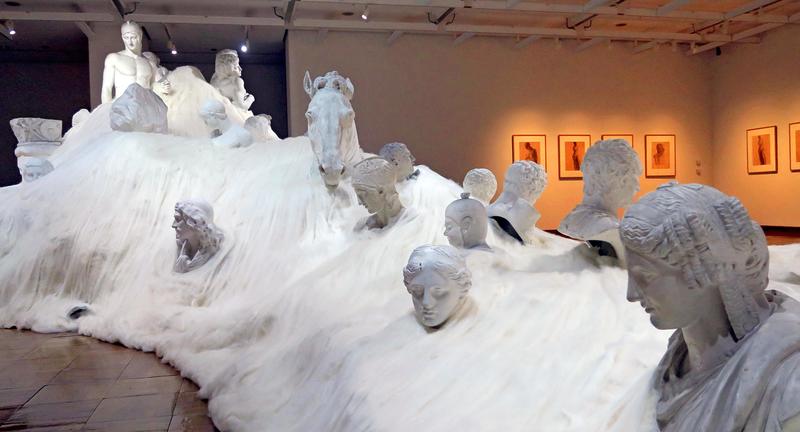
Visitors to a current exhibition at the Chiba City Museum of Art are greeted by an installation displaying a number of plaster figures amid a mass of white cotton and sheep's wool that looks like a miniature mountain or cloud.
Titled "Imperfection," the installation was created by Tsuyoshi Ozawa for his exhibition "Tsuyoshi Ozawa -- Imperfection: Parallel Art History," which runs through Feb. 25.
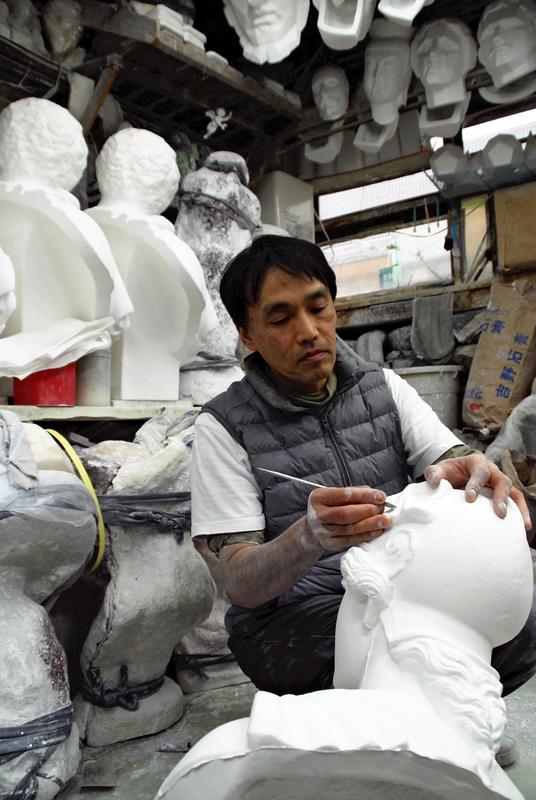
Plaster figures were created to promote the ideal beauty of classical Greco-Roman civilization, the origin of European culture. It was common to sketch these items in Europe, especially during the neoclassical period in the 18th and 19th centuries.
In Japan, the practice of using plaster figures for drawing lessons was introduced in the early Meiji era, when teachers from Italy were invited to teach at the nation's first art academy set up by the government. By the end of the 19th century, the practice was considered a basic part of art education, and therefore played a significant role in helping prospective artists develop their skill in observing subjects and making realistic depictions.
After World War II, drawing plaster figures was often part of the entrance examinations for art colleges. These plaster forms grew even more prominent as drawing them was emphasized at prep schools catering to students who wanted to enter art colleges. Such students were required to draw plaster figures over and over until they'd memorized every detail of the shapes.
As a graduate of Tokyo University of the Arts, Ozawa was among the students subject to this practice.
"I wondered why copying copies of [works of] Western art was considered necessary to develop our basic physical fitness as artists," Ozawa said, adding that this question -- which he has had since his high school days -- inspired him to create "Imperfection."
Meanwhile, publishing company Art Diver has just released a book reviewing how plaster figures have been used in the nation's art circles from the Meiji period through today. Written by art historian Shinya Araki, "Sekko Dessan no Hyakunen" (100 years of drawing plaster figures) was originally published as an academic book in December 2016 by Mie University Press, with just 300 copies printed.
According to Araki, Japan developed its own approach to drawing plaster figures by incorporating various principles -- such as seeing the practice as a way to learn classical art before seeking modernism -- whereas in the West, sketches of these figures were made with the aim of depicting ideal human figures. Araki also discusses in detail how drawing plaster figures was associated with entrance exams and the prep school industry, and examines the history of criticism of the practice.
Araki's book is notable because there are almost no previous studies available that review the nation's history of using such figures for drawing lessons. Many books have been published on the practice so far, but they focus on the technical aspects of making such sketches.
Drawing plaster figures for entrance exams has been required less often in recent years, as art colleges are more interested in how distinctively their prospective students can express themselves, rather than how precisely they can copy something. This factor, along with the chronically low birthrate, has resulted in lower demand for plaster figures, according to Soji Wakimoto, who runs Hori Sekko Seisaku, a maker that has been in operation for about 70 years in Toshima Ward, Tokyo.
Wakimoto said his company is now the only one in the field that regularly produces and sells plaster figures, whereas there were more than 10 such makers in the 1970s. He started selling online eight years ago in an effort to stimulate demand for purposes other than for use as educational materials.
"The time has passed when students were assigned to drawing plaster figures at prep schools, like they had to field 1,000 ground balls in baseball practice," Araki said. "Now, an increasing number of artworks cast a critical eye on these figures."
In addition to Ozawa's "Imperfection," another example is "Sekko Boys" (Plaster boys), a 2016 comical TV anime about a woman who graduates from art college and has nightmares about drawing plaster figures. She gets a job at a showbiz agency, only to find she has to manage a boy band in which the members are plaster busts.
"It is significant to take a look at, and get discussions started on, the history of drawing plaster figures, as the topic hasn't been in the spotlight before," Araki said. "That will help us better understand the history of the nation's art education and how we accepted Western culture."
Read more from The Japan News at https://japannews.yomiuri.co.jp/