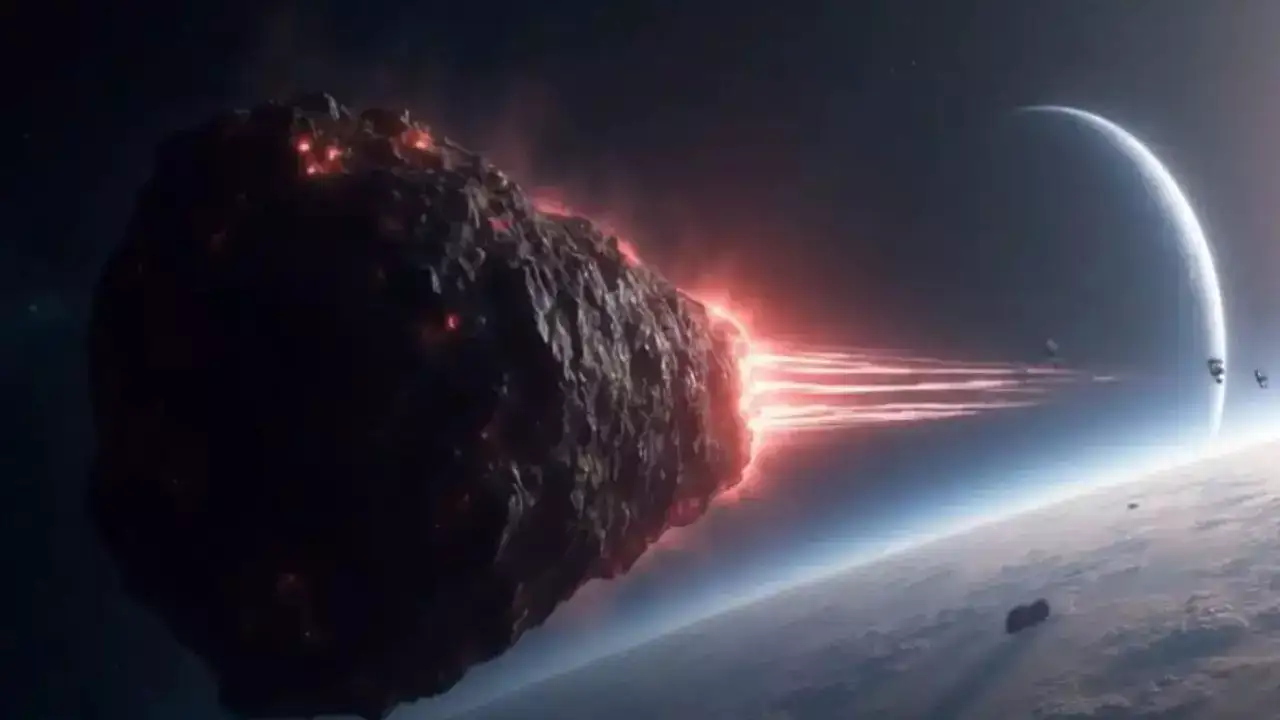
3I/ATLAS Interstellar Comet Found Rich in Methane but Dead Silent on Radio Signals: Somewhere between curiosity and cosmic awe lies the story of 3I/ATLAS — an interstellar comet that arrived from another star system and refused to be ordinary. Discovered on July 1, 2025, by the ATLAS survey in Chile, this object became only the third confirmed interstellar visitor ever recorded in human history. It moved fast — around 137,000 miles per hour — and it carried chemistry nobody expected.
Scientists across multiple institutions raced to observe it before it disappeared forever into the deep dark. What they found did not point to alien technology. But it pointed to something arguably more profound: a window into how planets form around other stars, written in frozen gas from a world billions of years old. The 3I/ATLAS interstellar comet is now heading back out past Jupiter, but the data it left behind is already rewriting what astronomers thought they knew.
Silent on Radio Signals but Rich in Methane: What Is 3I/ATLAS Trying to Tell Scientists About Distant Star Systems?
The James Webb Space Telescope made history when it captured its first mid-infrared chemical fingerprint of an interstellar object. Using the MIRI instrument, observations conducted in December 2025 detected water vapor, carbon dioxide, atomic nickel — and methane. That last detection was a first. No interstellar object had ever shown confirmed methane before. But the real story is not just that methane was there. It is how much of it there was.
The methane-to-water ratio in 3I/ATLAS is far higher than anything typical seen in comets born inside our Solar System. Carbon dioxide tells a similar story. JWST confirmed that the comet's CO₂-to-water ratio sits around 8:1 — among the highest ever recorded in any comet, interstellar or local.
Earlier near-infrared observations from August 2025 had already clocked this ratio at 4.5 standard deviations above what normal long-period comets show. These are not marginal differences. These are chemically extreme numbers. Both ratios together point to a formation zone that was significantly colder and far more distant from its host star than the equivalent region where our own Oort Cloud comets were born.
There is another detail that reveals the comet's layered interior. Water vapor spread much farther from the nucleus than methane or carbon dioxide did. Scientists interpret this as a structural clue: the methane is buried deeper beneath the surface. It was locked away in unprocessed subsurface ice for potentially billions of years. Only as the Sun's heat stripped away the outermost material did the methane begin to emerge — rising from a layer of the comet that had never been touched by a star before.
Why Radio Silence from 3I/ATLAS Is Scientifically Valuable — Not Disappointing
When an object arrives from another star traveling at those speeds, it is understandable that some people ask whether it could be artificial. The SETI Institute asked that question properly, methodically, and with the best available tools.
The Allen Telescope Array spent seven hours scanning 3I/ATLAS across a wide band of radio frequencies. The result: no radio transmitter stronger than 10 to 110 watts detected anywhere near the object. To put that in context, the only two interstellar objects in existence that actually do emit artificial radio signals are the Voyager probes — human-made, running on roughly 23 watts each, and already fading fast.
The Breakthrough Listen program at the Green Bank Telescope ran the most sensitive radio scan conducted on any interstellar object to date. They found no isotropic continuous-wave transmitters above 0.17 watts across the 900 to 1670 MHz range.
Every candidate signal traced back to local human interference. The MeerKAT telescope joined the search and detected hydroxyl — which forms naturally when sunlight breaks water ice apart — but nothing artificial. Multiple telescopes, multiple methodologies, total silence on the technological front.
What this actually demonstrates is the maturity of modern technosignature science. Researchers are not disappointed by the null result. As SETI co-author Valeria Garcia Lopez noted after the study, the exercise proved how realistic it now is to detect a signal if one existed, using present-day technology. The infrastructure works. The sensitivity is real. The silence means the comet is a comet — and that conclusion carries its own extraordinary weight.
Where Did 3I/ATLAS Actually Come From?
The interstellar comet 3I/ATLAS appears to be old — genuinely ancient in a way that reorients perspective. Dynamical models estimate the object's age somewhere between 3 and 11 billion years. Some analyses push toward 7 billion years. That would make its ice older than Earth itself. The frozen methane JWST detected may have crystallized in a protoplanetary disk that no longer exists, around a star that may have long since burned out or shifted beyond recognition.
Isotopic measurements add another layer. Research submitted to Nature Astronomy found that the deuterium-to-hydrogen ratio in 3I/ATLAS's methane is roughly 14 times higher than the same ratio in comet 67P measured by the Rosetta spacecraft — the only other comet where this comparison was possible.
High D/H ratios in this context indicate formation in extremely cold, radiation-shielded conditions deep inside an ancient protoplanetary disk or interstellar cloud. The 3I/ATLAS interstellar comet did not form anywhere near a warm inner zone. It formed in conditions of deep cold, under a star that operated very differently from our Sun.
This is what makes the silence on alien technology so fitting. The comet is not a message. It is something better: a sample. It is a physical fragment from a planetary system science cannot visit, delivered to our doorstep by the gravitational mechanics of the galaxy itself.
The chemical fingerprint now locked into published papers represents the most detailed record of extrasolar material ever assembled — obtained not by launching a probe across light-years, but by pointing existing telescopes at a visitor that came here on its own.
As 3I/ATLAS moves beyond Jupiter and fades into the dark, what remains is a shifted understanding. Planetary systems across the galaxy may share the same broad architecture of frozen volatiles, but the ratios, the depths, the isotopes — those vary in ways that carry the specific signature of where and when something formed. This interstellar comet arrived carrying chemistry we do not make in our Solar System. That fact alone is enough to rewrite a chapter of astronomy.