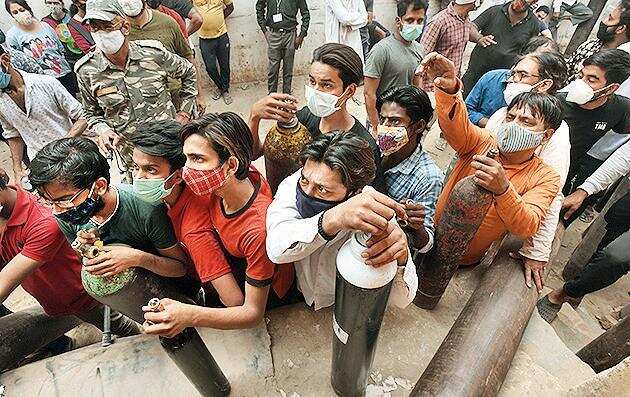
NEW DELHI: As Delhi battled the second and its deadliest wave of Covid-19 cases, the capital’s health infrastructure was stretched to the limit. Even as the number of cases and positivity rate have dipped, Delhi government-run hospitals are preparing for a likely third wave with concepts like ‘ICU at hospital doorsteps’ to save as many lives as possible.
The city’s biggest Covid facility, Delhi government-run LNJP Hospital, is working on a war footing to provide centralised oxygen supply to all Covid beds in the hospital, along with working on processes to ensure patients with severe symptoms get intensive care immediately.
“Changes are being made and arrangements will be in place so that sick patients are immediately shifted to ICUs and those whose oxygen saturation level is above 90 are taken to other Covid wards. Protocols and guidelines are being made so that there is absolutely no room for confusion now,” said Dr Suresh Kumar, medical director of LNJP Hospital.
While new protocols will ensure Covid-19 patients with severe symptoms are shifted from the emergency ward to ICUs swiftly, Delhi government’s Rajiv Gandhi Super Speciality hospital is bringing the ICU at its doorsteps.
Dr BL Sherwal, medical director of the hospital, said that “a Covid emergency ward has been made at the hospital, which has oxygenated beds and life-saving equipment to provide treatment to serious patients right from the moment they are brought to the hospital, even as necessary formalities are taken care of simultaneously.”
“The emergency ward that we have made has a provision that the ambulance can come inside. Now, treatment begins immediately and right at the door as soon as the patient gets down from the ambulance,” he said. “We have made an ICU there itself.”
“Initially, patients faced some time lag between shifting and being provided oxygen. During the second wave, there were many problems and we are improving wherever there were issues,” the medical director said.
“Apart from the triage system and ICU facilities, we will ensure that at least five beds are available at any point of time in the emergency ward. The emphasis will be on shifting patients who have arrived earlier to ward or ICU beds as soon as possible, to maintain the availability,” Dr Sherwal said.
“We already have 500 separate ICU beds at Ramlila Ground for adults and are now creating 150 paediatric ICU beds, keeping in mind the third wave,” Dr Suresh Kumar said.
“Also, while LNJP already has 2,000 beds for Covid-19 patients, 1,500 of these are oxygenated and work is now going on very fast to connect the rest of the 500 Covid beds to the central liquid medical oxygen supply through pipelines,” Dr Kumar said.
“This will ensure all the 2,000 beds are connected to the pipeline and there will be no need for oxygen cylinders. Also, ventilators or BiPAP machines can work on these oxygenated beds,” he said.