Iceland were close to breaking their tournament duck last time. Having confounded expectations by finishing second in their qualifying group for last summer’s World Cup, they were on the brink of making their first appearance on the big stage. Yet a sizeable obstacle was blocking their route to Brazil.
Iceland’s hopes died against Croatia in the play-offs. Niko Kovac’s side were too strong and the stakes were too high. The challenge came too soon for Lars Lagerback’s young team. The magnitude of the occasion was too much for Iceland, who had no experience of playing at that level, and Croatia gave them an object lesson in how to play under pressure, winning 2-0 on aggregate despite losing Mario Mandzukic to a red card in the first half of the second leg. While Croatia headed off to Brazil, Iceland went away to lick their wounds.
Yet there was no moping, no feeling sorry for themselves. Just reaching the play-offs was an outstanding and unprecedented achievement for Iceland given that they were among the lowest seeds in pot six when the qualifying draw was made in June 2011 and they have gone from strength to strength since losing to Croatia. One door closed, so they have spent the past year kicking another one down. A place at Euro 2016 is theirs to lose.
The disappointment of failing to qualify for the World Cup has not knocked them off their stride. It has had the opposite effect. Iceland have continued to grow and if they beat Czech Republic in Reykjavik on Friday night, they will be top of Group A. They are five and seven points clear of Holland and Turkey respectively.
It will not be easy. Iceland were beaten by the Czechs in November, losing 2-1 despite scoring an early goal, and Pavel Vrba’s side are unbeaten in five matches. They will be awkward opponents. Vrba is thinking of fielding Tomas Necid or Milan Skoda up front. He is ready for a battle. “They are both a similar type of striker – I would say ‘Kollerish’,” Vrba said, recalling the 6ft 7in former Czech Republic striker Jan Koller. “They like battling for the ball. Iceland’s defenders are uncompromising and physical, so that might be an advantage.”
Yet the Czechs will not relish the trip to Reykjavik. Iceland beat Turkey 3-0 at home in their opening victory and followed that up with their memorable 2-0 victory over Holland. The Dutch were stunned. They had never lost to Iceland before.
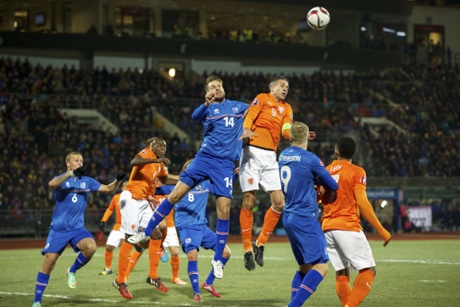
The result sent shockwaves around Europe. Holland were semi-finalists at the World Cup. They beat Spain 5-1. They have Arjen Robben and Robin van Persie. They are not supposed to lose to Iceland.
Yet it was no fluke. Iceland are a tough and well-drilled side. They work hard for each other and they have kept four clean sheets in their first five qualifiers. Only Belgium have a better defensive record. Although they do not concede possession willingly, Iceland are content to play on the break if it represents the best chance of winning.
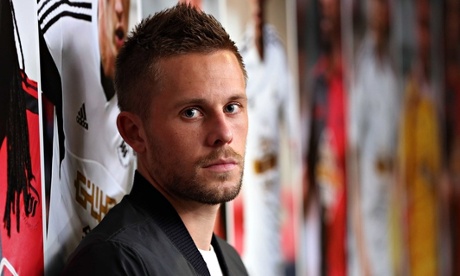
However, they are not defensive. Only Belgium, Spain, England, Croatia and Poland have scored more than their 12 goals. Gylfi Sigurdsson, their two-goal hero against Holland, is their top scorer with four goals. The Swansea City midfielder has accepted responsibility.
Along with Kolbeinn Sigthorsson and Birkir Bjarnason, Sigurdsson has been Iceland’s most important player, with his eye for goal, creativity, ability to keep the ball in tight situations and threat from set pieces. The one worry is that Iceland become too reliant on him. There may come a time when he needs the strikers to accept some of the load.
Eidur Gudjohnsen, Iceland’s greatest ever player, is still a member of the squad at 36. Although he is no longer their most influential player, the former Chelsea and Barcelona forward has plenty to teach his younger team-mates.
His international career appeared to be over last year and he missed the first four qualifiers, yet he was recalled by Lagerback after joining Bolton Wanderers in December and he marked his return by scoring the opening goal in Iceland’s 3-0 victory in Kazakhstan in March.
Building for the future has moved Iceland into this position. They were once an afterthought, whipping boys who could never dream of qualifying for a major tournament. Now a new generation has emerged; the majority of this squad has progressed through the youth teams together.
For years the harsh Icelandic winters made it impossible for youngsters to train and develop. They have had good players in the past, but rarely at the same time and rarely as the result of the country’s infrastructure. Natural talent always finds a way to thaw out.
That changed when indoor artificial pitches were introduced. “They’re probably the first generation able to play all year round in Iceland,” Gudjohnsen told the Guardian in 2013. “They’re coming through now and we’re reaping the benefits.
“Since then we’ve got approximately another 10 across the country. Football used to be played five months a year here – six months maximum, and then it just used to be pre-season or indoor football on wooden floors. It wasn’t the same. This is the first generation able to play all year round growing up. They moved abroad, all of them, at a fairly young age to develop their own careers.”
Now that children can train throughout the year, this should not be a flash in the pan. “It is the main reason for the steady flow of Icelandic talent to other countries,” Vidir Sigurdsson, the sports editor of Morgunbladid, says. “We have around 100 footballers playing professionally abroad – not so bad for a nation of 320,000!”
The appointment of the experienced former Sweden manager Lagerback has also been a crucial factor in Iceland’s surge. “Lagerback came to Iceland at exactly the right moment to guide those promising players with his experience and structure,” Vidir Sigurdsson says. “His assistant Heimir Hallgrimsson, who now is joint-manager with Lagerback, is also a clever coach who makes a strong duo with the Swede. Lagerback has seen it all with Sweden, and from day one he has been instilling the belief and confidence that this team has the ability to go to a major competition.”
Iceland still have to travel to Holland and Turkey. Yet that belief will become even stronger if they beat the Czech Republic.