New draft contract terms from US Immigration and Customs Enforcement (ICE) would place thousands of immigration detention beds beyond the reach of state and local health and safety oversight, setting up fresh legal battles across four states.
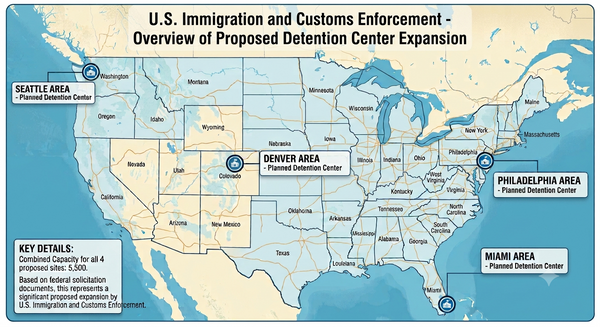
According to federal procurement documents reviewed by WIRED, ICE has proposed new agreements covering 5,500 detention beds that state local and state laws 'shall not apply' to facility operations. The draft terms were published on 10 July, one day after a federal judge ruled that a contract could not override state law in a case involving the Tacoma detention centre in Washington.
US District Judge Benjamin Settle ordered the operator of the Tacoma facility to allow Washington state health inspectors access, rejecting the argument that a federal contract could block inspections.
'Preemption requires Congressional intent, not a contract,' Settle wrote, adding that the agreement 'cannot preempt state law, even if it purports to.'
Although that ruling is still being challenged on appeal, the proposed ICE contracts would extend similar language to facilities in Washington, Colorado, Florida and Pennsylvania.
Facilities Match Existing GEO Sites
The contracts are presented as a competitive bidding process, but the requirements appear tailored to existing detention centres.
Facilities would have to begin housing detainees within 30 days of a contract award, leaving little realistic opportunity for new operators to participate. The required bed numbers and locations closely match centres already run by private prison company GEO Group in Tacoma, Aurora, Pompano Beach and Philipsburg.
Several of those operating agreements are due to expire over the coming months. In Pennsylvania, a new direct federal contract could bypass Clearfield County's role in renewing the local agreement before its September deadline.
Inspection Powers Could Be Narrowed
The proposal also shifts several detention centres to ICE's updated National Detention Standards introduced in June, replacing stricter 2011 performance-based standards previously used at most of the sites.
Under the draft framework, inspections would be limited to ICE officials, federally approved third-party inspectors and other federal personnel, effectively excluding state and local authorities. The standards also allow facilities to operate indefinitely with staffing levels as low as 85%, including medical staff, and include other operational changes intended to reduce compliance burdens on contractors.
The Tacoma dispute illustrates why the issue has become so contentious. Washington officials said they were denied entry 10 times over three years despite thousands of detainee complaints. The judge's order granting inspection access has since been temporarily paused while the appeal continues.
Wider Strategy Faces Scrutiny
The proposed contracts come amid broader tensions between federal immigration authorities and states seeking greater oversight of detention facilities.
In California, the Department of Homeland Security recently purchased two former CoreCivic detention centres after court fights over local inspection rights. DHS spokesperson Lauren Bis previously blamed what she called 'sanctuary politicians' for making private detention facilities financially difficult to operate.
Critics argue the new language could force multiple states into lengthy legal fights similar to Washington's. Supporters of the federal approach, meanwhile, are expected to argue that immigration detention remains a federal responsibility requiring uniform operating standards.
With appeals still pending and contract deadlines approaching, the proposed framework appears likely to keep the dispute over oversight of ICE detention facilities in the courts for months to come.