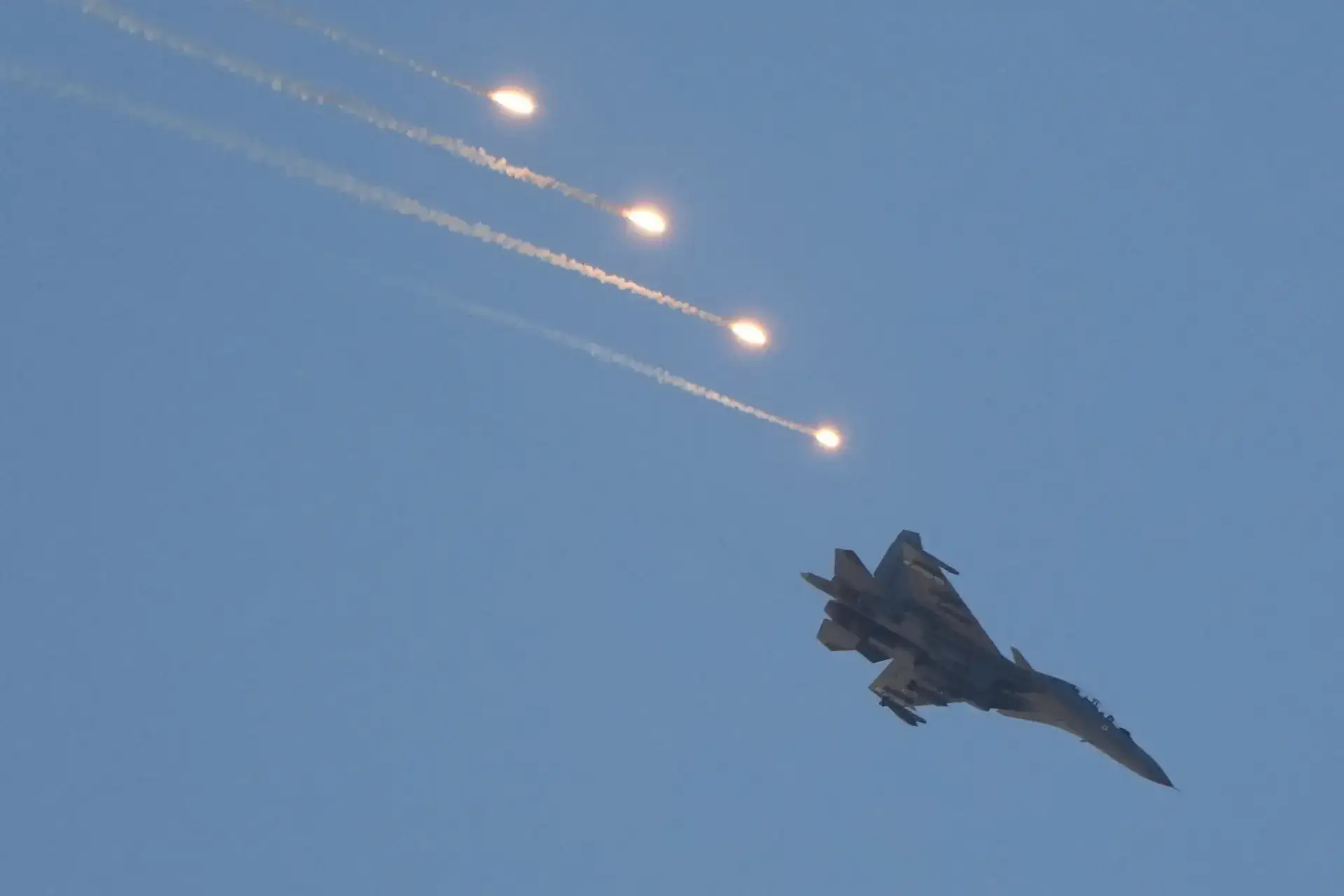
The Indian Air Force (IAF) has retained its position as the world's third most powerful air force for the fifth consecutive year in the World Directory of Modern Military Aircraft (WDMMA) 2026 Global Air Power Rankings. The rankings place the IAF behind only the United States and Russia, while keeping it ahead of China's People's Liberation Army Air Force (PLAAF) in seventh place and the Pakistan Air Force (PAF) in 18th.
The WDMMA evaluates 129 air services across 103 countries and analyses more than 48,000 military aircraft worldwide. Its proprietary True Value Rating (TVR) system assesses fleet size along with aircraft mix, technological sophistication, logistics, modernisation and overall operational capability.
IAF ranks sixth among all global military air arms
According to the WDMMA, the IAF ranks third among the world's air forces and sixth overall when air arms of the Army, Navy and Air Force are considered together.
The top overall rankings are led by the US Air Force, followed by the US Navy, Russian Air Force, US Army, US Marines and the IAF. China's air force is ranked seventh, followed by Japan, Israel and France.
| Rank | Air arm | Aircraft | TVR |
|---|---|---|---|
| 1 | US Air Force | 5,004 | 242.9 |
| 2 | US Navy | 2,504 | 142.4 |
| 3 | Russian Air Force | 3,677 | 114.2 |
| 4 | US Army | 4,333 | 112.6 |
| 5 | US Marines | 1,211 | 85.3 |
| 6 | Indian Air Force | 1,716 | 69.4 |
| 7 | Chinese Air Force | 3,733 | 63.8 |
| 8 | Japan Air Self-Defense Force | 756 | 58.1 |
| 9 | Israeli Air Force | 581 | 56.3 |
| 10 | French Air Force | 511 | 55.3 |
Quality of fleet outweighs numerical strength
The IAF currently operates a fleet of 1,716 aircraft, including 542 combat and attack aircraft spread across seven different types. Although the Chinese air force has a larger fleet of 3,733 aircraft, the WDMMA places greater emphasis on the quality and balance of an air force rather than numerical strength alone.
The IAF's inventory includes 498 helicopters, comprising 222 Mi-17 helicopters and 111 indigenously developed HAL Dhruv and Rudra platforms. It also operates 282 transport aircraft, 374 trainer aircraft and 20 special mission aircraft, including airborne early warning systems, intelligence-gathering platforms and aerial refuelling assets.
According to the WDMMA analysis, fighter aircraft account for 31.6 per cent of the IAF's fleet. In comparison, fighter aircraft make up 32 per cent of the US Air Force inventory, while combat aircraft account for about 41 per cent of the US fleet when bombers and close air support aircraft are included.
Planned acquisitions to strengthen fighter fleet
The IAF's fighter squadron strength currently stands at 29. India plans to acquire 114 Rafale fighter aircraft from France, which is expected to increase squadron numbers in the coming years.
The air force already operates 40 Tejas Mark-1 aircraft and has placed orders with Hindustan Aeronautics Limited (HAL) for 180 Tejas Mark-1A fighters.
Future inductions to support long-term modernisation
The induction of Rafale and Tejas Mark-1A aircraft is expected to enhance both the size and combat capability of the IAF's fighter fleet. India is also developing the fifth-generation Advanced Medium Combat Aircraft (AMCA), with induction likely to begin after 2029.
More than 200 Jaguar, Mirage 2000 and MiG-29 fighter aircraft are expected to be phased out during the 2030s, making the induction of Rafales, Tejas Mark-1A fighters and the AMCA a strategic priority for the country.
(With inputs from TOI)