
When I first heard Ford was working on a $30,000 electric truck in the wake of F-150 Lightning production coming to an end, my first question was simple: how?
How do you go from a truck that most people are looking at in the $70,000–$80,000 range and bring it down by nearly half? How do you do so without compromising EV performance? And how do you do it fast enough for people to care?
To find out, I went inside Ford’s EV Development Center in Long Beach, CA, where a specialized team of engineers are rethinking vehicle construction from the ground up.
It starts with the development of Ford’s all-new “Universal EV” (“UEV”) platform intended to support a high-volume family of affordable vehicles. The first is a midsize truck, about the size of a Maverick, slated for a 2027 release.
At no point did I get to see a complete product, nor was I allowed to capture photographs inside the facility, but nearly every demonstration featured different elements with fairly obvious respect to the confirmed form factor.
“The best part is no part”
The UEV engineers spoke about reducing parts, reducing complexity and in some cases eliminating components entirely. One phrase that kept coming up on the tour: “the best part is no part.”
Instead of traditional layered assembly where workers build step-by-step inside a partially completed frame, they’re experimenting with more modular, unicasting construction at the EVDC. The idea, production-wise, is for major components to be built separately and then brought together towards the end of the assembly process.
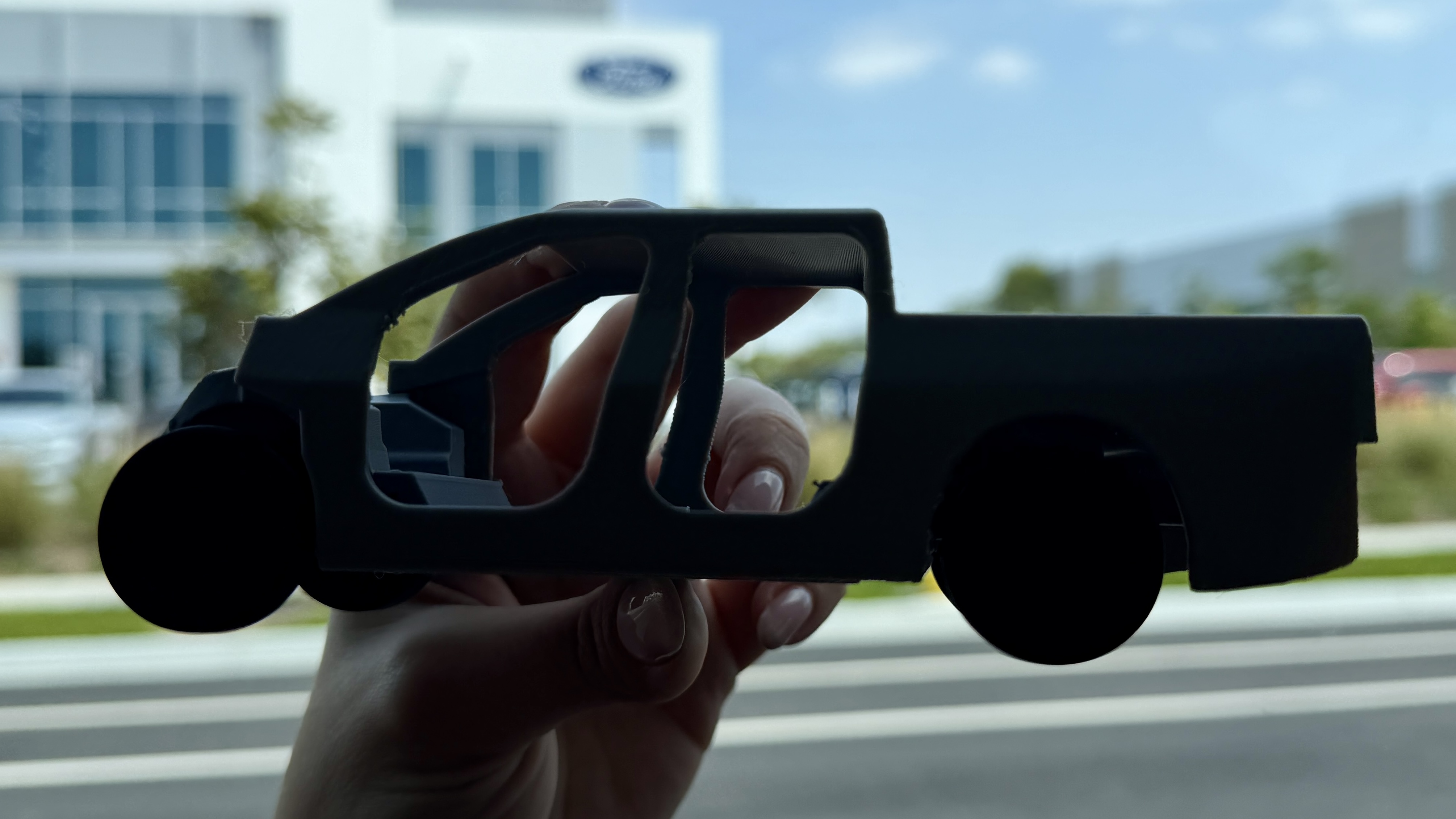
The company is also redesigning its tooling and prototyping pipeline to move faster. In one area, I saw foam and clay models being rapidly cut, reshaped and iterated in-house. In this facility, teams can test ideas in real time, adjust and immediately feed those changes back into design and manufacturing.
That efficiency extends into testing as well. Ford has built out environmental chambers capable of simulating extreme conditions, from subzero cold to desert heat. Vehicles (or in many cases, individual components) are pushed through stress cycles that replicate years of use in a fraction of the time. Even towing, charging and thermal load scenarios can be recreated back-to-back in the same space.
Rewiring a Ford EV
Perhaps the biggest technical leap is the shift to a 48-volt zonal wiring system. By moving away from the industry-standard 12-volt system, Ford shortened the wiring harness by over 4,000 feet and reduced vehicle weight by 22 pounds of copper alone. Fewer wires can mean lower cost, easier assembly and potentially easier repairs down the line.
Lower complexity usually means lower repair costs, fewer production delays and more predictable pricing. It also means iteration and improvement can be executed at a faster pace.
There’s also a major focus on in-house battery development in further pursuit of lowering costs. Instead of relying entirely on external suppliers for key pieces like cell design, pack integration and early validation, Ford brought more of that development inside its own labs.
That includes everything from designing battery cells tailored to its new EV platform, to assembling packs and running early-stage testing under the same roof.
What Ford’s EVDC *actually* tells us
So what does this all actually mean for people waiting for the cheaper electric truck?
Lower complexity usually means lower repair costs, fewer production delays and more predictable pricing. It also means iteration and improvement can be executed at a faster pace.
There is still a long road to 2027, but inside the labs at Long Beach, the path to the $30,000 EV finally looks clear.