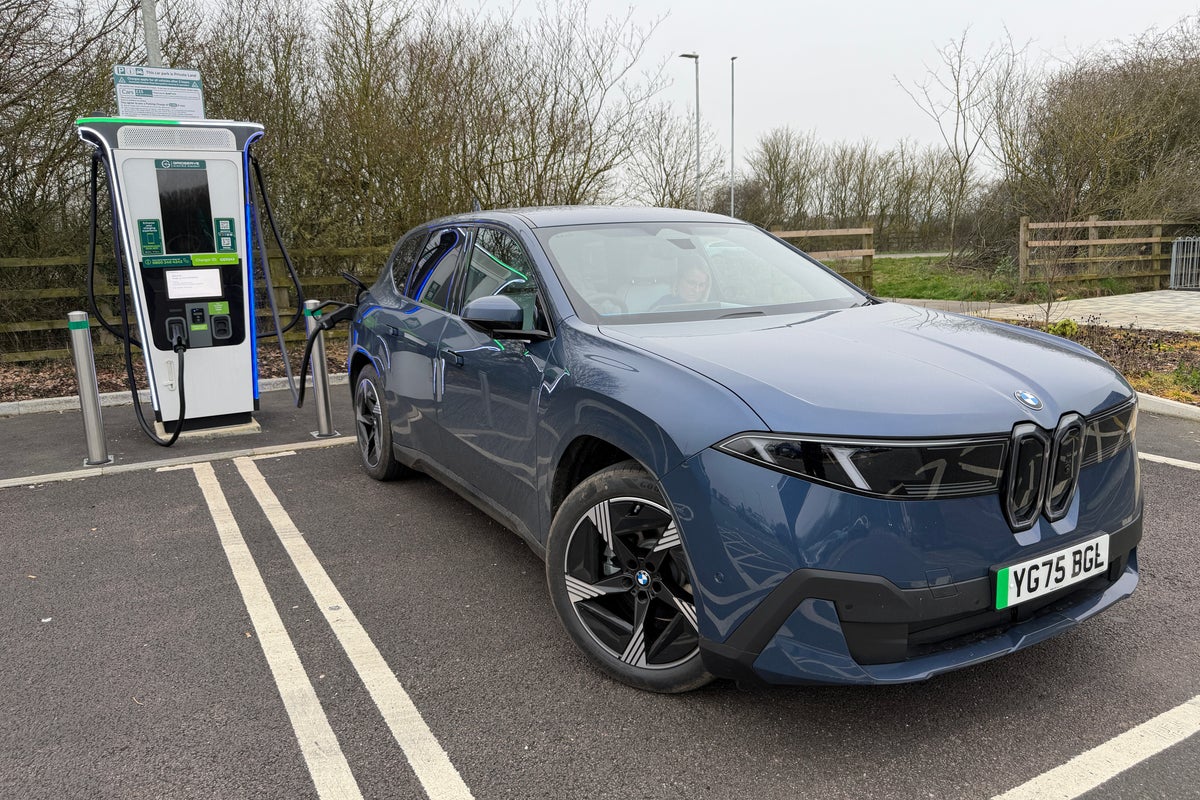
Game-changer is a phrase that’s overused in the car world – especially by automotive marketing teams. But, this word could be used to describe the BMW iX3.
Two things are key to the iX3’s appeal: its claim of a 500-mile range and super-fast charging, which can apparently add 231 miles of range in as little as ten minutes.
Combined, they overcome some of the biggest barriers that currently exist for potential electric car owners. And the good news is – with the arrival of the new BMW i3 saloon and more cars to come using the iX3’s ‘Neue Klasse’ tech – those barriers are set to be banished for good.
However, I’ve been around long enough to know that the figures car companies claim and what they actually achieve can be very different. And that’s the same, whether we’re talking 0 to 60 times, ride comfort, practicality, mpg and now, range.
The best way to put the iX3 and its claims to the test is to live with it. So, that’s what I did for 10 days – covering over 1,000 miles in the process.
Key to my assessment was one very particular, and very personal, challenge. I regularly cover a 405-mile journey from my home in South Buckinghamshire to Liverpool and back on the same day – yes, for football. Sometimes it’s worth it, sometimes it’s not (and yes, I’m in the ‘Arne Slot out’ camp).
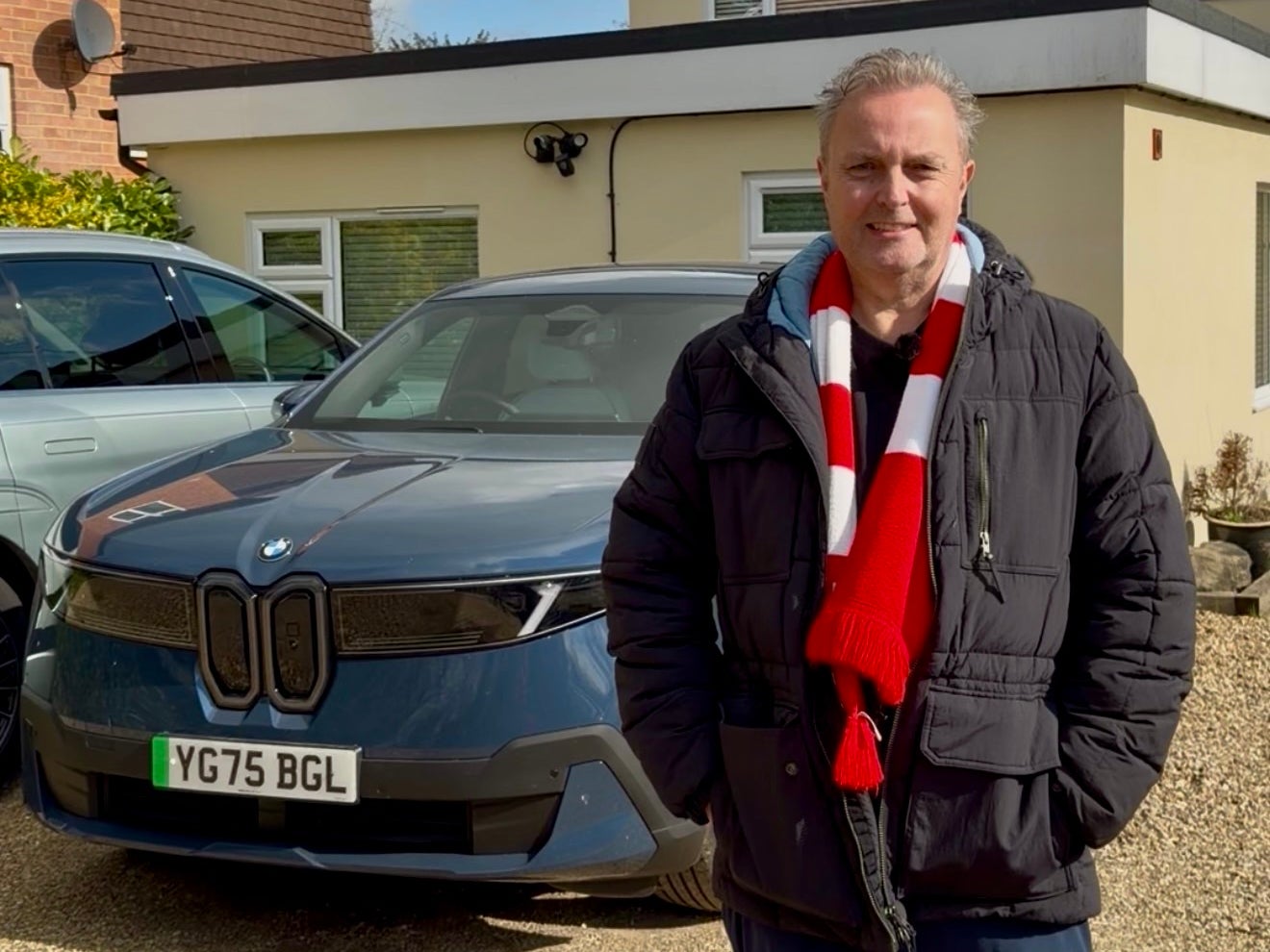
I want to be able to drive to Liverpool and drive straight home again, hopefully happy. I don’t want to stop for fuel – or charging – which is why I rarely do the journey in an electric car.
Could the iX3 do what other EVs can’t and fulfil my dream of having an EV I can charge at home (where a full charge on a low-rate tariff would cost me less than nine quid – in theory for 500 miles driving) and get me to Liverpool and back without stopping?
Let’s start with some context first. That 500-mile range claim is based on an ‘official’ WLTP test cycle that every new car has to go through. WLTP stands for Worldwide Harmonised Light Vehicles Test Procedure and is a 30-minute laboratory test cycle that’s designed to show an EV’s range and efficiency. It covers just over 14 miles over four dynamic phases: low, medium, high, and extra-high speeds, supposedly simulating urban, suburban, and highway driving.
The official WLTP tests give us a level playing field which we can use for comparative purposes, but that playing field might not be a pitch we play on in the real world
As with all WLTP tests – for EVs, hybrids or petrol and diesel cars – they give us a level playing field which we can use for comparative purposes, but that playing field might not be a pitch we play on in the real world.
The tests are more accurate than they used to be but can still be unrepresentative of the sort of efficiency figures you’ll get in the real world. And I know that ‘it doesn’t do what it says’ is the biggest gripe with new EV owners.
That said, it is possible to beat the WLTP figure if your particular driving suits an EV. Electric cars are super-efficient in stop/start traffic where energy generated during braking is fed back into the battery. So, if you’re driving around town a lot, you could well be pleasantly surprised.
On the flip side, if you’re on the motorway for long stints with the brakes not being used to recharge the battery, that’s when an EV won’t be as efficient and you’ll struggle to match the official claims. I’m not sure car dealers explain that to you in the showroom.
Another thing to bear in mind is that a car’s computer system will base its range predictions on what’s happened, not what’s going to happen. That’s why the iX3 was showing me a potential range of just 422 miles at 100 per cent charge. I had just finished a journey with plenty of motorway miles – so not the most efficient use of an EV – but still, 422 miles would be enough for Liverpool and back.
Before Liverpool, though, it was Lincolnshire and another 400-mile round trip, this time on a mix of motorway, rural and town roads.
The iX3 performed brilliantly with loads of space, a high-quality, comfortable interior, excellent tech on board and the brilliant full-width, high-set Panoramic iDrive display that’s easier and more intuitive to use than you might think.
I seem to have more of a problem with the iX3’s slightly firm ride than my passengers did, but they had more of a problem with my, at times, enthusiastic driving – I can confirm that the iX3 drives like a BMW should and I wore a big smile at the end of the journey.
I could’ve completed the overnight trip with charge to spare but wanted to try out the fast charging. In the UK, finding a 400kW charger (the speed that the iX3 maxes out at) is a challenge, but Gridserve’s 350kW charger at Sawtry services just off the A1 would do.
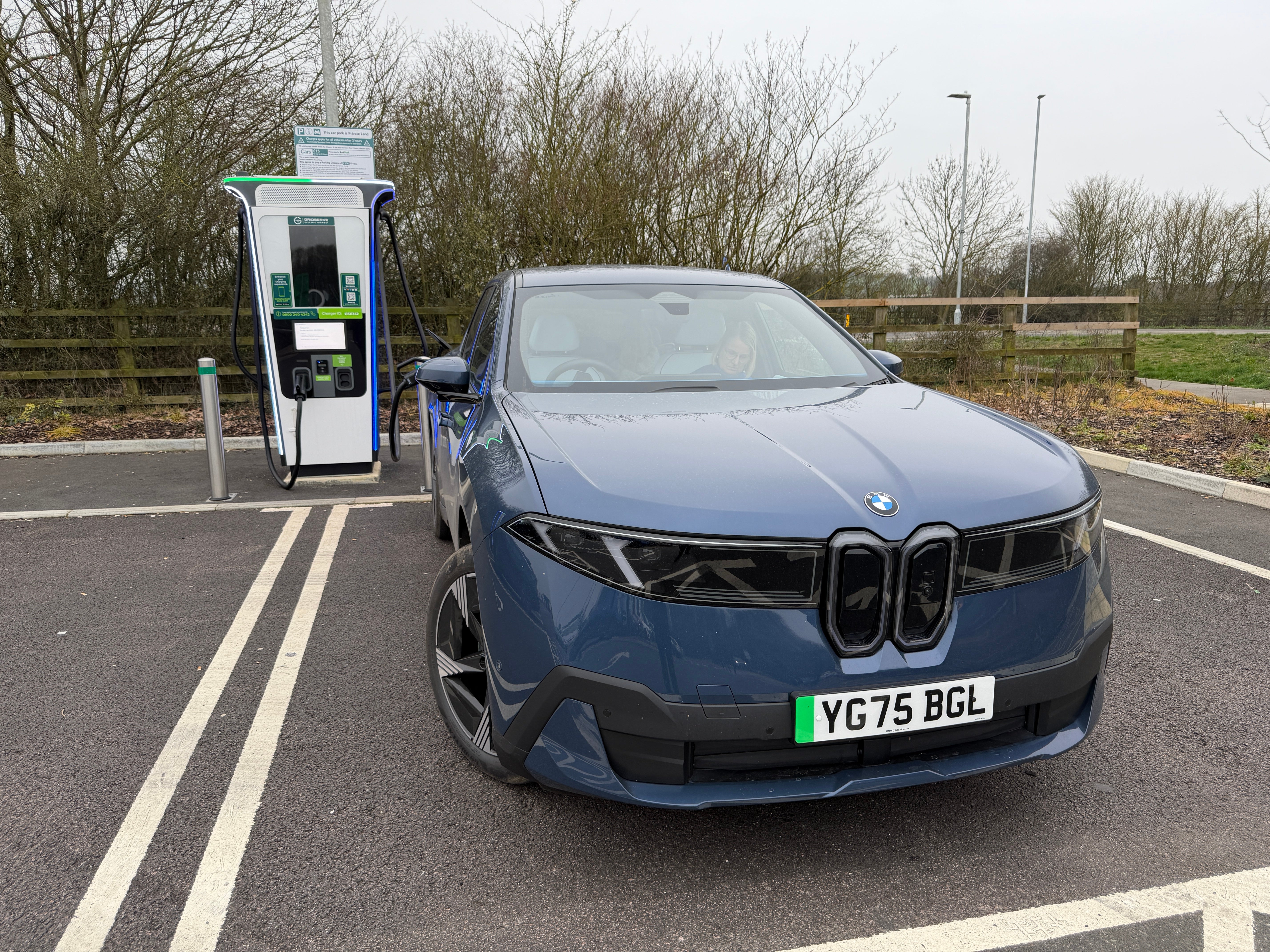
I get a real kick out of fast EV charging. It proves just how easy long-distance EV driving can be if you’re prepared to stop. And in this case, I saw charging peak at 330kW. In real terms, a quick trip into the service station for a toilet break and a bag of apples saw over 100 miles added in minutes, which was more than enough.
The kicker, though, was the price. At 89p per kWh, the cost was way more than the 8p I pay at home. Something on that score – including a levelling of the VAT (five per cent at home, 20 per cent on the go) – has to change.
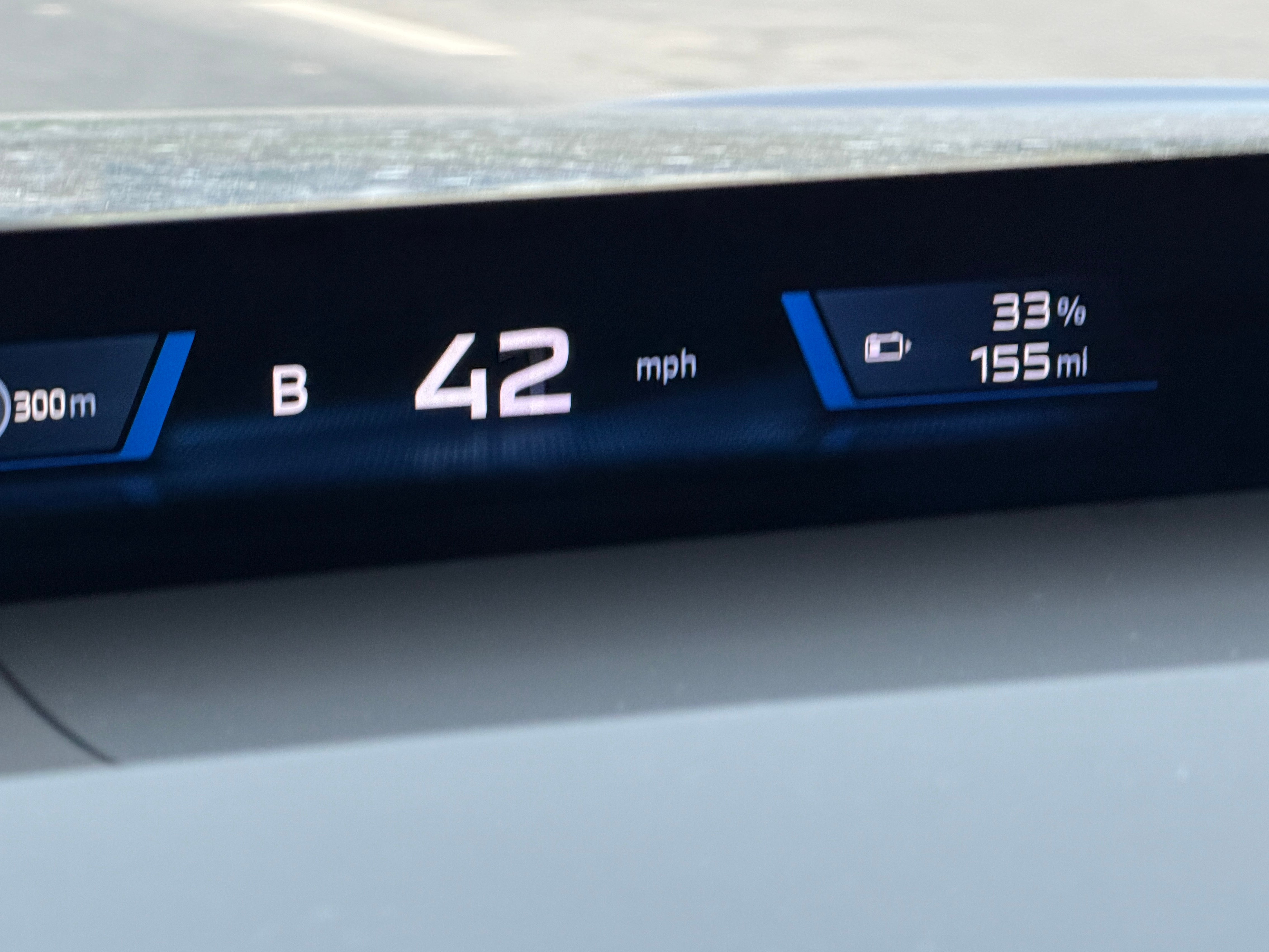
The iX3 and our trip to Lincolnshire was a resounding success. And with the car’s computer showing a 33 per cent battery level with 155 miles range left, I was very happy that it equated to a 465-mile overall range.
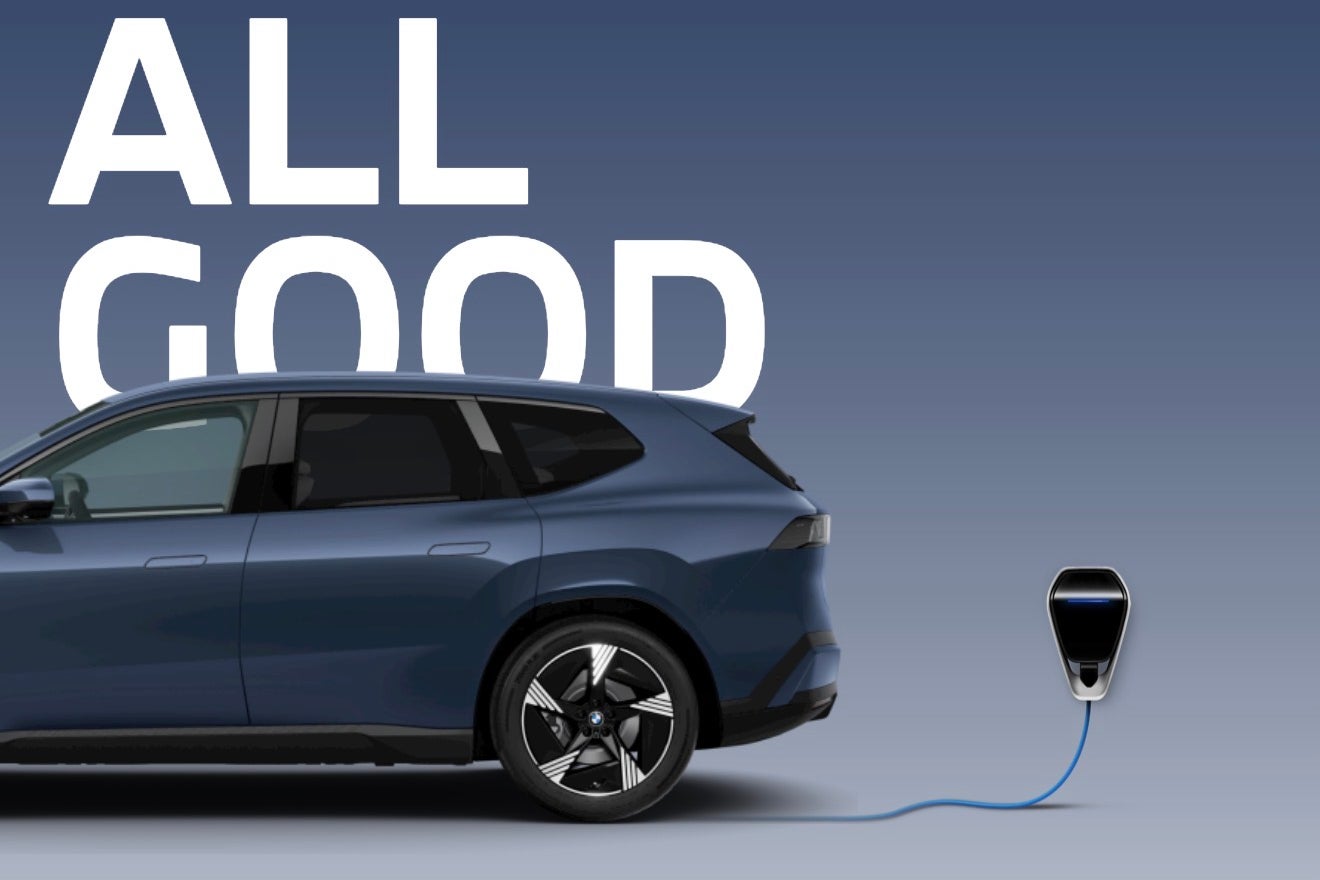
So, the Liverpool challenge: I had spoken to BMW folk about it and the fact that the vast majority of my journey would be on motorways meant the consensus was that it would be achievable. And after an overnight charge, the BMW app was showing 459 miles and the message ‘all good’. So off we went.
To make this a fair and proper test, I immediately set the car in its Efficiency Mode for the entire journey, and when on the motorway I activated the adaptive cruise control with the speed set at 70mph. And yes, I did feel like I was the slowest thing on the M40 on a Sunday afternoon.
With my son and I on board we both agreed that the iX3 is a fantastic car. He really liked the smart, modern interior and the clever lighting behind the cloth sections of the dash. And all the tech worked well.
We arrived at our friends’ house where we park in Liverpool with 48 per cent of battery power remaining. That meant the journey home was going to be interesting – not least because Tottenham scored a last-minute equaliser, with my wife and other son both Spurs fans.
Then ensued the game of watching the range read-out and frequently comparing it to how many miles the navigation said we had until we were home. For the first part of the journey, we were in good shape. However, when we got onto the M6 the computer had a rethink just as I was starting to get comfortable. I seemed to lose about 30 miles from the range, but we weren’t 30 miles closer to home. I wasn’t going to make it without a stop for a charge.
I was using the BMW’s navigation system for the journey home, and it knew, too – it kept trying to divert me to a charger at every service station I passed.
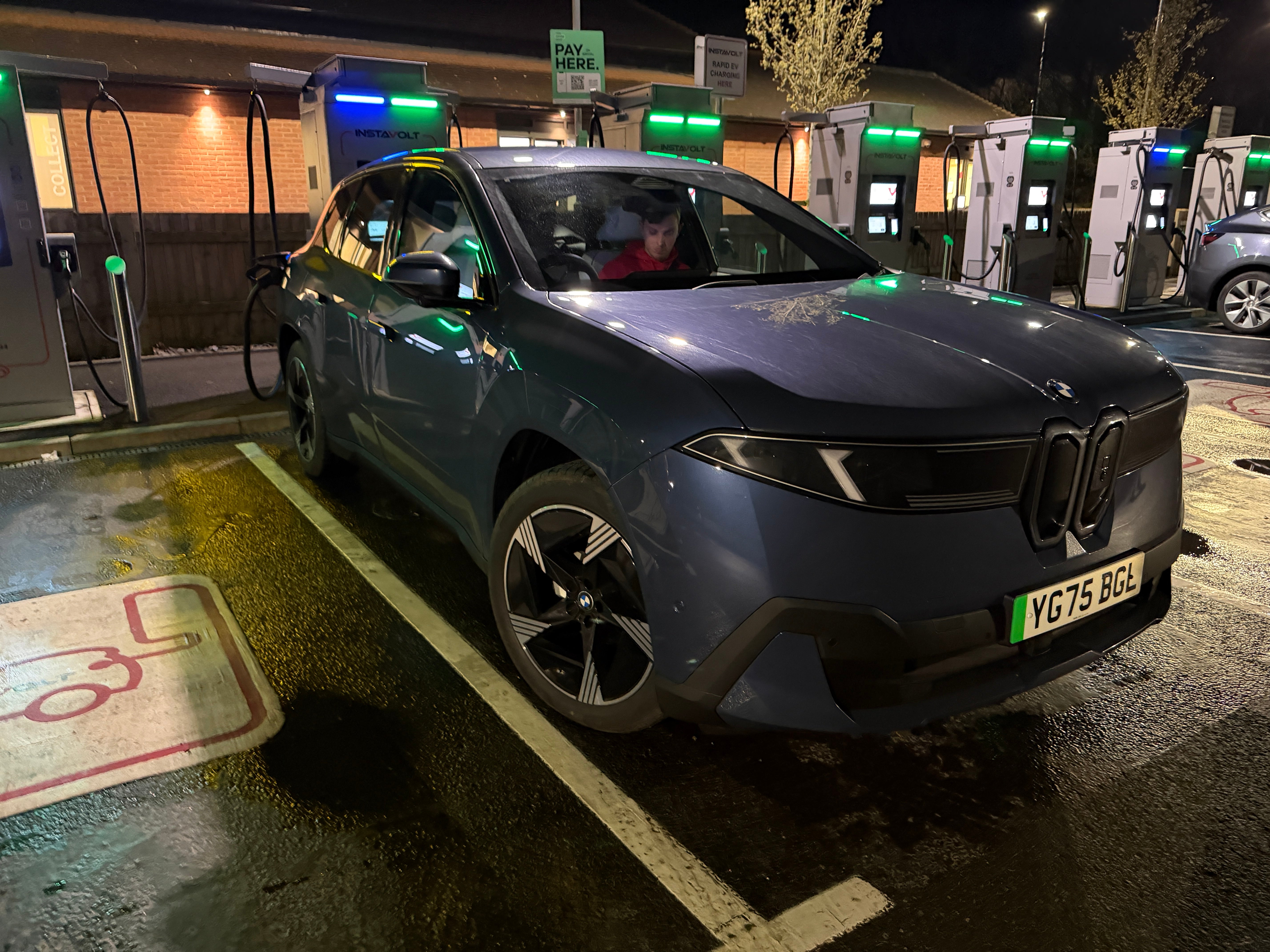
I chose an InstaVolt charger at a McDonalds outside Warwick, just off the M40. There a row of 10 160kW chargers waited for me – another 89p per kWh investment. Fuel costs on a motorway have always been a bit of a rip-off and I guess this is the price you pay for convenience. But at least the car knew where I was and what I was about to do, and kindly lifted the charging flap for me when I backed up to the charger.
I was using the BMW’s navigation system for the journey home, and it knew I wasn’t going to make it, too – it kept trying to divert me to a charger at every service station I passed
A 15-minute stop to get more than enough charge to get home was all I needed and only a Tesla Model 3 joined me, leaving eight chargers looking rather lonely.
My calculations meant that I was seeing a range of around 385 miles rather than the 500 miles BMW claims. Knowing that I was never going to get that 500 on a mostly-motorway journey eased things, but I had hoped that the BMW guys I spoke to were right and that 405 miles was achievable. It wasn’t.
So, what did BMW say? Apparently, my sort of journey would be classed as ‘ultra-high consumption’ even with the car in Efficiency Mode. That being the case, I could expect around 28 per cent less range than the claimed figure and that would work out at 360 miles – not too far off what I reckoned I had.
How does that leave me feeling about the BMW iX3? Most people drive fewer than 25 miles a day, with a 400-mile round trip without charging a rarity. I’m just a bit peculiar in not wanting to stop, but a brief break – which in reality and with the charging speeds the iX3 is capable of – was no big deal. And in any case, 360 – or 385 miles – on a single charge is mighty impressive for an EV today.
Would I recommend the iX3? Yes, I would. It’s a great car to drive and be in, while the tech works seamlessly and that range remains impressive. But as I always say to EV first timers, running an electric car needs a change of mindset. The rewards are there, but journeys need a bit more planning and you might have to stop more often, if not for long.
I’d easily be able to live with an iX3, or a Tesla (especially with its own super-reliable and slightly cheaper Supercharger network) or any other long range EV – I’d just have to allow a little bit longer on very long journeys. But for most people most of the time, they’ll get a fantastic driving experience and cheaper running costs, while the old barriers to buying an EV are fast disappearing.
I really enjoyed my time with the iX3 – if I was in the market for that kind of car at that price, it’s one I’d seriously consider.
BMW i3 first look: I’ve seen the new electric 3 Series
BMW’s Alpina brand will aim at Bentley, sitting between M models and Rolls-Royce
DS No7 arrives with up to 460-mile range as French brand reinvents its best-selling SUV
Audi revives A2 name for new entry-level electric model due this year
Jaecoo’s cut-price Range Rover rival now comes in black
Bentley ploughs on with electric Luxury Urban SUV plans
This fast-charging EV can have an almost-full battery in under 10 minutes
There’s never been a better time to switch to an EV – just ask this reformed petrolhead