How do revolutions begin? All ways are possible: rotten meat aboard the Tsarist battleship Potemkin (the Black Sea, 1905); rumours among riflemen that cartridge grease contained animal fat (India, 1857). These were just the sparks, of course, for a tindery combination of grievances just waiting to be lit. Is London so flammable? Could a revolution begin with a small crowd singing, to the tune of Drunken Sailor, that they want Boris Johnson to build council houses earl-y in the morning’? Might it start with Russell Brand calling a Channel Four reporter “a snide” – a fine new word – in an interview in Downing Street? No, probably not. These aren’t the sounds of the barricades. And yet London sometimes feels absolutely ready for an angry new movement that can take advantage of the disaffection and dispossession growing inside a city where property has become an asset class for international speculation, with even the pokiest flat well beyond the means of anyone earning the average wage.
The story of the New Era estate might be the pivotal moment. At least, I thought that when I first read Aditya Chakrabortty’s accounts in the Guardian of how the estate, which comprises 96 flats and a dozen shops in Hackney, had been sold to a US private equity firm, Westbrook Partners, which intended to triple or quadruple the rents to what they considered market values and in effect evict the many low-income tenants who couldn’t afford to pay. Unlike the Occupy movement against the global financial system in general, the New Era protest has a narrow but achievable aim – to shame the estate’s new owners into revising their plans or selling to more socially conscious owners. The heroes and villains of the piece could hardly be imagined in bolder colours. On the one hand, a single mother working for the NHS faces the prospect of her monthly rent rising from £640 to £2,400; on the other, absentee landlords with a global property empire headquartered in Madison Avenue, Manhattan, want to maximise their profits. I’m not alone in thinking that the unease many Londoners feel about the future of their city may have at last found a cause it can attach itself to.
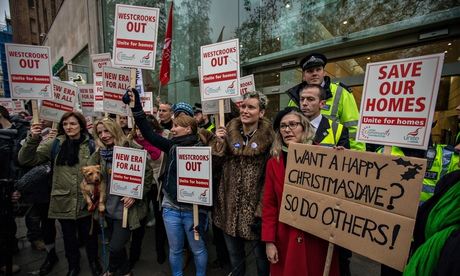
A demonstration outside Westbrook’s London office in Berkeley Square was scheduled for Monday last. I’m not sure quite what I expected. Not a re-enactment of Tahrir Square, for sure, but a substantial crowd all the same. Thousands, possibly; after all, more than 300,000 people had signed the online petition. In fact, once you subtracted the media, the police and the gawpers, only around 100 had turned up at the demo’s advertised start time. There were a few songs and chants, including the one about Boris Johnson and another that went “Toffs out, we’re stayin’ in”, but nothing loud or particularly threatening. Even the placards, courtesy of Socialist Worker and Unite, asked no more than that council housing should be defended and people put before profit.
The scene got livelier after two buses from the estate itself added another 100 protesters, and after Russell Brand himself arrived to march with them all to Downing Street. But the traffic flowed around Berkeley Square just as it always does, office workers walked to lunch, tourists stopped to wonder what was going on; it was hard to believe that the publicity, if any, would induce the same kind of the panic in Westbrook Partners that last month drove their British partner, the Tory MP Richard Benyon, to sell his firm’s stake in the consortium.
Apart from Diane Abbott and the mayor of Hackney, the big parties stayed away; even the Greens, so far as I could see, had nobody there. As a journalist covering the event later wrote to me, “From my observation of this case the politicos seem to want to deal in bland generalities and act as middlemen between people and power, rather than as representatives of the people.” That leaves a vacuum, for the moment filled entertainingly by Brand, who told Channel 4 that he was present simply to amplify the tenants’ protest.
It’s tempting in predictions always to be too dire. Still, I think the time will come when people will look back on Brand and marvel that so much unfairness could be talked about so genially – so unthreateningly – more shtick to the camera than spark to the tinder. Ours is perhaps an innocent time.
The product of another era
An interesting route to the New Era estate is along the towpath of the Grand Union canal, which in this stretch separates Islington from Hoxton and (at one time) the middle from the working classes. The New Era’s four-floor blocks lie close to the boundary on the Hoxton side. The shops don’t look fashionable – a halal butcher, a unisex hairdresser, Mr Samwidges, a minimarket – but a five-minute stroll north across the canal bridge will take you to premises that sell macchiato coffee and arts and crafts furniture.
The estate is thought to have cost the Westbrook consortium, which then included Benyon, about £23m. According to the estate agent’s brochure [pdf download], it provided a gross income of £754,098 a year from rents, which successful asset management could substantially increase. The site offered “extensive refurbishment/extension and redevelopment opportunities”. A map showed how close it lay to the City and the “increasing number of upmarket residential developments” along the canal banks.
One of the surprising aspects of this small part of inner London is how much of its architecture was built in the 1930s, when Britain made a start on improving its homes and factories, letting in air and light. As its name and flat roofs and metal-framed windows suggest, the New Era estate also dates from that time; it was built by a philanthropist to give its working-class tenants the benefit of electricity, baths, indoor lavatories and hot running water. As a reason to own property, that motive now looks remarkable.
A raw deal – but no complaints
A young friend of the family comes to tea with news that she’s found somewhere to stay in London. Hurray! Here’s the deal for the three-bedroom ex-council flat that she and two friends want to rent in Stepney: first, £500 to register their interest with the agent, who will keep the money if they decide against the property; second, £750 to the agent as his agency fee; third, £2,500 as the deposit; fourth, £1800 as the first month’s rent in advance. Total: a cheque somewhere north of £5,000 to the agent, which after his cut will still leave more than £4,000 to be dispatched to the flat’s owner in Abu Dhabi. Our young friend, who has a good degree from a fine old university, is currently working in a shop on a four-hours contract – a step up on a zero-hours contract, I suppose – that pays the minimum wage. Four weeks of 40 hours each = around £1,000. Rent for those four weeks = £600.
Oddly, she has no interest in the barricades. She thinks this is the way life just is.