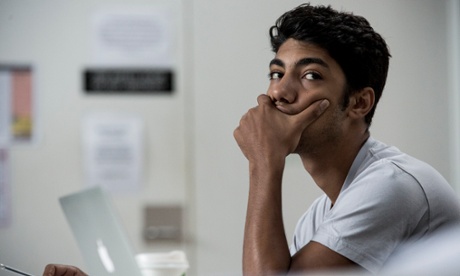
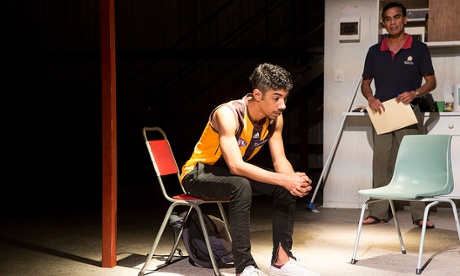
If anyone was destined to perform, it’s actor/dancer/writer Hunter Page-Lochard. Son of Bangarra’s artistic director Stephen Page and former New York City Ballet ballerina Cynthia Lochard, he’s been on stage since childhood and appeared on screen in The Sapphires, Bran Nue Day and more. Yet it’s his recent lead roles in productions Brothers Wreck and Black Diggers that have caught the industry’s attention, and saw him named best newcomer at the Sydney theatre awards.
As he prepares to play Orestes in Elektra / Orestes, a modern day adaptation of the Greek tragedy at Belvoir, he discusses growing up backstage, being connected to spirit and his hunger for industry change.
Why did you want to play Orestes?
I love Belvoir, they come up with great innovative theatre, but I’m an Indigenous Australian and unfortunately being an Indigenous Australian, you play a lot of those characters. So to be in a play that’s universal and a classical Greek tragedy, it’s a challenge and I love that challenge.
I bumped into Jada Alberts, who’s writing the play with [director] Anne-Louise Sarks, before rehearsals, and being the black activist, I asked: “‘Is it a black fella Greek tragedy or just a Greek tragedy?” She said: ‘It’s just a Greek tragedy.” I had the biggest smile on my face and she knew exactly what I was talking about.
Do you consider yourself an activist then?
I’m probably too lazy to be an activist, but I consider myself someone who can read between the lines.
Is there enough diversity on Australian stages?
It’s growing and changing. There are a lot more dark skinned people, not necessarily Indigenous but from New Caledonia or Fiji or Papua New Guinea. And there are a lot of amazing Asian actors coming through. I feel like it’s growing in film as well. Television might just have to keep up.
What can the Greeks teach us these days?
The Greeks have these big stories of death and love. One thing that I took from Orestes – and it’s something that Indigenous culture believes in strongly – is [the importance of] family. The Greeks can really teach us a thing or two about family, about chaos and how history repeats itself.
Both your parents are in the performing arts. Was it assumed that’s what you would do too?
Yeah, I don’t think I had a choice. I was raised backstage so I always saw the bulbs around the mirrors. My uncle David Page is a beautiful drag queen so I had the wigs and the sequinned dresses around me, and paint from painting dancers up. It was all I saw for the first couple of years of my life, and the first time I was on stage was at six months old, so it’s in my blood.
You dance, act and write. Which discipline is closest to your heart?
They are all close to my heart but I would have to say writing. Everything comes from the story, and I love spinning a yarn. I know a lot of people ain’t going to be happy about that because they’d expect me to say acting or dancing.
What motivates you?
I have a load of ideas and that motivates me to achieve. The other motivation would have to be my spirit. My father is an advocate for spirit and energy and he puts it in everything, in his work and his personal life. He tells me to listen and observe, to be sacred to your soul and your spirit and to understand that you are one. That’s always been one of my greatest inspirations, the fact that I know what spirit feels like and I can tap into that.
Apart from family, who are your other role models?
I look up to Leah Purcell – [she’s] one of Australia’s best directors and no one knows it. The way that she handled the strong, strong subject matter of Brothers Wreck, she was like a mother to us all, guiding us through that heartache, because the story was so close to home for some of the actors.
What did it mean to you to see David Gulpilill and Charlie’s Country recognised at the Aacta awards this year?
You’re going to get the activist side now. I’m 50/50. I’m 50% loving it because it’s recognition and it’s something that he deserved. And it was beautiful to see what he said, that if we really want to fix the industry, it’s going to be through our youth.
But the activist side of me thinks: “Did he win the award because he’s black and you guys need to fill it up with colour?” There is always that aspect. There are bucket loads of great Indigenous actors that should be nominated. Then I look at myself and wonder: are you just feeding the fire? There really is no way to win anymore.
What are your hopes for the future?
The main goal for us in the next five years is to take away that [tag] of Indigenous actor and just be a known as actors. That’s what I would love to see in the industry, that’s a big part of my motivation. I would also love to try out things in America and Hollywood, as it seems to me that’s the only way.
It’s taken 20 years to get Black Comedy, Gods of Wheat Street and Redfern Now up even though for more than two decades we’ve had great talent like Deborah Mailman and Luke Carroll. It’s slow and I’m too hungry for that timing.
What other issues do you feel passionately about?
I’m passionate about my community and where we are today as a society. We are supposed to be a country and it feels like we’re separated from every other culture. I don’t know if it’s a racism thing or a greed thing. Little things like not giving help after the storm in Northern Territory. I have family there and I asked: “How’s home?” He said: “Bad. There is no water, no electricity, there’s stuff everywhere and no-one is helping.”
Then we get news that Tony Abbott is cutting funds to the Indigenous legal aid, so we can’t even fight against mining on sacred land anymore. One of my main dreams is to start a collective of artists, to unite our creativity because I really feel like that’s a way to change the world. Creativity is a powerful thing.
-
Elektra / Orestes is at Belvoir, Sydney, from 14 March to 26 April