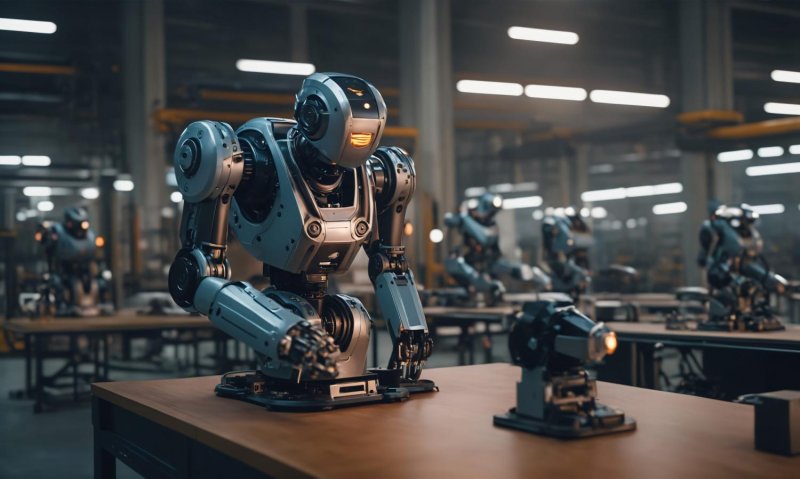
Humanoid robots are rapidly moving out of laboratories and into industrial reality as advances in artificial intelligence (AI) converge with growing global labour shortages, creating a pivotal moment for automation.
A study by Roland Berger projects that the humanoid robotics market could generate between US$300 billion and $750 billion in annual revenue by 2035, with long-term potential to reach $4 trillion by 2050, rivalling the size of the global automotive industry.
The report said structural labour shortages and ageing populations are becoming major drivers of the sector. Working-age populations in some regions are projected to decline by as much as 22% by 2050, creating a demographic challenge that traditional automation alone may not be able to solve.
Unlike conventional industrial robots, humanoid systems are designed to operate within existing human-centric infrastructure without requiring extensive factory redesigns.
The study said future operating costs could fall to around $2 per hour, potentially transforming manufacturing and logistics operations.
"The key question is no longer whether humanoid robots will emerge as a viable technology, but how quickly they will scale and which companies will position themselves early enough to capture the opportunity," said Damien Dujacquier, managing partner for Southeast Asia and Australia at Roland Berger.
The report said humanoid robots are expected to create new markets beyond the robots themselves, including motors, mechanics, sensors, electronics and production equipment, forming a complex industrial value chain that largely builds on existing manufacturing capabilities.
However, the study said the industry is not yet ready for mass commercialisation.
While hardware technologies such as actuators and edge computing are advancing rapidly, software systems and regulatory frameworks are estimated to lag behind by 3-5 years.
The report identified AI architecture as the industry's primary bottleneck. Modern humanoid robots rely on vision-language models and require large volumes of synchronised real-world sensor data to learn how to interact with unpredictable environments.
As a result, access to training data has become a major competitive battleground for developers.
The study also highlighted diverging strategies among Western and Chinese developers.
North American and European companies are pursuing an "AI-first" approach backed by advanced foundation models and venture capital, while China is taking a "deployment-first" strategy focused on rapid manufacturing scale and large-scale, real-world data collection.
Chinese developers were projected to manufacture around 15,000 humanoid robots last year, helping to accelerate cost reductions and improve training capabilities.
Before humanoid robots can perform fully autonomous production work, the technology still needs to mature. The report said early industrial benefits will likely emerge in repetitive and clearly defined applications such as unpacking, transporting items and moving goods within warehouses.
The range of tasks is expected to expand gradually as software capabilities improve.
The report advised manufacturers to engage with the technology early by offering factory floors as real-world training environments for robot developers.
Issues such as durability, safety and liability will determine the pace of industrial deployment. The systems must be capable of operating continuously in demanding production environments.
Existing safety standards were designed for traditional fenced-off automation, while humanoid robots are intended to work dynamically in the same spaces as people. This will require new testing and certification approaches, as well as harmonised regulations, before large-scale deployment becomes possible, the report noted.
Opportunities for Thailand
Udomkiat Bunworasate, partner and head of Roland Berger Thailand, told the Bangkok Post that Thai automotive and electronics suppliers can move early to secure a defined role within the emerging humanoid robotics supply chain by co-developing components and subsystems in close collaboration with original equipment manufacturers.
He said there is a significant opportunity to diversify into high-growth segments such as motion control, actuators, sensing technologies and integrated modules by leveraging existing strengths in precision manufacturing and scalable production.
Thailand can position its firms as proactive development partners, offering not only components but also a comprehensive "value bundle" that includes manufacturing capacity, real-world factory environments for robot training, operational data and risk-sharing through early commitments.
By doing so, Thai suppliers can embed themselves deeply within the structure and gradually move from Tier 2 or 3 roles to higher-value subsystem providers as the humanoid robotics market matures, Mr Udomkiat said.