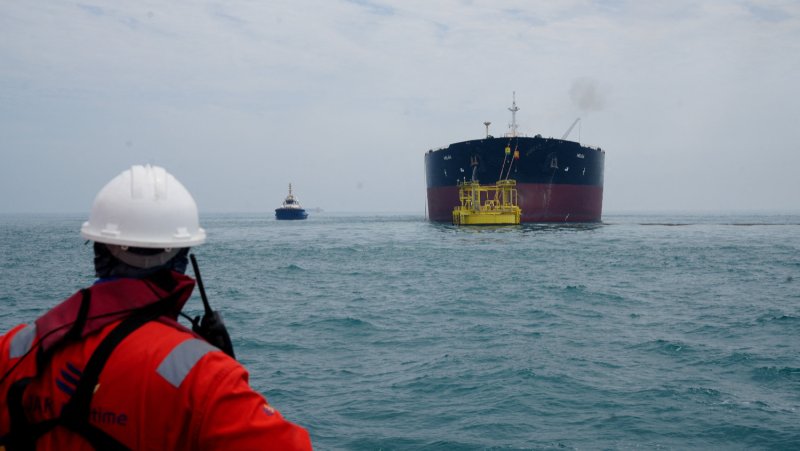
The war between the US and Iran is in its fifth month, and last week it escalated from military exchanges into something more dangerous for investors: the use of the world's energy arteries as a weapon. Brent crude has broken above $100 per barrel, its highest in two months, and has risen 40% since the start of July.
Everyone wants to know when the war will end, but the more useful question for a portfolio is whether the cost of fighting on is high enough to make either side back down. So far, the answer is no.
At the heart of this conflict is not only Iran's nuclear programme, but also the right to levy permanent transit tolls for the Strait of Hormuz, through which roughly one-fifth of the world's oil moves.
For Iran, this means both enormous revenue and long-term bargaining power. For the US, this position is unacceptable.
However, bombing alone cannot reopen the strait. A former US general estimated a ground operation would require as many as 600,000 troops and take about a year, which is considered politically implausible.
ECONOMIC WEAPONS
With negotiations failing and the use of force facing a ceiling, the main instrument becomes a blockade of Iranian oil exports to squeeze the country's economy.
The incentive to shift the battlefield from the military to the economic arena is clear given the depletion of US arsenals, with roughly 30% of Tomahawk missiles and 50% of Patriot interceptors already expended.
A war of this kind does not end quickly, and it is likely to widen towards US allies in the Gulf, as seen with the Tehran-backed Houthi rebels' declaration of a maritime blockade against Saudi Arabian ports.
The price of oil is the rulebook of this game. As long as Brent stays below $100, the cost to both sides remains manageable and the incentive to keep testing each other persists.
InnovestX expects the war to drag on for some time, with oil possibly holding around $100 for a while before easing. This is our base case because we believe a two-layer closure of the strait would leave Iran unable to access essential imports, eventually bringing it back to the negotiating table.
We maintained our average price assumptions of $85 per barrel of oil this year and around $70 next year.
The risk is the situation drags on longer than expected, pushing Brent to a range of $105-120. Goldman Sachs estimates prices could reach $120 if Hormuz remains disrupted into the fourth quarter.
Should Brent hold above $105 for more than three weeks, inflation expectations would begin to break out of their range, and the US Federal Reserve could be forced to resume rate increases.
Recent data have been more benign. US inflation in June came in below expectations at 3.5% against a forecast of 3.8%, helped by a 5.7% month-on-month decline in the energy component. In short, inflation that fell because of oil can rise again just as quickly because of oil.
US retail gasoline is around $4 per gallon, compared with $3.25 a year ago. If prices stay at or above this level, households will begin to expect higher inflation, which feeds a chain reaction in which consumers and businesses reset prices, and controlling inflation becomes considerably harder.
InnovestX's base case scenario projects the Fed to hold its policy rate steady throughout the year, while signalling a tighter stance should oil prices climb further. The effect is already visible: the 10-year Treasury yield has moved up to 4.65%, near the peak seen in May.
THAILAND OUTLOOK
For Thailand, the impact is mainly to energy costs and purchasing power. The Oil Fuel Fund pays out 650 million baht per day in subsidies and has accumulated a deficit of 62 billion baht, forcing an uptick of 0.90 baht per litre for retail fuel prices.
Meanwhile, the Bank of Thailand views oil-driven inflation as a temporary supply-side pressure, and we expect the policy rate to stay at 1.00% throughout the year, with the economy growing around 2.0% and inflation running at 1.8%.
One offsetting factor is higher oil prices support the earnings of energy and refinery names, which carry a heavy weighting in the Stock Exchange of Thailand (SET) index.
With global risk assets pressured by geopolitical tension, volatility in global technology stocks and risk from US tariff barriers, we believe the SET has already absorbed much of this risk.
The bourse can still grind higher but has limited upside, as the stocks that previously led the market now carry stretched valuations and have become less compelling.
Our short-term strategy is to rotate into laggards whose prices do not yet reflect improving earnings fundamentals through two themes.
The first is earnings plays, focusing on companies expected to report strong second-quarter profit growth alongside robust earnings momentum in the second half: ADVANC, CPN, GULF, PR9, SCGP and TIDLOR.
The second is focusing on SET50 names for which foreign ownership remains below their five-year averages, while second-half earnings momentum is expected to hold up: BEM, CPALL, HMPRO, MTC, OR, TRUE and TU.
Dr Piyasak Manason heads the Economic Research Department, INVX-Research Group, at InnovestX Securities.