

While wooden floors look incredible in any room in our homes and are relatively durable, they do take some care and attention to keep them looking their best. But it doesn’t need to be a laborious task, and knowing how to clean wooden floors isn’t hard to master.
With so many amazing wood flooring ideas out there, it’s no surprise that so many people choose this option when redesigning their homes. However, wooden floors are also susceptible to scuffs, marks, stains, and everyday grime that needs to be addressed to prevent further damage.
As Graeme Shelley, Managing Director at Factory Direct Flooring, explains, ‘The secret to keeping real wood floors clean and looking their best is getting the balance right between effective cleaning methods and protection.’ So, this is how to clean wooden floors.
1. Start with dry debris
Before you start properly cleaning wooden floors, it’s important to tackle any surface-level dust, dirt or hair. For this step, you should have one of the best vacuum cleaners to hand - ideally one with a soft brush floorhead like the Dyson V12 to minimise scratching.
However, this isn’t the only tool you can use to remove dry debris from wooden flooring. Darwyn Ker, Managing Director of Woodpecker Flooring, says, ‘Regular sweeping with a soft-bristle broom will get rid of dust and rogue bits of grit on the floor.’ And as it’s always best to vacuum before mopping, this step is essentially in preparing your wooden floor for the next step. So, don’t skip it.
2. Get mopping
The best mops come in many different forms, but it’s important to choose the right kind when cleaning wooden floors. You don’t want to use too much water on wood, so it’s best to opt for a wood-specific mop like the Bona Spray Mop Air for Wood Floor (£34 at Argos), or one where you can control how much moisture is on the mop head, like the Vileda H2PrO Spin Mop System (£49.99 at Amazon).
Then, you need to master the correct mopping technique. Clare Bolland, cleaning expert for Vileda, says, ‘Begin at the furthest corner of the room and work your way towards the exit. Use a figure-eight motion for maximum coverage, and don't forget to reach under furniture and into tight spaces.’
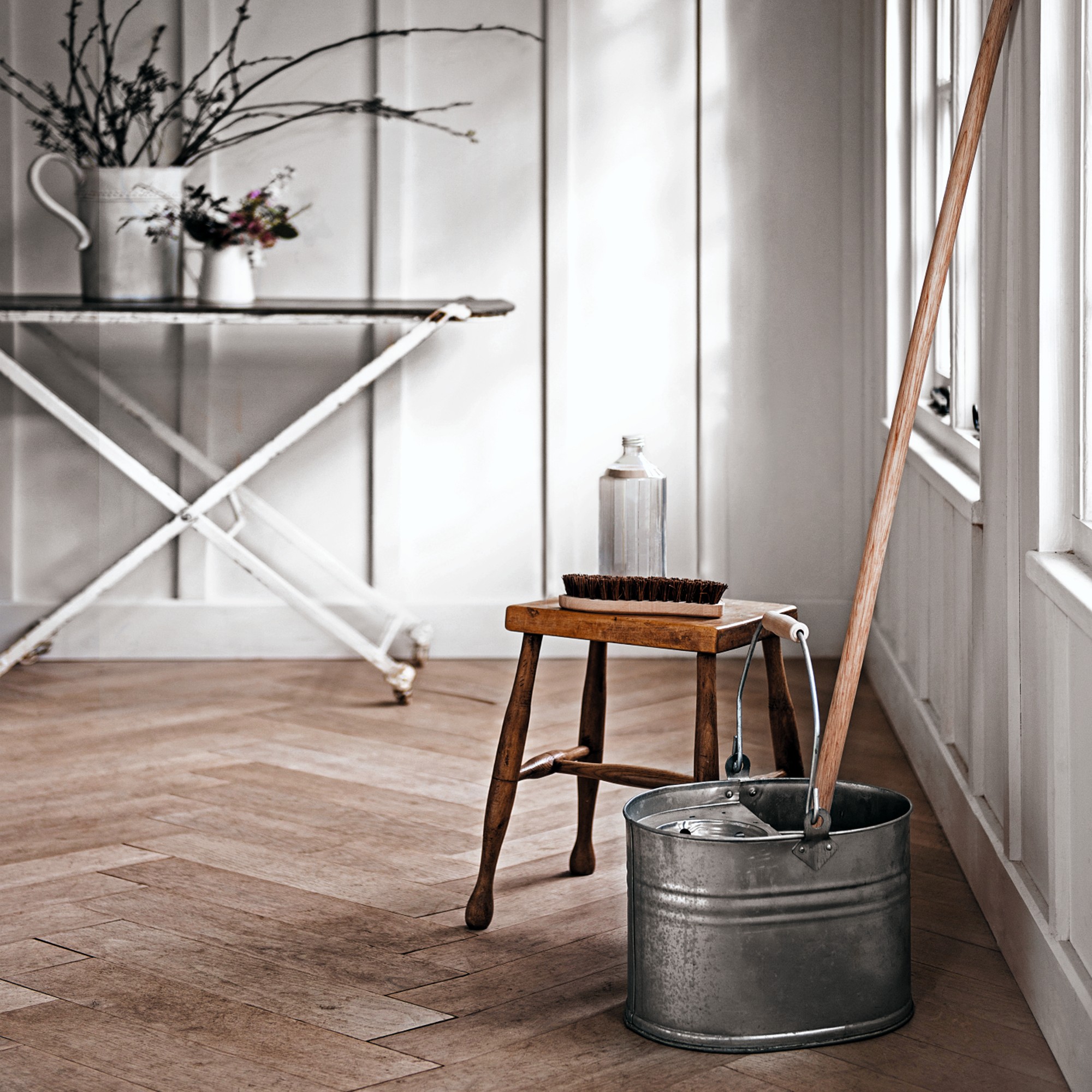
She adds, ‘Periodically rinse the mop head in the cleaning solution to prevent spreading dirt. Once the entire floor is mopped, leave it to air dry or use a dry mop to speed up the process.’
And while you can simply use water to mop your floors, it’ll be much more effective to use a cleaning solution. I always opt for my DIY floor cleaner (but just be warned that you can’t use this on unsealed hardwood floors), or you can buy a wood-specific cleaner like this Method Wood Floor Cleaner, £4.50 at Amazon.
3. Spot clean where necessary
When cleaning wooden floors, there may be certain areas that require a bit more attention than others. Whether it is a ring left behind by a glass or mug, or even a new scratch, the experts recommend taking a dry cloth or sponge and gently rubbing the stain until it begins to lift.
If you spot any deeper scratches and scuffs that can’t be buffed with a cloth, it may be that you need a specialist product like this Rustins Scratch Cover, £5.87 at Amazon. Alternatively, you may find success in rubbing a walnut over the scratches, as the oils naturally fill the gaps to visibly reduce the look of scratches.
In extreme cases, Yarl Christie, Managing Director of Stories Flooring, warns that ‘deeper black stains may need sanding or plank replacement.’ This is the worst-case scenario, however, and it’s best to seek professional advice before attempting this yourself.
In general, though, the key to preventing this in the future is to tackle stains and spills as soon as they happen. Darwyn says, ‘Liquid is the enemy, so mop up any spilt drinks and never allow water or other liquids to sit for any length of time. The odd drop may not hurt, but excessive amounts of water will cause lasting damage.’
4. Consider re-oiling
If you have wood flooring, it’s important to maintain regular oiling to maintain its shine and keep it protected from dirt and scuffs. How often you do this depends on the quality of the wood and the floor’s location, but most experts suggest every 2-3 years in high-traffic areas.
So, after you’ve mastered how to clean wooden floors, it may be worth adding this step into the process. Darwyn says, ‘A good way to check whether your floor needs treatment is to pour a few drops of water onto its surface. If the finish is in good order, the water will bead on the floor and can easily be wiped away. No maintenance is needed.’
He adds, ‘If the water slowly soaks into the timber, leaving behind a light saturation mark, the finish is starting to wear thin. A new coat of oil should be applied. However, if the water is immediately absorbed and leaves a dark stain, the finish has been completely worn away, and the floor may need sanding and re-coating.’
If you do need to re-oil your floor, opt for a product like this Rustins Floor Oil, £27 at Amazon, to get the job done properly. And make sure you always follow the instructions for the best results.
5. Take preventative measures
Nobody wants to clean wood floors more than they need to, which is why it’s well worth taking preventative measures to keep them in good condition. And alongside cleaning up spills and stains as soon as they happen, there are some other tips you can take advantage of.
Graeme advises, ‘Use doormats in entryways, add felt pads to your furniture's feet to prevent scratches, keep pet nails trimmed, and avoid walking on real wood floors in heels!’ Personally, I swear by this absorbent doormat to help keep my hard flooring free from muddy pawprints.
Furniture pads are a must when you have wooden floors. They'll protect them from scuffs and scrapes, and this pack comes with 133 pads of all different shapes and sizes.
Doormats don't have to be an eyesore. This doormat offers a pop of colour and style, while allowing you to remove dirt and debris from your shoes before walking them in the house.
If you want to clean your wooden floors without the hassle, this robot vacuum and mop is officially the top-rated model in our best robot vacuums guide. It'll clean your floors without any fuss.
FAQs
How often should you clean your wooden floors?
According to Lucy Pickett, Head of Specification & Design at V4 Wood Flooring, you shouldn’t wet or damp clean your floor ‘more than once a week – and remember to mop up puddles or spills immediately and vacuum dirt and debris to avoid embedded damage.’
Ideally, you’ll want to sweep or vacuum regularly as this will stop any abrasive dirt, dust or grit from accumulating.
‘Deep cleans can be done twice a year.’ This can vary household to household but generally you want to avoid over-cleaning your wooden floors as this can actually ‘degrade the surface of your floors over time,’ Lucy concludes.
What should you avoid using on wooden floors?
Much like how you should avoid a traditional mop head, you’ll also want to steer clear of steam mops as well.
‘Steam mops are growing in popularity, but the rapid changes in temperature and moisture will cause the wood to warp,’ Martin attests. And fixing a warped floor can leave you with a costly bill of ‘anywhere from £500-£8500,’ says Martin.
You’ll also want to avoid using anything with an abrasive texture, which could scratch or damage the surface.
Chemical-based cleaners may seem like a good idea if you have a particularly dirty floor or a stain to deal with, but some traditional cleaners, which contain things like bleach, will permanently stain your wooden floors.
‘Likewise, you may think that using natural cleaning ingredients such as distilled white vinegar and lemon would be a good alternative, but these can also cause discolouration,’ affirms Sue. This is because they can wear away protective finishes. Because of this, it is important to use cleaning products that are specially formulated for cleaning wooden floors.
Once you've nailed how to clean wooden floors, make sure you know how to properly clean carpets, too.