From noise and increased traffic, to demolition work and raised emissions, constructing a new power plant can obviously have a huge impact on the environment and on the people who live around it.
To address this, Enel Green Power (EGP) has developed a new way to work that it calls sustainable construction, which respects local areas, both from an environmental and social point of view. The company says a strong emphasis on dialogue with locals is helping it to create “shared value”, for both local people and the company.
“What we would like to do is create value for our project and also the communities nearby,” explains Antonella Santilli, head of sustainability at EGP, a subsidiary of energy multinational Enel. “So what we are doing is integrating sustainability into our business, which is all about developing, building and operating power plants.”
A key part of operating more sustainably – now being applied across the whole Enel Group – is a commitment to the “sustainable worksite”, a model for plant construction and renovation that seeks to protect the environment, make more rational use of resources and ensure attention to health and safety is embedded in daily work routines.
“Because our plants produce green energy, it is the engineering and construction work where we have the most impact from an environmental point of view,” continues Santilli. “It is at this stage that CO2 is produced – that’s why we have focused on creating and implementing a sustainable construction site.”
EGP has developed a checklist for their engineers which, says Santilli, “they have to apply to remind them to focus not just on the project but also on the environment.”
Worksites have strict rules on water management, waste and recycling, backed up by the latest technologies.
The list includes using low environmental impact materials and components such as environmentally-friendly paints and biodegradable oil, which can be dispersed in water. Where possible, machinery that operates without any oil is also used. There are strict rules around the use of water too, and in areas where water is scarce, EGP use purifiers to make unpotable water safe to drink.
EGP also tries to minimise the site’s footprint confining it to a set area. There are limits around acoustic and visual impacts, and a commitment to re-use excavated materials and so reduce trips by dumper trucks.
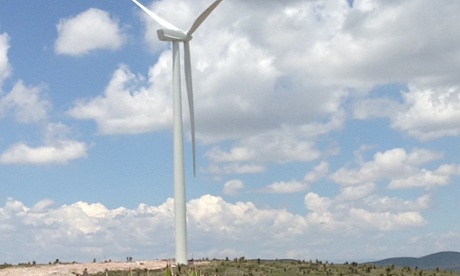
“Co-generation” technology that produces both electricity and hot water are installed at the sites, which are powered with renewables, PV panels and small wind turbines instead traditional diesel generators.
And, where possible, everything from solar panels, to batteries and even workmen’s huts are passed on free of charge to local people once the project is completed.
An imaginative way EGP has cut waste can be found in northern Chile, at its Valle de los Vientos wind farm. There, EGP passes waste pallets on to the Asociacion Sembra, an NGO that has been working to support indigenous communities in the Atacama desert since 2009.
EGP then provides scholarships to local people, who spend six weeks training as eco-carpenters, using the waste wood to create furniture.
“I think that the number of companies that have been adopting socially responsible behaviour has been increasing over the last years,” explains Monica Zarini La Nasa, president of Asociacion Sembra. “Companies in Chile have understood that competitiveness can be measured by their commitment… to identify and responsibly manage their relations and social, economic and environmental impacts.”
“Building trust is crucial and it’s one of the things that is often missing at the beginning of a project,” says Santilli. “Local people often don’t believe that the work will bring any benefits to them and this is why communication is so important.
“Unemployment is often a key issue and one of the most frequent demands from local communities is that they should benefit from all elements of the project, including the construction phase. At the same time, we’re also conscious that an influx of ‘migrant labour’ can cause local tensions.
“But sometimes local people don’t have the skills – so we train them before the construction starts and that can both minimise the migrant population and maximise local employment.”
EGP is also using the sustainable site model to refurbish many of its renewable plants and minimise the impact of maintenance. In Italy alone EGP operates 407 plants.
Some hydro-electric plants, such as the plant in San Pellegrino in the Bergamo province of northern Italy, were built at the start of the 20th century and needed major work if they were to continue to operate safely, efficiently and sustainably.
Today, says Vittorio Milesi, mayor of San Pellegrino, the plant: “is now in line with the highest standards of efficiency and security that will ensure high levels of reliability over time and respect for the environment.”
In San Pellegrino, EGP used abrasives made from maize, cutting out the creation of toxic dust and minimising health risks to operators. There was also a special rinsing system for concrete mixers that reduced the amount of water needed for washing, a comprehensive system to maximise waste recovery, and, where buildings were demolished, a commitment to green the areas with native trees including beech and oak.
EGP also installed a new PV system on the roof of San Pellegrino’s school. Shared value, Milesi seems to be suggesting, is a reality here: “The attention that Enel Green Power pays to the environment and, at the same time, the social issues, has allowed the achievement of a doubly significant and extraordinary result.”.
Santilli also points out that acting sustainably does not need to cost companies or their clients more: “This new vision of the relationship between economic activity and society is a key concept for Enel Green Power. Our analysis shows that sustainable refurbishment is no more expensive than ‘normal’ refurbishment, so clearly, we are not passing the cost of being sustainable on to the client.”
Vittorio Vagliasindi, Enel’s head of engineering and construction, says it is going to spread use of this construction model across the whole group: “Projects are not bounded anymore by the fence of the construction site but are developed in the land and by the community where the plant is located. Therefore, the success of such projects is not measured only in terms of production and return on investment, but also… the shared value and the involvement of the local communities.
“The more this value is created, the more new, similar projects will be developed successfully in the future, raising trust in the company and benefits for local communities.”
Content on this page is paid for and produced to a brief agreed with Enel, sponsor of the energy access hub at the Guardian Global Development Professionals Network.