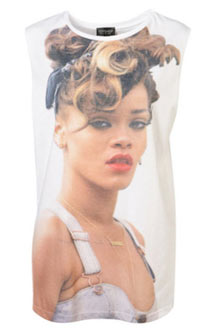
The T-shirt is cut square and it has what was once called a "muscle sleeve". Its other distinctive feature is that it is full to bursting with an image of Rihanna, coral lips pouting, hair piled on top of her head. It is that last detail that has proved problematic for Topshop, which sold the T-shirt in 2011 and 2012 under the product name "Rihanna Tank" and on Wednesday was found guilty at the high court of "passing off". Rihanna is suing for damages of $5m (£3.3m).
But what makes Topshop's sale of this T-shirt wrong? The world is full of unofficial merchandise, and Rihanna – as for all of us – does not own the copyright to her face. (Though she could try to trademark it, as Damon Hill once did with the image of his eyes staring out of his helmet.) The rights will have been owned by the photographer, who must have licensed or sold his image to Topshop. So what is the difference between straightforwardly reproducing an image on a T-shirt and "passing off"?
"The question is simply this," says Mike Brookes, a lawyer who specialises in entertainment dispute resolution at Lee & Thompson. "If you walk into Topshop and see that T-shirt, do you think that it is an official, Rihanna-endorsed T-shirt, or do you think that it is a piece of merchandise that someone else is selling without her approval?" In this case, the judge decided that the former is true. Brookes says that there are three elements to proving passing off. The claimant needs to have established a reputation. The defendant needs to have misled the public. And third, there needs to have been damage. "I suspect that the argument will be that for every person who buys a Topshop Rihanna T-shirt it does them out of a sale of an official one," says Brookes.
But even so, what is to distinguish one T-shirt legitimately bearing Rihanna's image and another that is "passing off"? Other celebrities have failed to assert a case against those who have reproduced their image – in 1997 the Spice Girls lost a case against Panini, which produced a sticker book of the band. In Rihanna's case, context plays a part: Topshop is a store of renown. "It's not like being on Oxford Street and a bloke offering you one from out a suitcase," says Brookes.
Rachel Cook, an associate at Fox Williams, read the 16-page Rihanna judgment and says that this "was very much a case of specifics". The Topshop tank shows Rihanna wearing a dungaree-strap bra top – the same outfit that she wore on the video for We Found Love, albeit one of about 47 outfits, each of which you get to see for a few seconds. (See it here at 2:57 seconds.) The photograph was taken unofficially during the shoot in Northern Ireland. "The judge was talking about the way they [Topshop] were using it, the time they were using it. It almost looked like the marketing campaign for that record." Plus, Rihanna has an active endorsement programme, having designed a clothes line for River Island.
So will this open the door for other celebrities to limit use of their images? "People may say that this is an extension of law into image rights, but there isn't a law of image rights in the UK," says Simon Bennett, a partner at Fox Williams who deals in trademark disputes in the fashion industry.
"Celebrities who think it is open season to sue anybody who uses their image or mentions their name will get a rude awakening."