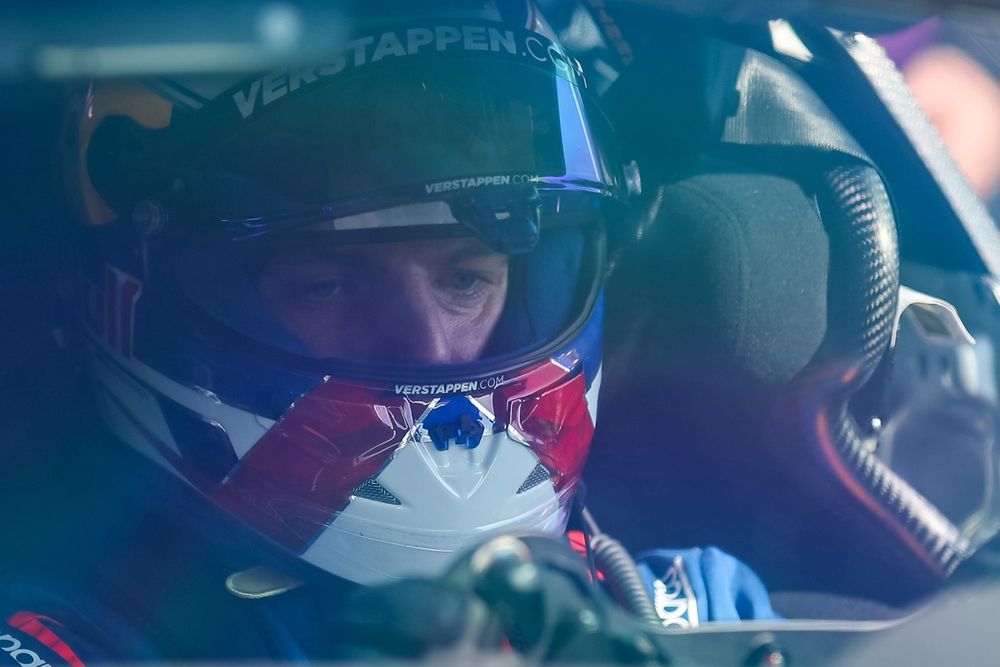
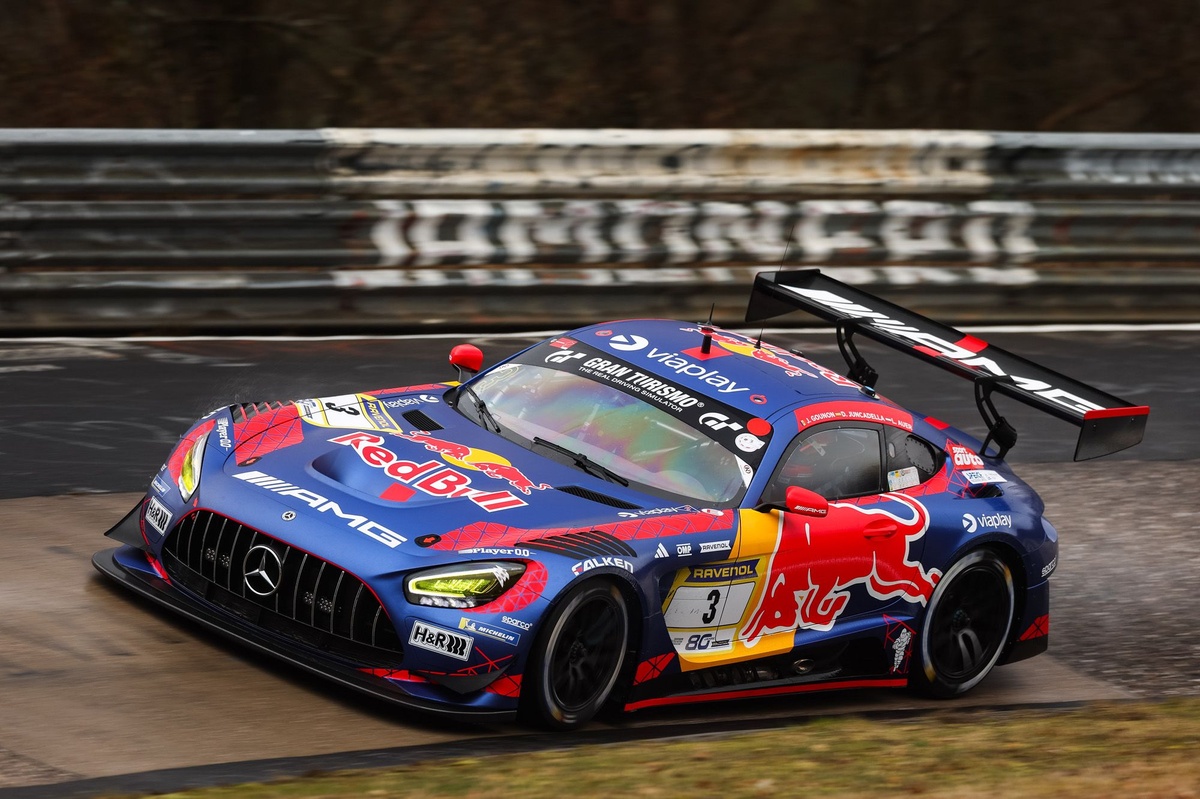
Before the stewards stepped in to strip the NLS2 win from the #3 Winward Mercedes-AMG GT3, Max Verstappen, Jules Gounon, and Daniel Juncadella delivered a historically fast performance at the Nurburgring.
The #3 Mercedes entered under the Verstappen Racing banner completed 29 laps on the 24.358km combination of the GP sprint circuit and the Nordschleife. In NLS 4-hour races, reaching the 29-lap mark is a rare feat, usually occurring only once per season on average. Most races last 28 laps.
Usually, when a race lasts 29 laps, the lead car crosses the finish line for the penultimate time shortly before the four-hour mark, leading to total race times north of 4h05m.
This race was different. Verstappen, Juncadella, and Gounon clocked in at 4:04:53.328, making the 58th ADAC Barbarossapreis the third-fastest four-hour race in NLS history with an average speed of 173.070km/h.
Only two four-hour races in the history of the series have been faster. Frank Stippler and Christopher Mies set the record at the 2023 season finale with a time of 4:03:38.088 (173.961 km/h). It was more than a minute faster than Saturday’s race.
Ironically, the record was achieved by a Phoenix Racing-entered Audi, the predecessor to today’s Scherer Sport PHX team, which gave Verstappen a run for his money with Christopher Haase at the wheel.
The second-fastest race was achieved by Michael Christensen, Frederic Makowiecki and Laurens Vanthoor in the Manthey Porsche "Grello" at the 2022 season opener with a time of 4:04:28.582 (173.362 kph).
It is worth noting that the 2023 record was set with only 113 entries in the race compared to 125 for the Grello Porsche and 129 for the Verstappen Racing AMG.
Lower traffic density reduces the likelihood of accidents and Code 60 zones, which are usually the deciding factor in whether a race reaches 29 laps.
Four out of seven laps under the eight-minute mark
Verstappen’s personal contribution was remarkable once more. Only Haase in the aforementioned #16 Scherer PHX Audi could follow with both gapping the field early on.
The German and the four-time Formula 1 world champion engaged in an equally professional and exciting battle, before Verstappen snatched the lead for good just before the first pit stop.
The data reflects this dominance when looking at the average lap times of all SP9 Pro entries up to the first stop (the first five to seven laps, depending on the car):
Average lap times (Opening stint):
- Max Verstappen #3 – 8:05.636
- Christopher Haase #16 – 8:05.768
- Augusto Farfus #98 – 8:10.953
- Thomas Neubauer #45 – 8:11.012
- Maximilian Paul #7 – 8:11.957
- Sven Müller #44 – 8:12.140
- David Pittard #47 – 8:13.539
- Mirko Bortolotti #130 – 8:13.541
- Dan Harper #99 – 8:16.232
- Mattia Drudi #34 – 8:16.377
- Nico Menzel #17 - 8:20.972
- Ugo de Wilde #77 - 8:23.671
- Arjun Maini #64 - 8:23.833
Lap 3 and 4 were interrupted by Code 60 zones, but from lap 5 onwards the track was clear again. So this list adversely affects those cars that pitted after lap 5 and 6, because they had fewer Green Flag laps.
To ensure a fair comparison, we also analysed only the first five laps. In this window, Haase was actually ahead of Verstappen and thus takes the lead:
Average lap times (Laps 1–5):
- Christopher Haase #16 – 8:08.134
- Max Verstappen #3 – 8:08.178
- Augusto Farfus #98 – 8:13.367
- Thomas Neubauer #45 - 8:13.823
- David Pittard #47 - 8:13.539
- Mirko Bortolotti #130 - 8:15.006
- Maximilian Paul #7 - 8:15.013
- Sven Müller #44 - 8:15.473
- Dan Harper #99 - 8:16.232
- Mattia Drudi #34 - 8:16.377
- Nico Menzel #17 - 8:20.972
- Ugo de Wilde #77 - 8:23.671
- Arjun Maini #64 - 8:23.833
The data confirms that Verstappen and Haase were in a league of their own, with a five-second gap per lap to the rest of the Pro field.
The "F1 Pattern" repeated
In endurance racing, races are won as a team. Verstappen has a reputation in F1 for completely dismantling team-mates because they struggle with his specific car setups.
At NLS2, he wasn't racing with his sim-racing friends who might be used to his set-ups, like Chris Lulham at Verstappen’s first Nordschleife outing in September 2025, but with elite factory Mercedes drivers.
The internal average lap times for the #3 Mercedes tell a clear story:
- Max Verstappen – 8:03.111
- Jules Gounon – 8:08.580
- Dani Juncadella – 8:16.964
Verstappen did 13 laps across two stints at the start and the end of the race. In seven of those laps, he broke the magic eight-minute barrier.
Gounon and Juncadella did eight laps each. Juncadella ran into more Code 60 zones during his stint than his team-mates and didn't manage a sub-eight-minute lap.
Gounon was caught in a battle with Dan Harper in the victorious #99 Rowe BMW who, thanks to an undercut, found Gounon on track. Even though it was not a “real” battle, with the Rowe BMW set for a 40-seconds longer pit stop at the end, both cars swapped positions several times.
However, the gap underlining Verstappen’s standout world-class pace is even more apparent when looking at each driver’s personal best laptime:
- Max Verstappen – 7:53.552
- Jules Gounon – 7:59.166
- Dani Juncadella – 8:00.001
Verstappen alone was responsible for the six fastest laps of the #3 Mercedes AMG GT3. Only then does Gounon’s personal best appear on the list, with Verstappen also managing the car’s seventh-fastest lap (7:59.268).
These figures are impressive, but they also highlight the familiar pattern from F1. Gounon and Juncadella are among the best in the AMG roster and have hundreds of laps of Nordschleife experience. Nevertheless, there is an apparent gap to Verstappen.
Verstappen’s challenge now will be to help dial in a set-up that allows his team-mates to find the same sub-8 minute consistency that he can achieve. Expect Winward to dive deep into the data before the Nurburgring 24 Hours.