Schools in the northern Indian state of Uttar Pradesh stayed open on Christmas, a public holiday, as the government ordered them to observe the birth centenary of former prime minister Atal Bihari Vajpayee instead.
According to media reports, an order issued by the state’s basic education department made student attendance mandatory on Christmas and instructed schools to organise speeches, cultural programmes and remembrance activities in Vajpayee’s honour.
Critics said the order followed a demand by the Hindu vigilante group Bajrang Dal to mark 25 December as “Good Governance Day” and “Bal Gaurav Divas”, or child pride day, instead of celebrating Christmas.
Good Governance Day is observed on 25 December to mark the birth anniversary of Vajpayee, the late stalwart of the ruling BJP. The observance was instituted after the party, now led by Narendra Modi, took power in India in 2014.
The Bajrang Dal and the BJP are both key constituents of a sprawling Hindu nationalist ecosystem commonly known as the Sangh Parivar.
Vajpayee, born in 1924 and started out as a functionary of the Rashtriya Swayamsevak Sangh (RSS), the ideological mothership of the Sangh Parivar, before moving laterally to a political entity that would eventually morph into the BJP.
He was India’s prime minister for a little over six years around the turn of the century, and died on 16 August 2018.
Uttar Pradesh is ruled by a Hindu monk who calls himself Yogi Adityanath, 53, a senior member of the BJP. Adityanath is notorious for making inflammatory statements against Muslims and other religious minorities in the country.
“Adityanath has been one of Uttar Pradesh’s most polarising politicians, given to hateful rhetoric that incites discrimination and hostility against minority groups, particularly Muslims,” Amnesty International noted in 2017.
Militant Hindu outfit Bajrang Dal vandalizes Christmas decorations worth 100 thousands at Raipur Magneto Mall. People like @narindertweets are indirectly responsible for inciting these fanatics. Even her previous tweets were amplified by far-right Hindu nationalist groups. https://t.co/CaXQe0lyHf pic.twitter.com/iOaDrl1bTJ
— South Asian Christians (@S_AsianXtians) December 24, 2025
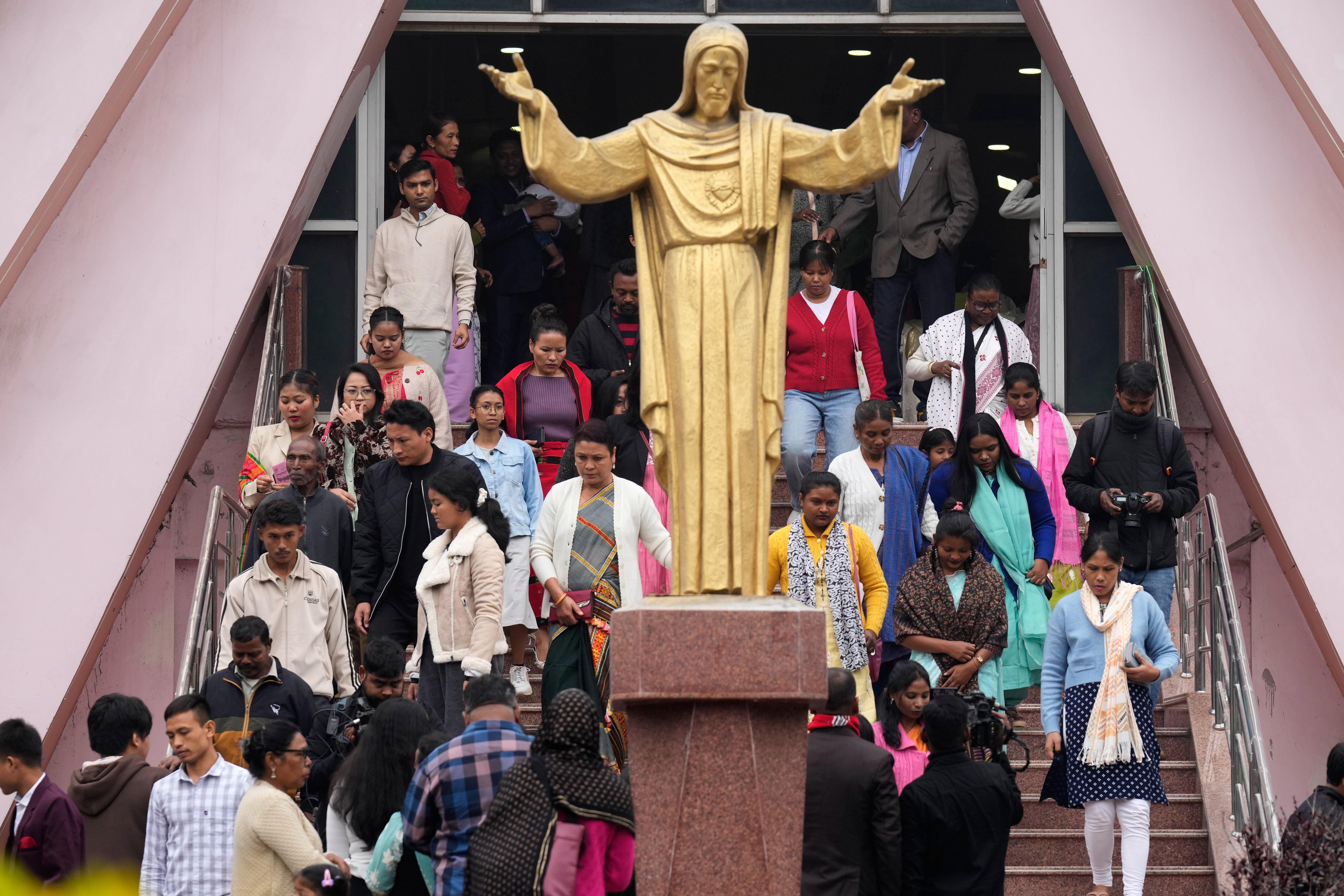
Ahead of Christmas this year, Hindu vigilantes across the country attempted to disrupt celebrations, leading to a sharp rise in attacks on Christians. They vandalised churches, interrupted prayer services, harassed carol singers and dismantled festive decorations.
Christian advocacy group Open Doors said it had documented more than 60 incidents involving the disruption of Christmas gatherings or church services.
In Uttar Pradesh, the Bajrang Dal reportedly urged authorities to prevent Christmas celebrations in schools. Students should be taught “Indian values” instead, the group argued, proposing recitation of Vajpayee’s poetry and essay competitions in place of Christmas activities.
The state government order came soon after, drawing sharp criticism from Christian organisations and educators who said it sidelined religious minorities and weakened the secular character of public education.
As the world watched, an unruly mob vandalised Christmas festivities in Raipur today
— Supriya Shrinate (@SupriyaShrinate) December 25, 2025
Shame on those who did it
Shame on those who patronise them
Shame on all those who remained quiet
Shame on you Mr Modi, this happened on your watch
What have you done to my beautiful India? pic.twitter.com/SS6dElICTr
John Dayal of the All India Christian Council described the directive as a “deliberate targeting of the most sacred day in the Christian calendar”.
“The decision reflects a sustained and intensifying pattern of marginalisation of the Christian community under the current regime,” Mr Dayal was quoted as saying by Maktoob Media, an outlet which reports on minority affairs in India.
The Catholic Bishops Conference of India, meanwhile, issued a condemnation of the attacks on Christians this festival season, describing them as a grave violation of the minority community’s constitutional rights.
INDIA AT CHRISTMAS
— Catholic Arena (@CatholicArena) December 23, 2025
• Bishops warn of season of hate from Hindu Nationalists
• 60 church services interrupted by Hindu Nationalists last Christmas
• 2,900 anti Christian incidents in 2025
• 112 Christians in jail for faith
• 'Conversion Laws' used to jail Christians pic.twitter.com/Gxl719VMzB
“These targeted incidents, especially against peaceful carol singers and congregations gathered in churches to pray, gravely undermine India’s constitutional guarantees of freedom of religion and the right to live and worship without fear,” the group said in a statement.
It also flagged the circulation of “hate-filled digital posters” against Christians in the central state of Chhattisgarh.
"Christianity is not allowed in India."
— Suraj Kumar Bauddh (@SurajKrBauddh) December 22, 2025
"You bring girls for dhandha (s**x trade)." 👹
BJP woman leader Anju Bharvav assaulted and abused blind girls in MP's Jabalpur.
Targeting Christians days before Christmas is pathetic. The world is watching us. pic.twitter.com/EX7m7NCeTr
The uptick in the disruption of Christmas celebration came after another Sangh Parivar group, the Vishwa Hindu Parishad, called on Hindus to stay away from these festivities.
In a letter to Hindus earlier this month, the group’s leader, Surendra Gupta, declared that participation in the festivals of other religions “may lead to social acceptance of other faiths”.
This video shows right-wing goons vandalising Christmas decorations in Raipur. It exposes the true face of the BJP government.
— Congress (@INCIndia) December 25, 2025
This is not an isolated incident. Across India, people are being targeted and terrorised simply for celebrating Christmas. From Jabalpur and Delhi to… pic.twitter.com/2Jt4SJhO25
The group also objected to shopkeepers and businesses displaying messages like “Happy or Merry Christmas”, arguing that Hindus doing so purely for commercial benefit fostered “cultural confusion and self-abasement”.
It asked Hindu consumers to “consider” avoiding purchases from such establishments.
Christians make up about 2.3 per cent of India’s population. Community leaders have said they face growing hostility, allegations that the ruling BJP has previously denied.
Christian rights groups report a sharp rise in alleged cases of persecution, with the United Christian Forum documenting more than 600 attacks on Christians between January and October this year, ranging from mob violence and public humiliation to church disruptions and home demolitions.
Concerns have also grown over the expanded use of anti-conversion laws, particularly in states ruled by the BJP, which experts have noted are often misapplied to harass and criminalise Christians and other minorities rather than prevent coercion. Such laws are now in force in 12 states. As many as 123 criminal cases under these were registered against Christians this year alone.
Some Hindu groups claim that Christians are engaged in conversion of Hindus through force or inducement, a narrative that critics note is used to justify anti-conversion laws and targeted harassment of Christian communities in India.
May Christmas bring renewed hope, warmth and a shared commitment to kindness.
— Narendra Modi (@narendramodi) December 25, 2025
Here are highlights from the Christmas morning service at The Cathedral Church of the Redemption. pic.twitter.com/BzvKYQ8N0H
“Christians in India are punished not for wrongdoing but for simply gathering, praying, or helping their neighbours,” Tehmina Arora, Asia advocacy director for the nonprofit ADF International, told members of the European parliament earlier this year. “Even the Supreme Court of India recently noted how the anti-conversion laws are misused to wrongly prosecute Christians.”
In the wake of the recent attacks, the main opposition party, Congress, said: “From Jabalpur and Delhi to Chhattisgarh, Kerala, Odisha and Uttarakhand, and in many other places, we are witnessing an organised targeting of minority communities. Such incidents raise serious concerns about the state of our nation, which has always been defined by its strength in unity and diversity.”
The prime minister hasn’t commented on the recent attacks, but he shared a video on X showing him attending a church service on Christmas morning in Delhi.
The Independent has reached out to the BJP for comment.
Alarm as Hindu vigilante groups target Christmas celebrations in India
Hundreds protest outside Bangladesh embassy in Delhi over Hindu man’s death
At least 13 killed in massive pile-up on Indian highway amid dense smog
At least 10 dead as passenger bus erupts in flames after collision in India
Airplane ‘lost’ for 13 years turns up in airport parking bay
Eight elephants killed as passenger train hits herd in India’s northeast