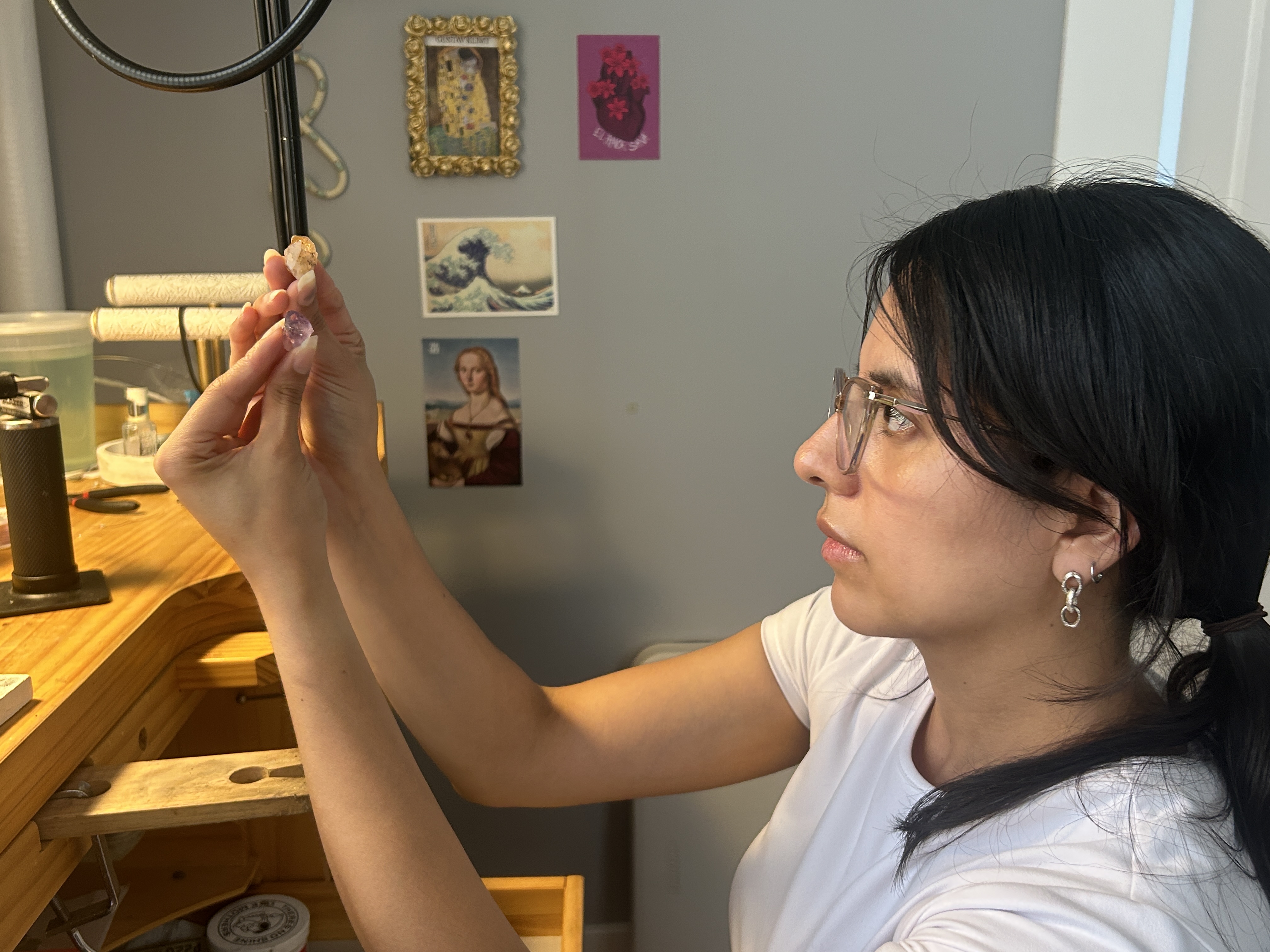
Most luxury objects are designed to impress. A few are designed to remain. Visit any estate sale or peer into a family jewelry box, and you can tell the difference immediately. The piece bought for status still carries its price tag in spirit, admired, perhaps, but strangely weightless. The piece someone wore through a difficult year, a quiet morning ritual, or a moment of private joy carries something heavier. It has absorbed a life. It has begun to belong to someone in a way that has nothing to do with karats or hallmarks.
That second kind of preciousness, built from memory, emotion and human connection rather than rarity alone, is exactly what drives the work of jewelry designer Andrea Ortiz.
For Ortiz, luxury is not a finish line marked by the price of materials. Gold, pearls and precious stones may supply a physical vocabulary, but they are, in her view, only the beginning of the conversation.
The deeper value arrives later, in the invisible exchange between an object and its wearer. The stories it holds, the resilience it quietly commemorates, the identity it helps to shape over time.
That philosophy runs through every tier of her practice, from commissioned pieces to experimental art collections. Rather than beginning with a gemstone or a setting, Ortiz begins with what the piece needs to carry emotionally. Then searches for the materials and techniques capable of holding that weight.
"A piece becomes genuinely precious when it carries something beyond its physical body," she says. "At that point, it can become an expression of the person who chooses it."
This way of thinking also has practical advantages. Ortiz's architectural training means she approaches each design as a structural problem before it becomes a decorative one. By resolving form and support early, she can eliminate excess metal without compromising presence. An approach that, in a high-cost gold market, translates into meaningful material savings for the brands and clients she works with.
The result is jewelry that delivers visual impact and emotional resonance while remaining intentionally lean in its use of precious resources. And when it comes to the ever-increasing cost of materials themselves, it is a philosophy that has gained traction among jewelry brands and businesses. For investors, having someone delivering this approach creatively can be a very interesting prospect.
How The Beauty Begins
The key and first stepping stone for Ortiz is emotion. That becomes the starting point. Ortiz does not treat emotion as a finishing touch. It arrives at the beginning.
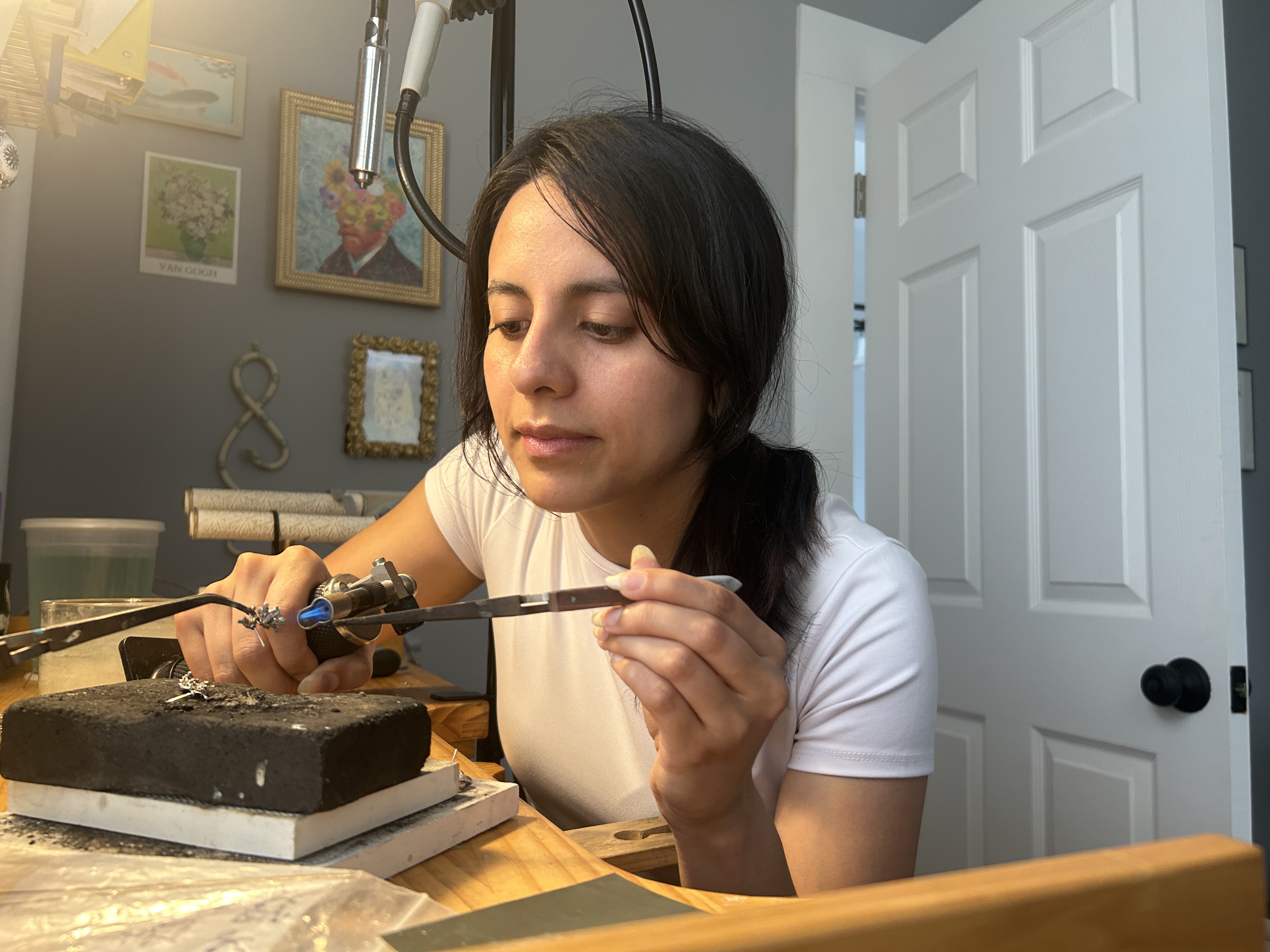
Memories, relationships, private associations and fleeting ideas can all become starting points for a piece. Her creative process is concerned with those less tangible ingredients. The things a wearer may struggle to articulate but immediately recognize when they see them translated into form.
She is drawn, Ortiz explains, to what cannot be held in the hand at first. The feelings, memories, and half-formed ideas that seem to reach for a physical language before they have one.
That instinct is reinforced by Ortiz’s background in architecture, which was mentioned previously as integral to her unique method. Before moving into jewelry, she studied in the medium, an experience that informs the structural discipline of her work. Her pieces must work on the body, but they must also carry an internal framework capable of supporting the story or feeling behind them.
It is this meeting of precision and intimacy that gives her work its particular character. Craft is not simply there to demonstrate technical skill. It is also the mechanism through which an idea becomes something another person can live with.
For Ortiz, this distinction matters beyond her own studio. She argues for a broader rethinking of what luxury and craftsmanship can mean. One that gives greater weight to human touch, cultural inheritance, and deliberate making rather than relying exclusively on conventional markers of prestige.
That rethinking, in her view, should extend to everyone involved in bringing an object into existence. A piece of jewelry ought to create value not only for its eventual wearer but for the artisans, producers, and communities whose labor and knowledge shaped it.
The Necklace That Turned Feeling Into Form
Few examples make the philosophy more tangible than Beauty Interrupted, an award-winning couture necklace developed during Ortiz's studies at the Savannah College of Art and Design (SCAD).
The work, formed using Ortiz's distinctive design methodology, takes pearls, materials traditionally associated with refinement and elegance, and places them in a more unsettled conceptual landscape. Rather than allowing conventional associations of beauty to dictate the piece, Ortiz used the material to explore tension and interruption.
She describes the necklace as one of the clearest expressions of the emotional impulse behind her practice. It’s a feeling that arrived first, with the object becoming, in her words, "a way of giving that feeling somewhere to exist."
That approach earned Beauty Interrupted a 2022 Silver in Accessory-Jewelry at the International Design Awards, while the work was also subsequently shown as part of Fashioning Power, Fashioning Peace at the Woodrow Wilson House in Washington, D.C.
The recognition is notable not simply because the necklace received an award, but because it provides peer and institutional validation for a methodology in which concept, emotion, and technical execution are deliberately intertwined.
A Design Conversation That Goes Deeper Than Taste
Ortiz has also developed a more explicit framework for drawing emotion into the design process. She calls it Symbolic Inquiry.
The idea grew from a frustration with the conventional jewelry consultation. A client can easily say they prefer yellow gold, oval stones, or a particular style. But those preferences do not necessarily reveal why a piece matters, or what a relationship, memory or person feels like from the inside.
Ortiz's method asks different questions. For engagement rings, she might ask clients to imagine their partner as a color, landscape, plant, animal, season or quality of light. The answers can uncover qualities that ordinary design conversations rarely reach: gentleness, resilience, playfulness, steadiness or quiet strength.
Those symbolic associations then become design material. The aim is to discover aesthetic preferences, Ortiz explains, as well as map the emotional character of the relationship itself. The finished piece becomes, in her words, "a more exact portrait" of what the wearer and their connection actually feel like from the inside.
Ortiz applies the same associative logic to her independent art jewelry, deliberately looking beyond the most obvious interpretation of a concept. Cultural echoes, hidden relationships, and unexpected emotional connections all become legitimate research material. In this sense, Symbolic Inquiry functions less as a design recipe than as a disciplined practice of listening. It asks what happens when preciousness is untethered from precious materials altogether.
She has experimented with objects and substances that would rarely occupy the traditional vocabulary of high jewelry, including faceted coffee beans and tea-dyed salt. Rather than presenting unconventional materials as a gimmick, she treats them as potential carriers of cultural and emotional meaning.
Her specific process involves transforming and recontextualizing the everyday material, refining its surface, imposing structure, and combining it with traditional metals until it can operate simultaneously as an aesthetic element and a conceptual one.
The result challenges a familiar assumption: that a material's price determines its capacity to be precious.
Ortiz says: ‘’Ordinary materials can become objects worthy of contemplation precisely because transformation changes the way we look at them. The question is no longer simply, ‘What is this worth?’ but ‘What can this mean?’”
That thinking, which has had an impact on the way other artisans move through the creation process, was particularly visible in Linking Realms, which received a 2023 Silver in Conceptual Products and Copper in Accessory-Jewelry at the International Design Awards. Ortiz also received 2022 Honorable Mentions for Cup of Home and The Salt Left On My Skin.
When Jewelry Leaves The Studio And Enters A Life
Ultimately, however, the most revealing evidence for Ortiz's philosophy may not be found in an exhibition catalog. It can be found in what happens to the jewelry once it belongs to somebody else.
She recalls a customer navigating serious health challenges who told her that a pair of earrings had become a quiet but persistent reminder that beauty still existed in the world. Another client contacted her because household soaps had altered the surface of a ring—not because he was upset, but because he had worn it while cleaning without a second thought. The piece had become habitual, inseparable from the rhythm of his day.
For Ortiz, these moments are the real measure of her work. "A piece that accompanies someone into the mundane parts of the day has crossed a threshold," she says. "It is no longer merely something beautiful to look at. It has become part of a person's routine, memory, and sense of self."
The Quieter Question Of Influence
The external recognition surrounding Ortiz's work is substantial. Alongside her International Design Awards, she was selected by Art Jewelry Forum for its Outstanding Students of 2023, received the SCAD Outstanding Academic Achievement Award in 2024, and was a finalist for the CFDA Design for Justice MFA/MA program in 2021. Her work has also appeared through SNAG In Focus 2024 and exhibitions including Design Miami, NYC Jewelry Week, the American Craft Council Baltimore show, and Fashioning Power, Fashioning Peace.
These distinctions provide evidence that juries, curators and institutions have responded to the ideas and execution behind her work. They lend weight to Ortiz's argument that craftsmanship can function as something more than production: it can carry culture, narrative and human connection.
But awards do not, on their own, establish that a designer has changed how an entire industry works.
Ortiz herself points to a quieter form of evidence: what happens when another maker takes an idea from her studio and makes it their own. Following the exhibition and discussion of Linking Realms, two designers who had studied with Ortiz at SCAD began incorporating similarly transformed organic materials into their own exhibition work; using, she says, "faceting and surface treatments I had developed." Separately, a small New York studio adapted the tea-dyeing and stabilization process she had refined for salt, applying it to narrative-led collections of its own.
The same pattern appears in her account of Symbolic Inquiry. Several independent designers she has mentored, collaborated with or worked alongside have reportedly incorporated versions of the questioning process into bridal practices, while teams she worked with have continued using elements of her material-optimization and storytelling frameworks after her direct involvement ended.
These accounts point to something smaller and perhaps more intimate: an idea moving from one practitioner to another, tested in real studios and client relationships.
For now, the case for Ortiz is therefore strongest as a proposition rather than a wholesale shift in the jewelry industry. A proposition recognized by juries and curators, embraced by individual clients and, according to her account, beginning to circulate among a circle of fellow makers. Whether that philosophy ultimately changes luxury on a larger scale remains unresolved. What is already observable is that the objects themselves can carry a kind of value no price tag fully captures.
Her approach has led to collaborations with several independent jewelry labels, where her emphasis on structural economy and narrative coherence has found commercial application.
This combination of emotional instinct and structural discipline is also observed by those who have worked directly with Ortiz.
Shakeh Kalashnikov, founder of SEIDA and a brand collaborator, describes someone able to translate abstract, poetic concepts into jewelry without sacrificing practicality or emotional depth.
"Her ability to navigate production requirements while preserving the original artistic intention," Kalashnikov says, "is an unusual strength. It's what allowed our designs to move from concept to reality without losing their integrity."
Professor Lanelle Keyes, of the Jewelry Department at SCAD, worked directly with Ortiz during her graduate studies.
"Andrea's design process is unusually rigorous. It’s concept-driven, research-informed, and executed with a level of precision that allows her to achieve strong visual results without unnecessary excess," Keyes says. "What distinguishes her is the ability to maintain a clear artistic voice while designing in ways that align tightly with brand aesthetics and the practical expectations of the industry. Her capacity to interpret and extend a brand's visual language is exceptional; she delivers work that feels both inventive and fully resolved within commercial constraints."
In a practical endorsement of her methodology, several jewelry brands, including Natural Inclusion, Anturio Atelier, and The Accessory Think Tank, have begun integrating Ortiz's Symbolic Inquiry process into their own design and client work. By adopting her layered questioning approach, these companies report creating pieces with stronger narrative coherence and deeper client attachment, while also benefiting from the material-efficiency principles that underpin her method.
For Ortiz, the quiet uptake by commercial studios is one more signal that her approach holds value well beyond the gallery.
The Luxury Of Making Something Matter
For Ortiz, the primary catalyst remains the act of transformation: that specific transition where a conceptual spark takes on physical gravity, texture, and structural presence. She suggests that jewelry possesses a unique capacity for this evolution due to its proximity to the skin: "It travels through milestones and quiet, taxing days alike, embedding itself into photographs and personal ceremonies," she says, noting its potential to eventually "descend through generations, retaining the subtle impressions of its original steward."
This is the foundation for her belief that craftsmanship is far more than a technical exercise. In its most elevated state, it functions as a vessel for cultural narrative and human intent, allowing a story to endure within the object itself. This perspective has earned significant, tangible recognition within the industry.
Her acclaimed portfolio—highlighted by International Design Awards Silvers for Beauty Interrupted and Linking Realms, alongside Honorable Mentions for Cup of Home and The Salt Left On My Skin, serves as evidence of this methodology's impact.
Further validation includes her selection as an Art Jewelry Forum 2023 Outstanding Student and receiving the 2024 SCAD Outstanding Academic Achievement Award. Her work has also been showcased at Design Miami, NYC Jewelry Week, the American Craft Council, and the Woodrow Wilson House, marking it as a contribution of enduring substance.
The integration of her Symbolic Inquiry framework by commercial entities like Natural Inclusion, Anturio Atelier, and The Accessory Think Tank underscores its functional utility. Academic mentors and industry peers have pointed to her exceptional talent for balancing artistic purity with the demands of production, distilling complex emotional states into resolved, wearable artifacts that foster deep, lasting bonds with their wearers.
Through this practice, Ortiz demonstrates that genuine luxury is not an empty marketing claim regarding rare minerals, but a verifiable result of disciplined, sentiment-led design. The artifacts produced through her studio—and the techniques she has disseminated to other designers—are supported by a legacy of accolades, exhibitions, and professional replications.
What she cultivates in the space between the wearer and the worn is the concrete outcome of a methodology that is actively redefining how we assign value in the landscape of modern jewelry.
.png?w=600)