SACRAMENTO, Calif. _ For California Assemblyman Eduardo Garcia, global warming conjured images of stricken polar bears on melting ice sheets, a problem with little relevance to his arid Inland Empire district.
But at the United Nations conference on climate change in Paris last year, he was struck to hear people talking about helping the world's poor, polluted communities _ places that sounded a lot like his own district.
"I don't consider myself a climate change activist," the first-term Democrat said. "I consider myself an advocate for my community."
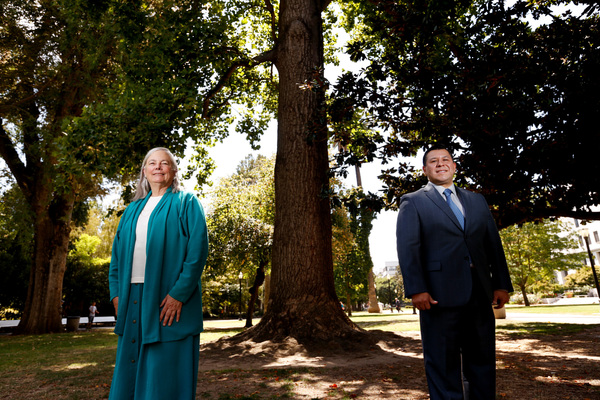
Returning to Sacramento, Garcia teamed up with Sen. Fran Pavley, a Los Angeles County Democrat from the kind of wealthy, white, coastal area that has dominated environmental conversations in the state.
Their alliance turned out to be key: Lawmakers passed and sent to Gov. Jerry Brown a bill that would set a more ambitious target for reducing greenhouse gas emissions, preserving the state's international reputation for fighting global warming while grounding it in local concerns over jobs and health.
"That's exactly the discussion we needed to have," Pavley said. "How can we make the benefits of reducing carbon pollution relevant to everyone?"
Her partnership with Garcia helped broaden political support for climate change policies and provided a potential road map for future environmental battles.
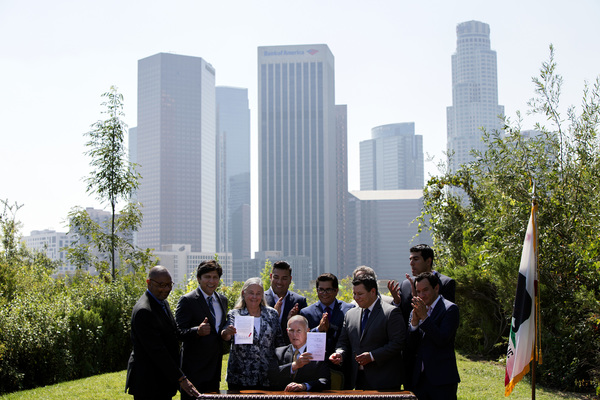
The victory didn't come easy. Supporters waged an insurgent campaign that faced opposition from oil companies, hesitance from Democratic leaders and deep divisions among environmentalists. But, just one year after industry opposition had buried or watered down other high-profile proposals, Brown is poised to sign measures to spur more investments in clean technologies and cut pollution from refineries and other facilities.
In the end, the legislative odd couple of Garcia and Pavley became what Senate leader Kevin de Leon, D-Los Angeles, called "the partnership of the future. We're bridging that gap within the environmental community."
A longtime environmental champion, Pavley had written the 2002 law that became a national standard for reducing vehicle emissions. Another landmark measure she wrote four years later set a 2020 target for reducing emissions to 1990 levels and became the legal foundation for many of the state's climate programs.
For her last year in office, Pavley had an even more ambitious goal _ setting a new target for slashing emissions to 40 percent below 1990 levels by 2030.
She asked Jake Levine, a Los Angeles native working for an energy company in Washington, D.C., to join her in Sacramento to help pass the legislation. He jumped at the chance, assuming Democratic-dominated California would continue embracing the kind of policies he had watched stall in Washington's partisan gridlock.
But Levine discovered a different political reality when he arrived.
Pavley's proposal, SB 32, had been in limbo since it was rejected the previous year, and it was strongly opposed by oil companies, which already had torpedoed a proposal to reduce gasoline use for transportation.
Most of all, Levine was puzzled by what he called the "heated and emotional rift" within the environmental community, a divide that reflected the complexity of California's climate politics.
The state has more solar power and electric cars than any other, and national environmental groups have hailed the state's policies, hoping they could spark much broader, international action to slow global warming.
But those advances weren't always evident in poorer parts of California, with some of the worst air quality in the country. Communities dotted by refineries and carved by freeways have felt left behind, and community organizations known as environmental justice groups argue that state regulators should focus more on local concerns.
That divide also had a racial component: Whites were often leading the push for new regulations, while blacks and Latinos were more likely to suffer the consequences of pollution.
"There wasn't enough communication and trust" between different environmental groups, Levine said.
He partnered with Carlos Gonzalez, the policy director for Garcia, and an informal group of advocates. Jena Price, a lobbyist for the California League of Conservation Voters, contributed her political instincts for the Capitol; Alex Jackson, a lawyer at the Natural Resources Defense Council, provided the legal perspective from a more traditional environmental group; and Parin Shah, a senior strategist at the Asian Pacific Environmental Network, spoke for low-income communities harmed by pollution.
Their strategy discussions at an office near the Capitol were a microcosm of larger debates that have divided Democrats and environmentalists. How much unilateral power should regulators have? Where should the state focus its efforts? What's the best way to win over skeptics?
"We learned from the old fights," Shah said. "We don't need to relive them."
The group's dialogue helped produce AB 197, which Garcia introduced as a companion to Pavley's proposal for a new emissions target. It was designed to address lawmakers' long-standing concerns about the power of the California Air Resources Board, the leading agency for state climate policy.
The legislation calls for a new oversight committee and limits how long board members could serve without needing reapproval from lawmakers. It also prodded the board to focus on local pollution concerns when implementing climate regulations.
Concerns about jobs and health resonate in Garcia's district, which stretches from Joshua Tree National Park to the Mexican border. One in five residents lives below the poverty line, and the unemployment rate of 24 percent is four times the statewide figure. In one county he represents, children visit emergency rooms with asthma problems at twice the state rate.
But Garcia's legislation, with its push for more regulator oversight, was on a collision course with the governor, who has chafed at attempts to rein in his administration's authority.
In addition, Garcia's legislation did not address cap-and-trade, the centerpiece of California's climate policy. The program requires companies to buy permits in order to release greenhouse gases into the atmosphere, providing a financial incentive to clean up their operations. But some activists believe the program doesn't do enough to curtail pollution.
Brown was focused on safeguarding cap-and-trade from a lawsuit over whether it amounts to an unconstitutional tax. Bulletproofing the program _ and the revenue it generates for projects such as the bullet train from Los Angeles to San Francisco _ would require a two-thirds vote, the threshold needed for approving taxes and fees.
That was a steeper challenge than the majority vote needed for Garcia's and Pavley's legislation, and the governor's office was negotiating directly with oil companies in hopes of laying the political groundwork for a deal.
Administration officials were agitated that Garcia and his allies were pushing forward with their own legislation while talks were ongoing.
Brown spokesman Evan Westrup said the governor was prepared to battle the oil companies if necessary but wanted the chance to work on "a potential peace treaty."
"It's important to put down your weapons and negotiate in good faith," Westrup said.
Assembly Speaker Anthony Rendon, D-Paramount, new to his post, feared that the legislation wouldn't pass and suggested Garcia hold off until next year.
"I wasn't sure he was listening," Rendon recalled. "He nodded his head and kept pushing forward."
When the last month of the legislative session began, Brown, De Leon and Rendon held a series of tense meetings to determine the fate of climate legislation. Afterward, the governor's office and Rendon issued statements suggesting it could wait.
But De Leon was silent. He was the most eager to push forward, and had even chatted with President Barack Obama's advisor, Valerie Jarrett, during the Democratic National Convention in Philadelphia in hopes of getting the White House on board.
Garcia's office had prepared a statement saying it would hold its climate legislation until next year. But Gonzalez took De Leon's silence as a sign of hope, and he didn't hit Send.
"We felt that there was a chance," Gonzalez said.
Despite widespread belief that climate legislation was dying, a lobbying operation was whirring to life.
Supporters believed they were roughly 10 votes short of what they needed in the Assembly, and they knew passage would require making climate change relevant to lawmakers who had opposed the previous year's effort. Because of term limits, there had been an almost complete turnover in the chamber since 2006, when the state set its original emissions target. Pavley was one of the only ones left.
During last year's battle over a failed proposal to reduce oil use, both sides had taken a scorched-earth approach that left emotions raw. Environmentalists accused lawmakers of being in the pocket of oil companies, while the industry warned that Californians wouldn't be allowed to gas up their minivans if the legislation passed.
This year, supporters pursued a more nuanced campaign.
Health groups lobbied Assemblyman Joaquin Arambula, D-Fresno, an emergency room doctor, about the benefits of reducing air pollution. Executives at San Francisco Bay Area businesses such as SunPower and Salesforce pitched Assemblyman Evan Low, D-Campbell.
Clean-energy companies also played a more central role in the lobbying. One trade group distributed fact sheets listing the number of jobs that could be gained in each district, and another flew in an out-of-state investor to dangle the possibility of millions of dollars in new projects.
The effort hinged on picking off a few business-aligned Democrats who had united to block previous climate proposals, and advocates carefully crafted their appeals.
Their targets included Assemblyman Jose Medina, D-Riverside, who said last year that the people pushing climate policies were "outside environmentalists saying what's best for my district." But this year he connected with a business building a massive new biofuel facility in his district and decided that supporting climate legislation was "the right thing to do for my area."
Garcia and his allies eventually secured enough support to convince Brown and Rendon that they were within striking distance.
"The timing was right and the politics aligned," Westrup said, and the governor worked with top lawmakers for the final push.
At one point, the practical limits of green energy intruded: Dan Reeves, De Leon's chief of staff, was a no-show for a meeting because his daughter hadn't plugged in his electric car the night before.
With Reeves stuck at a charging station, the meeting was postponed. But the plan continued falling into place. On the night before the Assembly vote, Rendon called a handful of lawmakers to seal the deal, telling them simply: "It's important to me."
The oil industry was caught flat-footed as supporters rushed the legislation to a vote. Just weeks after it appeared dead, Pavley's bill was approved by the Assembly. The lobbying had paid off, and the 42-29 vote included a dozen yes votes from lawmakers who had abstained or opposed her proposal the previous year. Garcia's bill passed the following day.
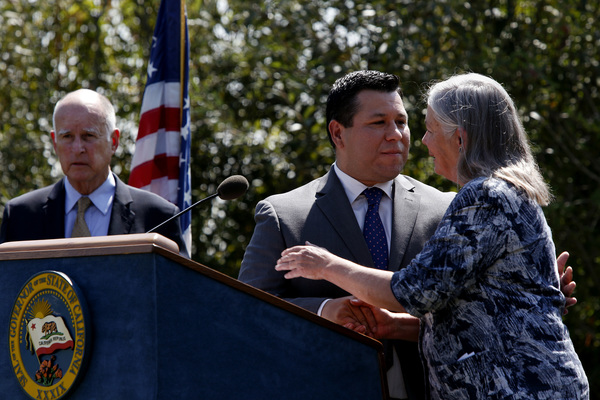
Shortly after the vote, Pavley and Garcia hugged outside the Assembly chamber. His eyes were wet as congratulatory text messages streamed in from his colleagues.
Although there will be more battles over the future of the cap-and-trade program, Pavley said she was ready to hand the baton to Garcia, a decade after passing her first legislation for setting emissions targets.
"He'll be in the same place I am in 10 years," she said. "It's a relay race."