Alan Greenspan, who died on June 22, 2026, at the age of 100, is best remembered for his 18 years at the helm of the Federal Reserve. What many people don’t know is that an earlier and more obscure stint during the administration of President Gerald Ford shaped him as a public servant.
As professors of economics, we haven’t just covered Greenspan’s legacy for our students. We also knew him personally, in different capacities: One of us interviewed him in 2016 for a book on public service, and the other was present as a young professor when Greenspan defended his dissertation at New York University in 1977.
To us, one of the most notable aspects of his career was his commitment to public service, cemented while he served as chair of the Council of Economic Advisers from 1974-77, during the Ford administration.
The early years
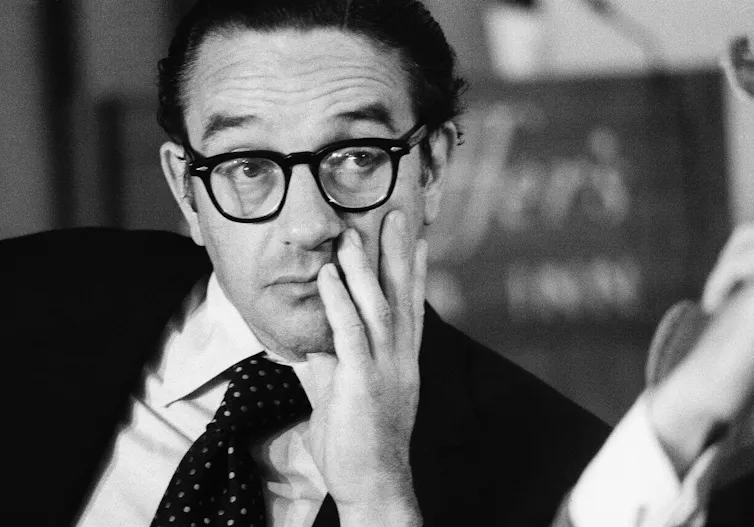
The younger Greenspan cut a different figure.
He studied clarinet at the Juilliard School and worked as a professional musician while attending New York University in the late 1940s. He was briefly married to Joan Mitchell, an art historian who introduced him to the libertarian writer Ayn Rand.
Through the 1950s Greenspan was part of Rand’s inner circle – which emphasized radical individualism, self-interest and laissez-faire capitalism – while he developed the building blocks for an economics career.
Greenspan later came under criticism for his early association with Rand. But we believe that his approach to economics was essentially practical and fact-based, not ideological.
“You begin with a conceptual framework of cause and effect,” is how he put it in the book interview. “And then you observe reality, and try to anticipate what is going to happen in the future, even though you can never see beyond a certain horizon.
"Data are a measure of what is going on in reality,” he continued. “If you want to endeavor to try to lower the probabilities of forecasting mistakes in the future, the more information you have about the structure of the system, the better off you will be.”
After completing his undergraduate degree at NYU, Greenspan moved on to graduate study at Columbia University, one of the preeminent economics departments in the country at the time. But he left academia in 1954 to join a consulting firm while still managing to publish academic work in economics.
One example was a piece that foretold economist James Tobin’s “Q theory of investment,” a tool to estimate whether a business or market is overvalued or undervalued. That insight was prominently noted in Tobin’s Nobel Prize 1981 citation.
Meanwhile, as he built his consulting firm, Greenspan took great pride in its data-based work.
“My reputation was as an economic forecaster of the United States,” he recounted in the book interview. “Through my company, I became an expert in about 15 different industries. I brought to the table types of analysis which no one else had.”
A professional turning point
It wasn’t until 1974 that Greenspan first considered public service.
Arthur Burns, a close adviser to President Richard Nixon who also served as Fed chairman from 1970-78, had mentored Greenspan and prevailed upon him to join the Nixon administration. While he shared the Republican conservatism of the administration, Greenspan had qualms about some of Nixon’s policies, such as the 1971 price and wage controls. He told Nixon’s chief of staff, Al Haig, that he would quit if Nixon went too far.
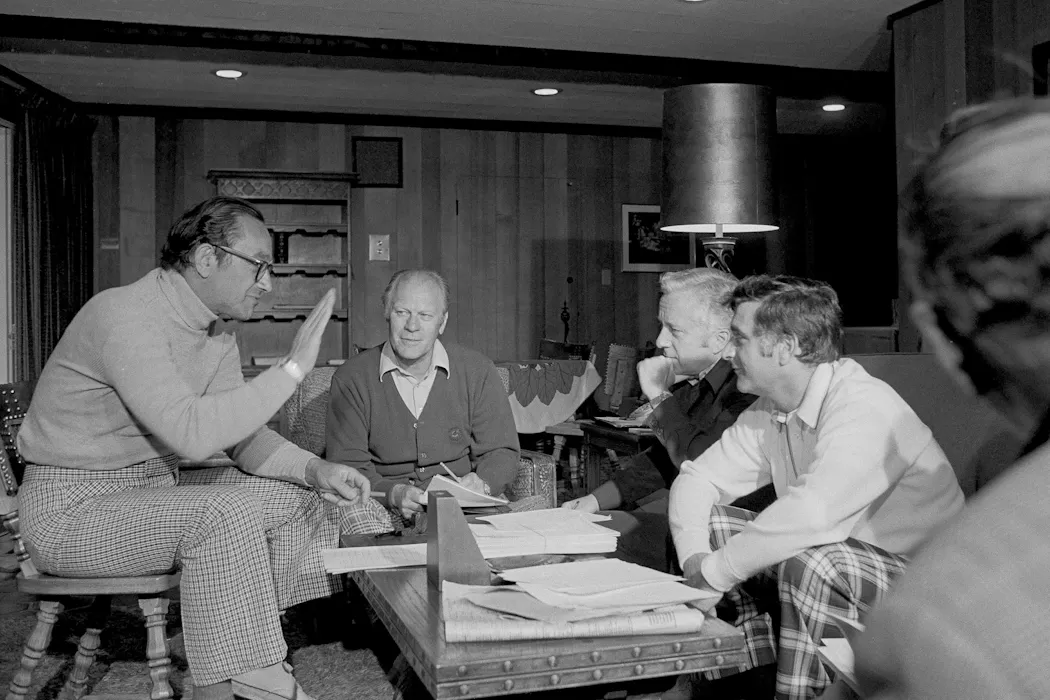
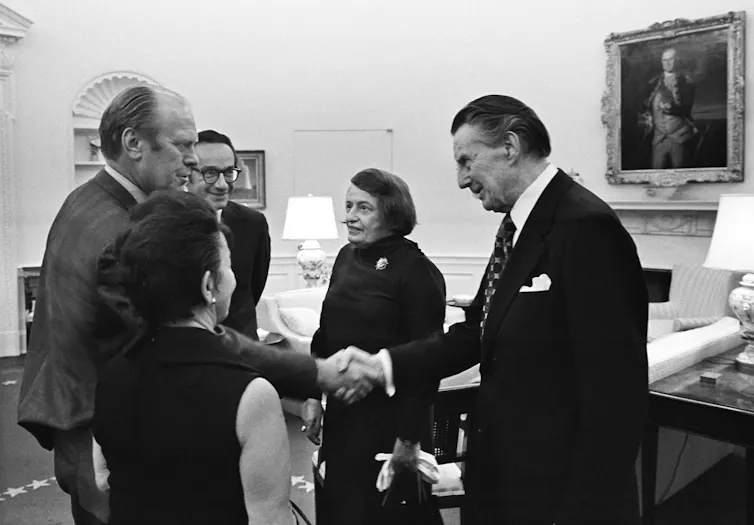
Greenspan never had to make that call – Nixon resigned before he took up the post – and he went on to lead the Council of Economic Advisers under Ford, advising the president on economic policy.
“It turned out that working for Ford was more interesting than my eighteen-and-a-half years at the Federal Reserve,” he explained in the book interview.
That job turned Greenspan into a dedicated public servant. “I saw Ford three or four times a week for one-on-one meetings,” Greenspan recalled. “I would just do what I did for my clients before I got into the cauldron of politics. And he responded like a regular businessman. We had a very good rapport.”
Ford was an “extraordinary man” who “always acted as though we were equals, which was quite remarkable,” Greenspan added. “I’ve never run into anything like it before or since.”
Era of free markets
Greenspan was called back to public service in 1987 as Fed chair, ultimately serving five consecutive terms under both Democratic and Republican presidents – Ronald Reagan, George H.W. Bush, Bill Clinton and George W. Bush. He cut a commanding presence in policy circles and congressional appearances, carefully using measured language to explain – or, just as often, to avoid explaining – what he chose to share with the public.
His long tenure as chair coincided with increasing U.S. prosperity, when free markets, free trade and deregulation seemed to serve the global economy well. It was also a period of enormous political change with the demise of the Soviet Union and the opening up of China. And central banks rose in prominence and power, as monetary policy replaced fiscal policy as the primary tool of macroeconomics.
Against this backdrop, Greenspan developed a more public role than most central bankers, in part because the new focus on monetary policy demanded it. At the time, he seemed to relish the attention, but later he looked at it differently.
“I did what I had to do, and I made decisions when I had to make them. I could argue with senators when I had to go up to Capitol Hill, and I held my own very well because I knew a lot more than anybody up there,” he said in his 2016 interview. “But it wasn’t an enjoyable function since none of the people were analytical or conceptual. They had opinions without any reasoning.”
A reckoning after the crisis
Greenspan’s obsession with data notwithstanding, it’s sometimes difficult to uncover an analytical framework underlying his approach to macroeconomics – aside from his preference for a very light regulatory hand, particularly in financial markets. But to his credit, he acknowledged the inadequacies of the frameworks that led to the financial crisis in 2008. While the crash happened after his watch, many scholars point to monetary policy under his Fed in the preceding years as a key factor.
“Each of us has a model in our heads; some of them work, and some of them don’t,” he conceded in the 2016 interview. “What you need to measure is continuously evolving. I know that because the Federal Reserve had an extraordinarily good and very sophisticated model, but it did not capture what was wrong that led to the crisis in 2008.”
Greenspan was often accused of excessive self-confidence. But his own description of his role – an introvert and the “side man” in the dance band – might be more accurate. The man who began his career reading scores written by other people in the band ended up with the whole world trying to read him.
This article was updated on June 23, 2026 to correct the identification of Greenspan’s first wife.
This article was originally published on The Conversation. Read the original article.