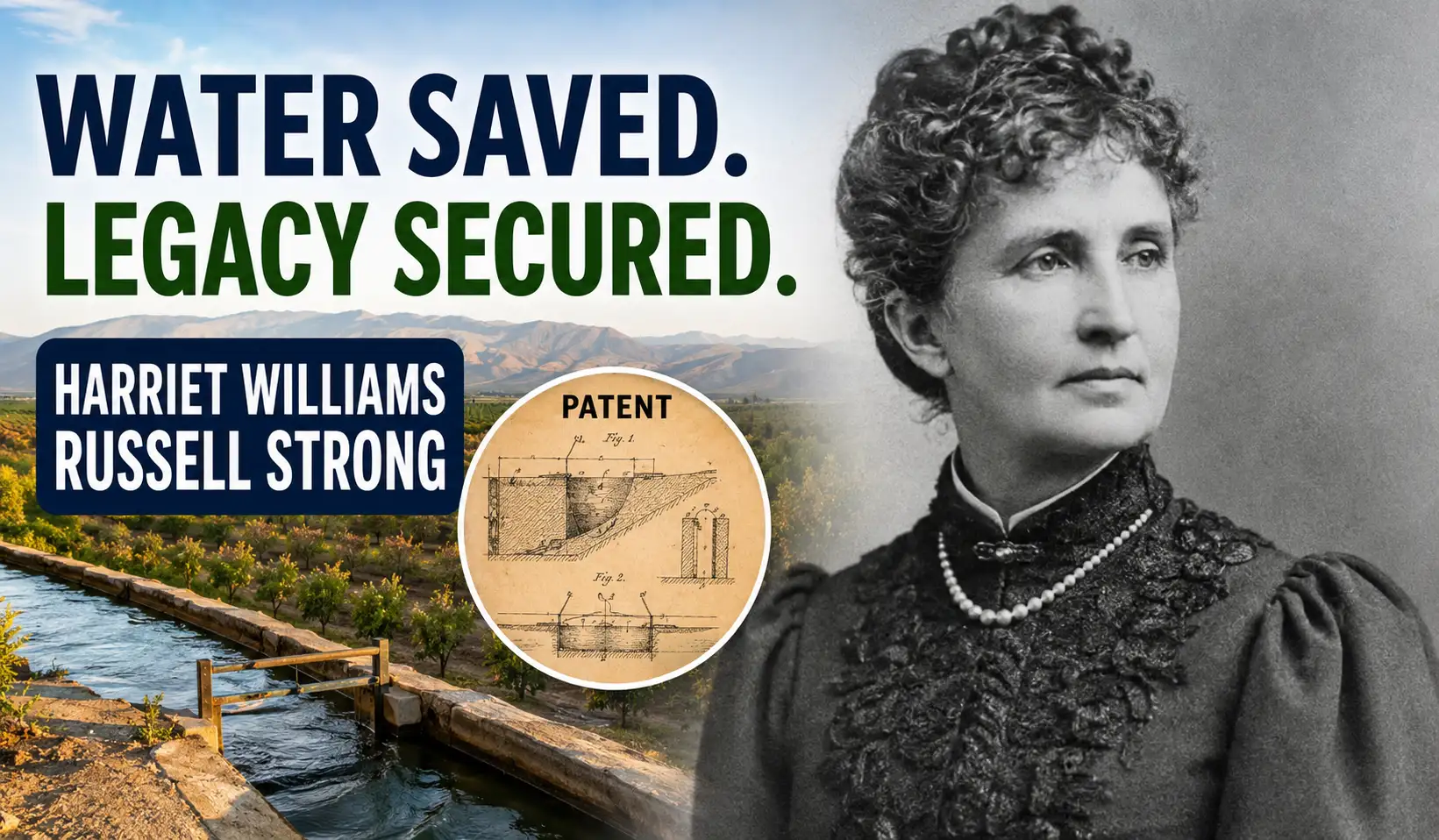
In 1883, Harriet Williams Russell Strong faced total ruin. Her husband had just died by suicide. She was left alone with four young daughters, a heavily mortgaged 220-acre California ranch, and zero income. She had no formal engineering or business training. But she refused to lose her family home.
Southern California was brutal. Dry summers scorched crops. Wild winter floods washed away precious topsoil. Harriet spent months studying how water flowed across her land. In 1887, she patented a groundbreaking stepped-dam water conservation system. Her invention safely stored floodwaters for summer dryland irrigation.
To survive while her walnut trees grew, she raised pampas grass for the booming millinery hat trade. Within five years, Harriet cleared every debt. She built the largest commercial walnut operation in the United States, earning the title "Walnut Queen."
Her simple water designs changed Western agriculture forever. Here is how a widowed mother outsmarted the desert.
How one widow changed California's water future
When Harriet Williams Russell Strong was widowed in the 1880s, she inherited far more than grief. She was left with four young daughters, a struggling ranch in Southern California, and mounting debt during a period when drought and unreliable rainfall threatened agriculture across the region.
Rather than abandoning the land, Strong began studying how rainwater and seasonal floodwaters behaved. Although she had never studied engineering, she experimented with ways to capture, store and reuse water instead of allowing it to disappear after storms.
Her practical observations soon became a completely new approach to farming in one of America's driest landscapes.
How Harriet Williams Strong developed new irrigation ideas
Strong designed systems that collected floodwaters and directed them into reservoirs for later agricultural use. She believed California could thrive only if water from wet seasons was stored efficiently and distributed during dry months.
Her work eventually resulted in several U.S. patents covering reservoir construction and water conservation systems. At a time when very few women held engineering-related patents, Strong established herself as an inventor whose ideas attracted attention from farmers, business leaders and policymakers.
The techniques also helped improve irrigation efficiency for orchards growing crops that required dependable water supplies throughout the year.
How a struggling ranch became one of America's leading walnut farms
The new irrigation methods transformed Strong's own property first.
Within less than five years, she brought the debt-ridden ranch back to profitability. She expanded commercial production of walnuts, olives and pomegranates while also cultivating fast-growing pampas grass, whose decorative plumes were sold to the millinery industry for women's hats.
Her walnut orchards proved especially successful. Strong became widely known as the "Walnut Queen" and was recognized as one of the leading commercial walnut growers in the United States during the late 19th century.
Her success demonstrated that careful water management could make productive agriculture possible even in regions facing frequent water shortages.
How Harriet Williams Strong's influence reached beyond agriculture
Strong never limited her work to her own land.
She spent years promoting improved water storage across California, arguing that reservoirs and floodwater conservation would strengthen agriculture throughout the state. Many of her ideas anticipated later investments in large-scale water infrastructure across the American West.
She was equally active in public life. Strong campaigned alongside women's suffrage leader Susan B. Anthony, advocating for women's voting rights, financial independence and access to higher education.
Her achievements also broke barriers in business and education. She became the first woman elected to the Board of the Los Angeles Chamber of Commerce and later served as the first female Trustee of the University of Southern California Law School.
Why Harriet Williams Strong's legacy still matters today
More than a century later, California continues to struggle with drought, groundwater depletion and increasing pressure on water supplies driven by climate change.
Many of the principles Strong promoted—capturing floodwater, storing seasonal runoff and using irrigation efficiently—remain central to modern water conservation strategies. Today's engineers employ more advanced technology, but the basic philosophy of making every drop count closely reflects the ideas she championed in the 1890s.
Harriet Williams Russell Strong proved that innovation is not always born inside laboratories or engineering schools. Sometimes it begins with necessity, careful observation and the determination to solve a problem that affects an entire community.
FAQs:
What was the "millinery trade," and why was pampas grass so profitable?
The millinery trade was the 19th-century women’s hat-making industry. Victorian fashion called for elaborate hats decorated with large, fluffy plumes. Pampas grass produced soft, feathery white stalks that hatmakers used as a cheap alternative to costly ostrich feathers.
Walnut trees take up to five years to produce a profitable harvest. By planting fast-growing pampas grass between her immature trees, Harriet generated immediate, high-margin cash flow to pay off her farm's debts without waiting on her walnut crop.
How did Harriet's "stepped-dam system" actually store water without bursting?
Harriet’s 1887 patent solved this using structural counter-pressure. She designed a series of curved, ascending dams down a sloped canyon or riverbed. As winter floodwaters filled the canyon, water collected in each lower reservoir pressed against the backside of the dam directly above it. This water cushion acted as a natural brace, distributing hydraulic weight evenly, preventing dam bursts, and safely holding runoff for dry summer irrigation.
The Economic Times