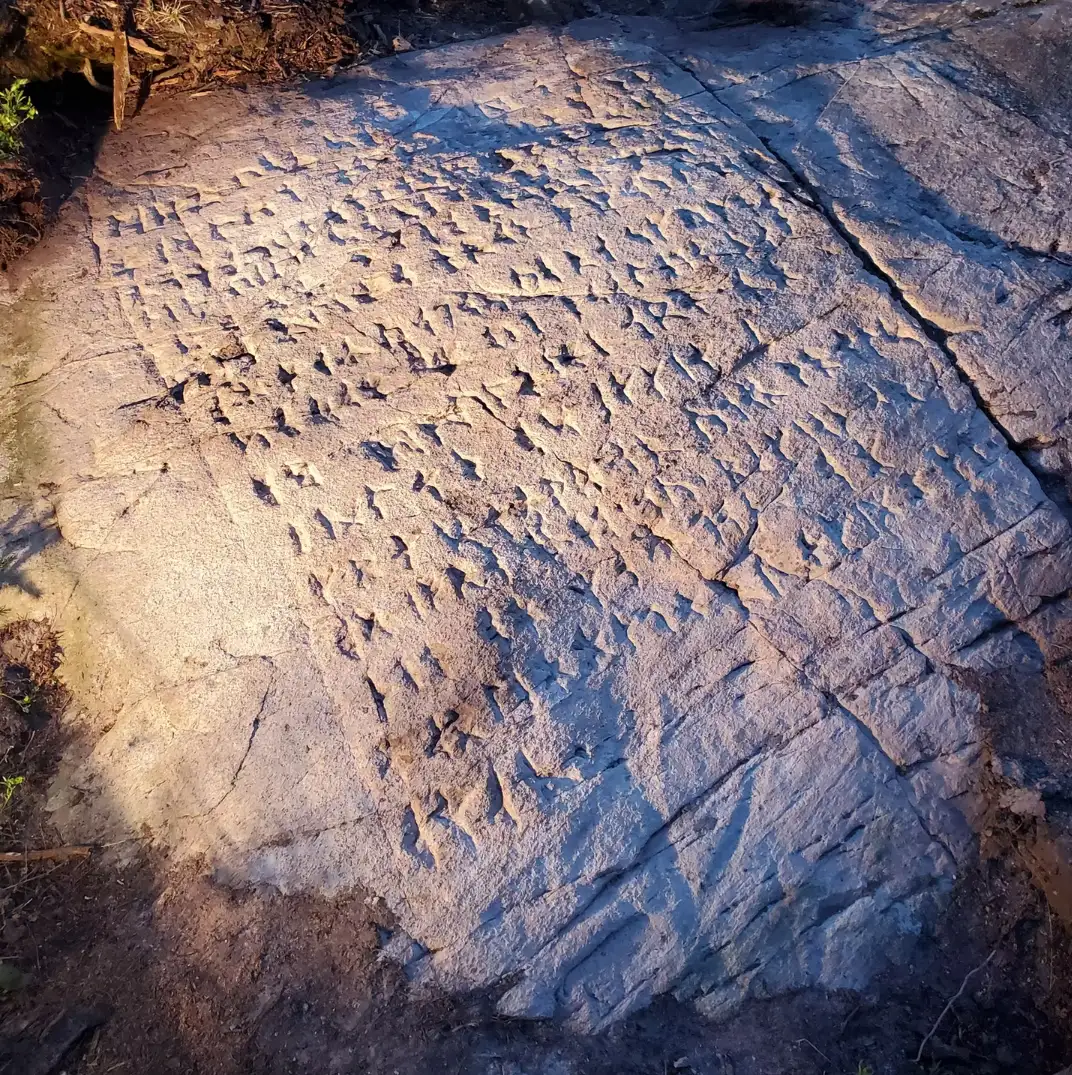
For years, it lay hidden beneath the soil of a remote Ontario forest, concealed by earth, moss and the roots of towering trees. Then, a fallen tree exposed something extraordinary: hundreds of carefully carved runes etched into a bedrock, accompanied by the image of a boat filled with passengers. What initially appeared to be an unsolved archaeological mystery has now become one of the most fascinating runic discoveries ever made in North America.
Researchers believe the inscription, known as the Wawa Runestone, may be the longest runic text ever found on the continent. Even more remarkably, experts say it is the only known runic inscription in the world that preserves the complete Lord's Prayer.
What is the Wawa Runestone?
The Wawa Runestone was discovered near the town of Wawa in northern Ontario after a tree fall exposed a previously buried section of bedrock. Researchers from the Ontario Centre for Archaeological Research and Education (OCARE) began investigating the site after photographs of the unusual carvings reached archaeologists. What followed was a multi-year effort involving archaeologists, historians and runologists to decipher the mysterious markings.
The inscription consists of 255 runic characters arranged within a rectangular panel measuring approximately 1.2 by 1.5 metres (about four by five feet). Alongside the text is a detailed carving of a boat carrying 16 figures and a series of 14 X-shaped symbols whose meaning remains uncertain.
The longest runic inscription in North America
Runes are letters from ancient Germanic alphabets used across Scandinavia and parts of northern Europe before the widespread adoption of the Latin script. While a handful of runic inscriptions have been found across North America, many have been controversial or later dismissed as hoaxes.
According to runologist Henrik Williams of Uppsala University, the Wawa inscription stands apart. In a report cited by OCARE, Williams described it as "the longest runic inscription of any on the North American continent." He also noted that Ontario had never previously produced a verified runic inscription of this scale.
The discovery immediately drew comparisons with famous finds such as the Kensington Runestone in Minnesota, an artifact that has sparked debate for more than a century regarding its authenticity and origins. Unlike many earlier discoveries linked to speculative Viking narratives, experts studying the Wawa inscription do not believe it represents evidence of medieval Norse exploration.
A surprise hidden in the runes: The Lord’s Prayer
The breakthrough came when specialists translated the inscription and discovered that the text was not a Viking saga, exploration record or ancient memorial. Instead, it was a Swedish-language version of the Lord's Prayer.
Researchers determined that the text corresponds to a form of the prayer used in Sweden from the 16th century onward. The inscription was written using a variation of a runic system developed by Swedish scholar Johannes Bureus in the early 1600s. Bureus played a major role in preserving and promoting runic writing during a period when interest in Scandinavian history and language was growing.
According to OCARE, the Wawa Runestone is currently the only known runic inscription anywhere in the world that reproduces the complete Lord's Prayer. This singular characteristic has elevated the site's significance beyond Canada and attracted international scholarly attention.
Who carved the stone?
Although the exact identity of the carver remains unknown, evidence currently points toward the early to mid-19th century rather than the Viking Age.
Experts believe the inscription may have been created by a Swedish individual connected to the fur trade, possibly an employee of the Hudson's Bay Company, which operated trading posts throughout northern Canada during that era. The use of Swedish language, combined with the specific runic style employed, strongly supports a post-medieval origin.
The mystery of the boat and the fourteen marks
While the text has largely been deciphered, several elements of the site remain unexplained.
The boat carving, which depicts 16 figures, has become a particular focus of interest. Scholars have yet to determine whether it represents a specific expedition, a symbolic religious image or a reference to transportation associated with the fur trade. Similarly, the purpose of the 14 X-shaped markings carved near the vessel remains unknown.
These unanswered questions continue to fuel research and debate. Unlike the inscription itself, which can now be read and understood, the imagery offers no straightforward clues about the intentions of the person who created the monument.