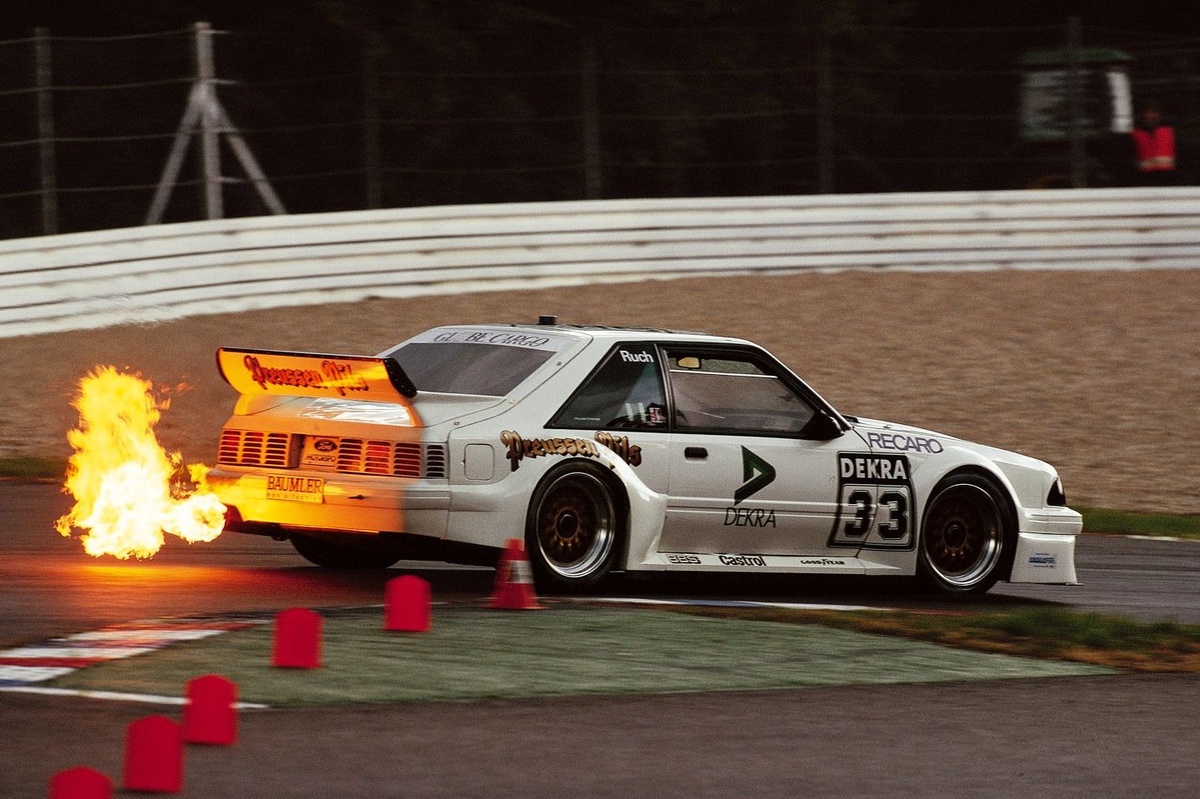
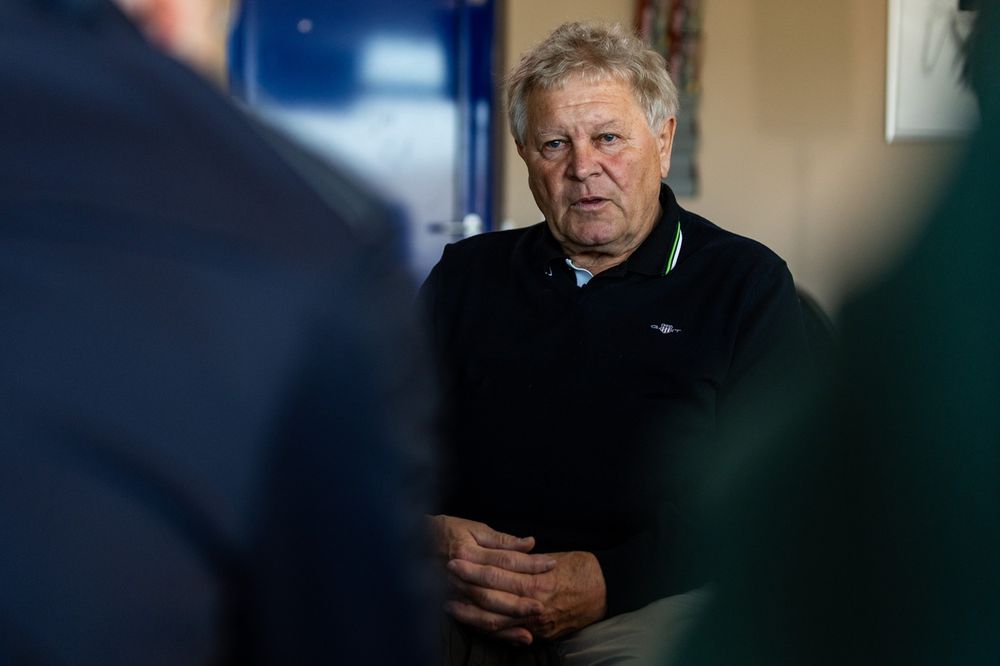
“The Mustang destroyed my hearing,” says Gerd Ruch, as he asks people to speak louder. And yet the Berlin-based heating engineer and amateur racer still looks back with great passion on the years between 1988 and 1994, when he and his brother Jurgen Ruch turned the Ford Mustang with its legendary sound and flames shooting from the rear into a cult icon in the DTM.
“That was the best era of motorsport ever,” says the now 72-year-old, who has been involved in motorsport since 1973. “You simply can’t top it.” Even while setting up his team in the paddock, fans would line up and ask for autographs. “They knew more about my life than I did myself,” he says with some amazement. “They were completely immersed in it.”
Ruch was their great favourite, even though — or perhaps precisely because — he scored just four points and a single tenth place in 95 DTM races with the privately-run Mustang. He was the Don Quixote of the DTM, fighting the mighty factory teams in the “white giant”.
Ruch on the Mustang project: “I wanted to quit every year”
It had never been the plan for Ruch, who had only competed sporadically in races before entering the DTM in 1988, to run the Mustang in the championship for seven years.
“I wanted to quit every year because we had so much work,” he recalls. “Working 20 hours a day. At the same time, I still had to run my company.”
But the Mustang project gradually became something of an addiction, also thanks to the enormous support from fans and the respect of rivals — even though he and his crew often spent entire nights working on the car.
“Every year you’d say: 'now we’re so well accepted here and everyone loves us.' So you keep going.”
“I wasn’t really an American car fan”
But how did the curly-haired racer, originally from Hesse who later moved to Berlin and ran a building technology company, end up entering the DTM with an American muscle car? Was it simply fascination with the Mustang?
“No, that wasn’t it for us,” Ruch says, shaking his head. “I wasn’t really an American car fan. The Mustang was simply the cheapest car where you could buy performance at the lowest price. I paid $16,000 in the US for 550 horsepower.” Engine rebuilds in the United States also cost no more than $5,000.
“At that time, a BMW or Mercedes engine already cost 80,000 Deutsche Marks,” Ruch recalls — nearly three times the price despite delivering less power. “That was our motivation. We had to build the car and develop everything ourselves, but I didn’t have a power problem.”
As a base, Ruch used what was known as a “Luxembourg Mustang”, essentially a production car because no bare chassis was available.
“We stripped it, took it apart, re-welded and rebuilt it.” The engine came from American Car Service in Dusseldorf, a company that had also competed in the early years of the DTM with a Chevrolet Camaro.
“It looked like a ship’s diesel,” he says with a smile. “But I realised that even back then I could keep up with the other cars in terms of performance.” That was enough motivation to continue with the Group A machine after two appearances in 1988 in Hungary and at Hockenheim.
Weakness in the corners: “We had to brake 80 metres earlier”
After numerous retirements and difficulties qualifying, Ruch caused a real sensation for the first time in 1990 at the AVUS in Berlin. In the qualifying race, he fought his way to the front and even sensationally led the field before colliding with BMW driver Steve Soper.
On the high-speed circuit, nobody could match the power and acceleration of the Mustang with its five-litre V8 engine — but Ruch was vulnerable under braking.
“At that time we still had problems with the brakes,” he explains. “At Hockenheim, we reached 330 km/h on the forest straight, but before the first chicane we had to brake at 180 or 200 metres.”
Later, when the team installed a Bosch ABS system — which Ruch obtained with the help of Mercedes motorsport boss Norbert Haug — and gained access to better tyres, he could brake at the 120-metre mark.
“You can be fast on the straight for as long as you want,” he says with a shrug. “If you have to brake 80 metres earlier, everyone drives past you.”
“Klaus Ludwig told me to take the cutting torch”
Gerd Ruch and his brother Jurgen Ruch, who joined the Ruch Motorsport team in 1992 and drove a second Mustang, also spent countless hours working on the car in their workshop in Berlin’s Wedding district. In the process they significantly improved the weight distribution and reduced the car’s weight from 1,500 to 1,060 kilograms.
“Mr Klaus Ludwig once told me: 'You have to take the cutting torch and cut everything out',” Ruch recalls. “So that’s what we did.”
“We then installed a proper rear axle setup. That was the current version of the car — and it really was a good car.”
Hockenheim 1992: Rivals form guard of honour for Mustang hero
Ruch’s sporting highlight came in 1992 at the season finale in Hockenheim, where he finished 10th — scoring his first two points in his 57th DTM race. When the Mustang drove into the pit lane after the race, rivals including Haug formed a guard of honour for the secret hero, who also received the biggest applause from the grandstands in the Motodrom.
“Well, okay, you scored some points,” Ruch downplays it today. “But we weren’t racing to score points. My competitors were the other privateers — Severich, Murmann and all the others. If we were mixing it up in the middle of them or even ahead of them, that was already a success.”
When the DTM’s escalating technological arms race could no longer be stopped with the introduction of the Class 1 regulations — bringing Formula 1-level technology into what had once been a touring car series — the Mustang era also came to an end.
“They didn’t really want us anymore,” Ruch believes.
Fans called Ruch a “traitor” after Mercedes switch
Thanks to Haug, Ruch received a Mercedes car for the 1995 season and briefly got a taste of factory backing. But after the Mustang years, the move caused unrest among fans.
“That went down badly with our fans,” Ruch says. “They already started calling us traitors.”
When the DTM became the ITC in 1996 as part of its international expansion, it was finally over.
However, the popularity of the man himself never faded. Mustang fans eventually forgave the Mercedes detour, and his autograph is apparently still in demand today.
“I notice it at every event,” Ruch reveals.
“For example, if I go testing at the Oldtimer Grand Prix, the following week I receive 20, 30, 40 autograph requests,” he says with an incredulous smile. “You’d think people would slowly have passed away by now. The fact they still remember it ...”
With the Mustang’s return to the DTM through HRT, there may soon even be a few new ones.