The Russia-Ukraine War did not begin as a drone war. It began with tanks, artillery barrages, and the grinding logic of territorial conquest. But somewhere between the first weeks of the invasion and the brutal stalemate that followed, something fundamental shifted. Cheap, disposable, commercially sourced drones began appearing everywhere along the front lines — buzzing over trenches, guiding artillery strikes, diving into tank hatches. By 2024, an estimated 10,000 drones per day were being deployed across the battlefield.
What makes this conflict so uniquely instructive is not the sophistication of the hardware involved. Most of the decisive drones cost between €300 and €5,000 — the price of a used motorcycle or a high-end laptop. Ukraine built much of its drone program on crowdfunded civilian donations, commercial DJI components, and smartphone-era navigation software. The Russia-Ukraine drone war is not a story about exotic military technology.
How drones in the Russia-Ukraine war changed ground combat forever
Before this conflict, the dominant assumption in Western military circles was that advanced platforms — stealth jets, precision missiles, main battle tanks — would define future warfare. Ukraine shattered that assumption. Drones responsible for up to 75 percent of combat losses on both sides is not a figure that leaves room for ambiguity.
The Russia-Ukraine conflict is now producing a staggering operational tempo. According to defense analysts, approximately 9,000 drones operate daily across the frontlines as of early 2026, generating terabytes of real-time battlefield data.
Ukraine alone struck over 105,200 targets in February 2026 in a single month. These are not abstract numbers. Behind each strike is a pilot hunched over a screen, watching grainy FPV footage, making a split-second decision that would once have required an air force, a targeting chain, and weeks of planning. The drone warfare Russia-Ukraine war has compressed all of that into minutes — sometimes seconds.
What makes this conflict uniquely consequential is not just the technology. It is the lesson embedded in the chaos: that a smaller, outgunned nation facing a nuclear-armed adversary can achieve tactical parity — and sometimes superiority — through scale, speed, and ruthless innovation.
Ukraine had almost no domestic drone industry in 2022. By 2025, it was operating roughly 500 drone manufacturers and producing 200,000 FPV drones per month. That transformation is one of the most remarkable industrial pivots in modern military history. And it tells us something profound about the future of war.
The battlefield has become transparent to a depth of 10 to 20 kilometers. Nothing moves unobserved for long. A column of infantry, a supply truck, a mortar team setting up position — all of it becomes visible within minutes to a drone operator wearing a virtual-reality headset kilometers away. This is what military analysts call the "reconnaissance-strike complex," and drones are its nervous system.
First-person-view (FPV) kamikaze drones have become the conflict's most feared weapons at the tactical level. Comparable in effect to miniature anti-tank missiles, they are produced in the hundreds of thousands per month. In some Ukrainian assault units, drones now constitute up to 60 percent of deployed assets. That number alone should stop any defense planner cold.
Why the Russia-Ukraine drone war exposed a global procurement crisis
The speed of innovation in Ukraine's drone ecosystem runs on a cycle measured in weeks, sometimes days. A new jamming frequency emerges from Russian electronic warfare units — and within days, Ukrainian drone software is updated to compensate. An effective counter-drone tactic appears on the Russian side — and within weeks, Ukrainian operators have adapted their flight patterns, approach vectors, and swarming tactics. This is not how traditional defense acquisition works anywhere in the West.
France offers an instructive case. Despite being a major NATO power with a sophisticated defense industrial base, France fell approximately 15 years behind in combat drone development — a gap shaped by institutional culture that prioritized human-controlled airpower and manned systems, combined with procurement cycles too slow to respond to battlefield-speed innovation.
This is the lesson every military needs to internalize from the Russia-Ukraine drone war: the speed of adaptation now matters more than the sophistication of the initial platform. A drone that is slightly less capable but updated weekly will outperform a more advanced system that received its last software patch eight months ago. The race is not to build the best drone once — it is to build a system that can build better drones faster than the adversary can counter them.
How FPV Drones in Ukraine Destroyed the Economics of Modern Warfare
The most disorienting shift in the drone warfare Russia-Ukraine war is not tactical. It is economic. A Russian FPV kamikaze drone costs between $400 and $2,000 to build.
An American-supplied M1 Abrams tank costs between $8 million and $10 million. In some sectors along the eastern front, these cheap drones have accounted for up to 90 percent of Russian vehicle losses — a cost asymmetry so extreme it borders on the absurd. As the Hudson Institute's analysis of drone battlefield lessons notes, the war's defining feature has become the mass deployment of cheap, disposable, and networked technologies — particularly drones, loitering munitions, and small-scale electromagnetic warfare systems.
Russia's Lancet loitering munition, a purpose-built weapon that uses AI-guided terminal seekers to hit high-value targets at ranges of 40 to 70 kilometers, has documented over 1,500 confirmed strikes by early 2025 — primarily targeting artillery systems, air defense radars, and electronic warfare stations. Ukraine's Operation Spiderweb in June 2025 demonstrated the other side of this calculus.
Ukrainian operatives reportedly smuggled FPV drones inside modified civilian trucks and launched simultaneous strikes against multiple Russian strategic airbases, destroying or damaging 41 aircraft — including Tu-95 and Tu-22 strategic bombers — and inflicting an estimated $7 billion in damage. The entire operation used 117 FPV drones. That arithmetic — 117 cheap drones erasing $7 billion in strategic assets — is the new math of drone warfare Russia-Ukraine war, and it is irreversible.
This has not gone unnoticed in Washington. The U.S. Army is now rethinking tank tactics, procurement timelines, and infantry doctrine based directly on Ukrainian battlefield data.
War Secretary Pete Hegseth issued a directive ordering every Army squad to be equipped with unmanned systems by the end of 2026. Army Chief of Staff General Randy George testified to Congress in mid-2025 that technology is changing too fast to keep building large platforms that take years to develop and can become obsolete the day they're fielded. The drone warfare Russia-Ukraine war has forced the world's most powerful military to look east for doctrinal lessons it never expected to need.
What Is a "Transparent Battlefield" — and Why There Is No Safe Zone Left
One of the most unsettling outcomes of drone warfare in Russia-Ukraine is the complete elimination of what soldiers once called "dead ground" — terrain where troops could shelter, regroup, or move without being observed. Analysts now call this the "transparent battlefield," and it is exactly what it sounds like: a war zone where near-constant aerial surveillance means virtually nothing moves undetected for long.
Ukrainian infantry have described the psychological toll in stark terms. There are now so many drones in the sky, one Reuters report captured soldiers saying, that it is difficult to move to and from trenches without being detected or attacked. The FPV drone has operationalized this surveillance. A reconnaissance drone identifies a target.
A strike drone is launched within minutes. The kill chain — from detection to impact — has been compressed to under 10 minutes in some documented cases. Russia has formalized this into doctrine: real-time drone video feeds are now integrated directly with artillery systems, creating persistent battlefield visibility and enabling rapid re-targeting that reduces ammunition waste significantly.
Ukraine has answered with its "Delta" battlefield software platform, which fuses data from drones, satellites, sensors, and human intelligence into a comprehensive, constantly updated picture of the frontline — a kind of God's-eye view of a war where the sky never sleeps. This platform, developed organically by Ukraine's civil-military innovation ecosystem, stunned NATO commanders during the Hedgehog 2025 exercise, where a small team of Ukrainian drone operators using Delta software effectively countered an entire British brigade and an Estonian division.
The lesson was embarrassing for NATO and clarifying for everyone else: in drone warfare Russia-Ukraine war, software and adaptability now matter as much as hardware and firepower.
This battlefield transparency has also pushed both sides into a relentless electronic warfare competition. GPS denial is now a baseline assumption on the frontline. Russia invests heavily in jamming systems. Ukraine responds with fiber-optic tethered FPV drones — drones that use physical cables instead of radio signals, making them immune to jamming. These are no longer niche systems; they are becoming a substantial and growing segment of frontline munitions delivery, especially in GPS-denied airspace.
The cat-and-mouse dynamic of drone warfare Russia-Ukraine war plays out daily, in real time, with engineers feeding lessons from morning combat into afternoon software updates.
What Drone swarms really mean for air defense and NATO strategy
Western air defense doctrine was not designed to stop swarms of cheap drones. It was designed to stop sophisticated cruise missiles and fighter jets — expensive threats that justified expensive interceptors. The drone war in Ukraine has exposed the devastating asymmetry at the heart of this model. Shooting down a €400 Iranian Shahed drone with a surface-to-air missile costing €500,000 is not a sustainable defensive equation.
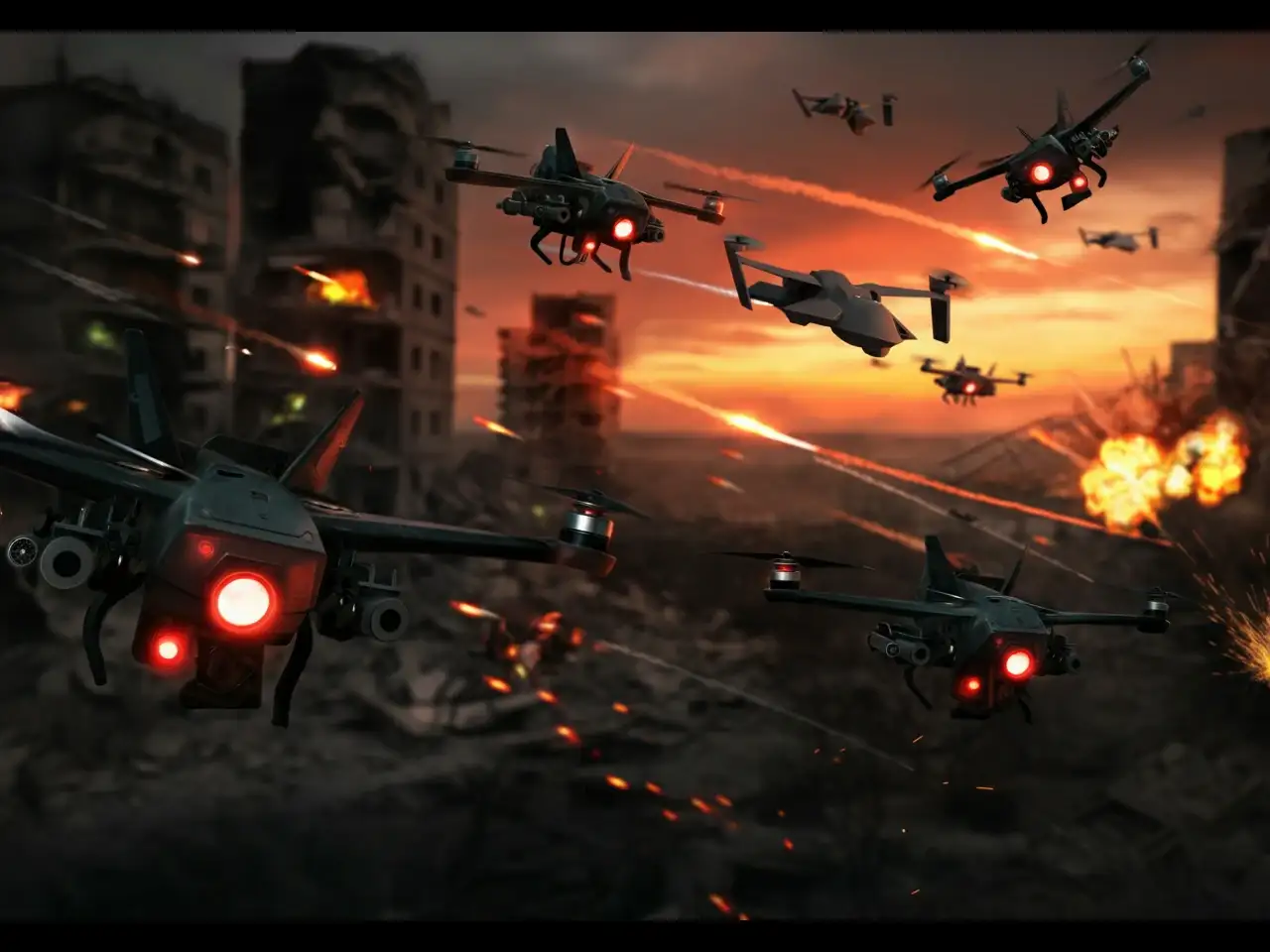
Swarms of cheap drones overwhelm radar systems and interceptors by exploiting volume. They force defenders to exhaust high-value air-defense ammunition before more sophisticated threats arrive — exactly the combined-arms logic that underlies Russian long-range strike doctrine, where Shahed drones fly alongside hypersonic missiles, using mass to punch gaps in layered air defenses. The result is a structural vulnerability in NATO-standard air defense that the conflict has exposed repeatedly.
For NATO planners, this means rethinking what air superiority actually means in an era of drones in the Russia-Ukraine War paradigm. It is no longer simply a question of controlling the skies with jets and helicopters. Drone superiority — the ability to out-produce, out-update, and out-swarm an adversary's drone fleet — has become a parallel and equally vital form of air dominance.
Drones are not the end of war — But they are the end of war as we knew it
It would be tempting to conclude from the Russia-Ukraine experience that drones have decisively transformed warfare in the way that nuclear weapons transformed deterrence or blitzkrieg transformed operational art. The honest assessment is more complex and ultimately more sobering. Despite 10,000 drones per day, despite FPV strikes accounting for the majority of armored losses, despite unprecedented battlefield transparency — neither side has achieved a strategic breakthrough through drones alone.
Drones in the Russia-Ukraine War are a tactical revolution constrained by strategic continuity. They have transformed how battles are fought without yet transforming who wins wars. Clausewitz still applies: war remains an instrument of policy, decided ultimately by the ability to hold ground, sustain forces, and break the adversary's political will to continue. No drone swarm has yet achieved any of those things independently.