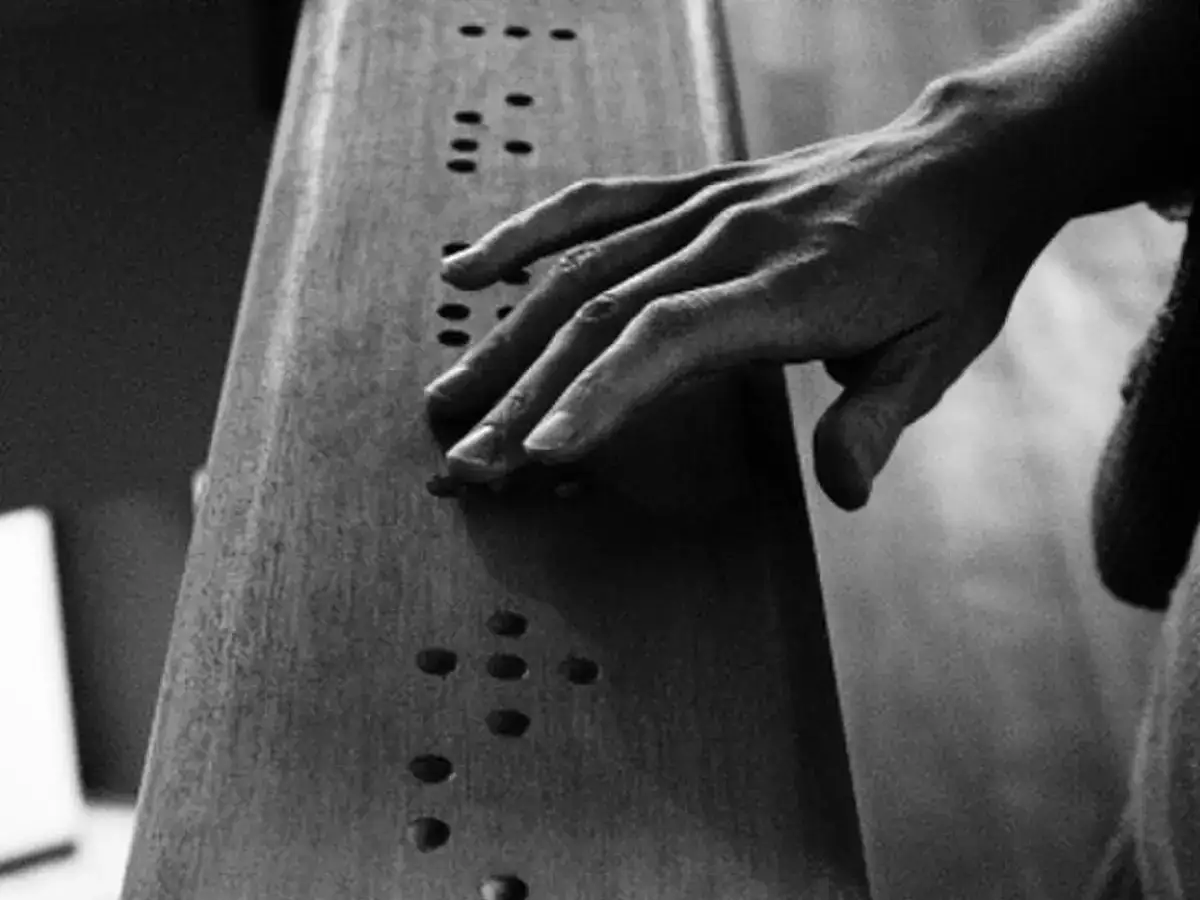
Fifteen years of age, Louis Braille devised a dot-based system for reading which was to revolutionize literacy among the blind population across the globe. A solution to an academic problem in early 19th-century Paris, Braille's system has become a very significant tool in terms of accessibility and mobility. By means of a raised-dot pattern, it facilitated reading and writing through touching tiny cells.
The simplicity, portability and practicality of the invention were not the only factors that contributed to its success. Even today, after nearly two centuries have passed, the system is widely applied in schools, publications, public signs, elevators, drug labels, and technological gadgets. Moreover, Braille research continues exploring the ways the raised-dot system enhances tactile reading and learning. The key to the system's success lies in its ability to resolve a real problem efficiently.
Louis Braille invented the system as a student
As a student of the National Institute for Blind Youth in Paris, Louis Braille invented his reading system. In accordance with the Library of Congress, the system is based on a six-dot cell as its primary element. Various combinations of those six dots represent letters, numbers, punctuation marks, and words.
Prior to the development of Braille, there were several attempts to create raised print systems, but these were not easy to read and were not produced quickly. However, Braille had a unique advantage because it was specifically tailored to be used by fingers. The compact nature of the symbols allowed faster recognition.
According to historians, this aspect contributed to the rapid adoption of the new technology outside the classroom environment where it emerged.
Significance of the six-dot cell
The six-dot cell became the key component of the Braille code. All characters can fit in this area and can be easily recognized through touch. According to the Library of Congress, this uniformity allowed Braille to become a teachable language. In addition, the six-dot cell design demonstrated great versatility. Users can transition from recognizing individual letters to understanding whole sentences.
As a result, Braille became not just an educational tool but a complete writing system. However, it is often stated that the majority of inventions fail due to solving only one problem. The success of the Braille system is its ability to fit into a life routine.