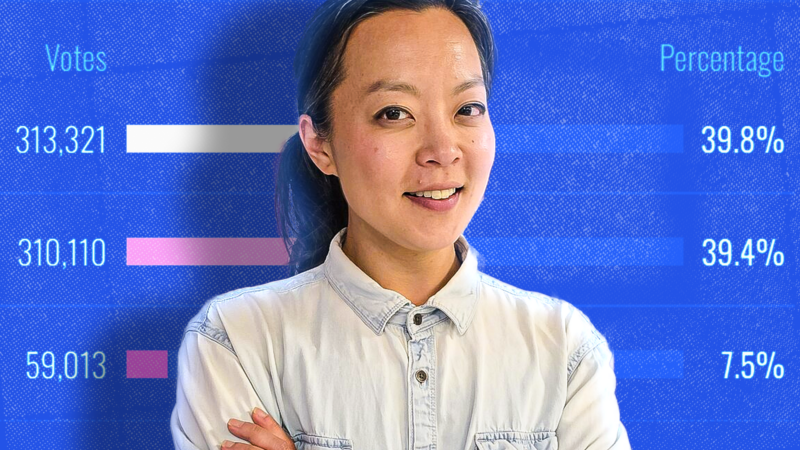
David Crowley beats Francesca Hong: Why was the whole country watching Wisconsin's gubernatorial race? Because Francesca Hong seemed like an Alexandria Ocasio-Cortez-esque character: a socialist bartender and chef, with good political instincts, who seemed to come out of nowhere.
Now, she's out. The Milwaukee County executive, David Crowley, beat her and will now face off in the general with Rep. Tom Tiffany, "a Republican with close ties to President [Donald] Trump who easily won his party's primary," notes The New York Times.
Crowley is decently pro-business and comparatively moderate for a Democrat. He will certainly be a welcome improvement over Hong, who felt like a blast from the woke past (wanting to cancel Thanksgiving!) and was a legitimate class warrior who wanted to massively redistribute the wealth of the rich in her state.
This is all a bit of a surprise: Polls did not anticipate this good of a performance from Crowley. When Hong had been surging, "Crowley had suspended his campaign in early July only to jump back in a few weeks later shortly after Wisconsin Lt. Gov. Sara Rodriguez was forced to leave the race amid a campaign finance scandal," reports Politico.
So far this year, candidates from the Democratic Socialists of America (DSA) have logged House primary wins in New York City, Detroit, Philadelphia, and Denver. But it's possible that this phenomenon is limited to really urban, really blue areas, and that more normal suburban and rural voters are freaked out by this rhetoric. We should take the DSA momentum seriously, but these candidates' appeal might be blessedly limited.
It had really seemed like Hong was going to win it all, but it's a huge relief that she didn't. With all due respect (to bartenders, but not to socialists), let's hope she goes back to bartending—no need for politics.
Wisconsin moderate wins: Rebecca Cooke won her primary in Wisconsin, vying for a seat in the U.S. House. Cooke is the daughter of dairy farmers, who worked as a waitress and now runs a small business. She describes herself, via her campaign website, as having "worked her way through college with the help of Pell Grants, local scholarships, financial aid, and multiple jobs." She's portraying herself as an everywoman in a campaign season where that type of Democrat has been hotly desired by operatives, but she legitimately seems a helluvalot better than, say, Maine's disgraced Graham Platner. The electorate agreed: Cooke won the Democratic primary easily and will now go up against Rep. Derrick Van Orden, a Republican who is running for his third term ("who defeated her in 2024 by fewer than three percentage points," adds The New York Times).
Wisconsin's third congressional district—where Cooke and Van Orden will face off—is kind of weird. It went for Barack Obama, then it went for Trump in the last three presidential races. Cooke has faced her opponent before and seems to be approaching this race with some caution and prudence: There is no talk of Medicare for All, socialism, the American Israel Public Affairs Committee (AIPAC), or any of that. She doesn't seem to be that kind of Democrat. She seems like a straight shooter in a district that probably needs that type of candidate.
Minnesota progressive wins: Matt Little won his primary in Minnesota for a seat in the U.S. House. He now faces a Republican come November, but his odds look decent. He's rather different than Cooke, and definitely has more in common with the DSA wing of the Democratic Party, but still styles himself a "local guy" and plays up the everyman energy. "I'm running for the healthcare my Mom needs, the retirement my Dad earned, and the future my daughter deserves," reads his campaign website. Not bad. Of course, Little also promotes Medicare for All, opposes AIPAC, talks about taxing the ultra-wealthy, and wants to "get our country back from the oligarchs." So he appears to be splitting the difference between Hong's style and Cooke's.
Little's victory against state Rep. Kaela Berg and state Sen. Matt Klein will be used as evidence that someone further to the left can win in a moderate area. But it might not be that moderate of an area these days: "The Second Congressional District, just south of the Twin Cities, is the only open House contest in the state," reports The New York Times. After it was won "handily in 2024, it is now considered to favor Democrats."
The upshot: Beware the pundits and their overly tidy extrapolating. Beware the pollsters, who were somewhat blindsided by Hong's defeat. The Democratic Party doesn't seem to have much of a playbook right now, for how to win in the Midwest or for how to win nationally. It's probably smart that they're trialing a bunch of different genres of candidates. It's possibly bad that the answer voters, operatives, and candidates are converging on is that "eat the rich" messaging works—whether it's DSA-flavored or not, the policies that stem from it will hurt us all.
And on the other side of the equation, it's a shame so much of the Republican Party is an exercise in MAGA-fealty. But I suppose, technically speaking, the results of South Carolina's special election—to replace the late Lindsey Graham, which have resulted in the need for a run-off later in the month—are a good example of candidates' imperfect allegiances to Trump not damaging them too much: "All of the main contenders have found themselves out of step with the president at some point—an awkward dilemma that has made his influence in Tuesday's election less firm than usual," notes The Washington Post. "Adding to the uncertainty: Trump's endorsement failed here just two months ago, in the June primary for governor, in which he had to issue a last-minute dual endorsement to avoid an embarrassing loss."
Let's hope we get better options than DSA and MAGA on this 250th year of the great American experiment. There's reason to be optimistic that voters all over the country are pulling the levers for interesting candidates that scramble politicos' narratives. You truly love to see it.
Egyptian-owned ship hit: "Four crew members were killed in an attack by Iran-backed Houthis on a cargo ship in the Bab el-Mandeb strait on Tuesday, Yemen's transport ministry said, while the U.S. military said it struck a container ship attempting to sail toward an Iranian port," reports Reuters. "The fatalities aboard the Egyptian-owned Tihamah, if confirmed, would mark the first deaths in a Houthi strike on shipping since the Iran war began on February 28."
Scenes from New York: "In early June, the power went out at Stephanie Hart's bakery on Chicago's South Side, during an intense storm and a suffocating heat wave," reports The New York Times. "Five hundred ice cream bars meant for a restaurant customer had already perished, along with chocolate candies, and $30,000 worth of cakes in her walk-in freezer were at risk. Ms. Hart quickly directed her staff to pack the freezer with dry ice, which cost $1,700. Then she began calling every politician she knew. 'Every good-will thing I've ever done, I called it in,' Ms. Hart said. Finally, it worked: The utility turned her power back on the next day, and her cakes were saved." These types of themes have been playing out with small business owners in New York as well, as they got clobbered by heat waves during the summer months.
QUICK HITS
-
"Prices rose 0.1 percent in July from a month earlier, and 3.4 percent from the previous year on a seasonally adjusted basis, as the war in the Middle East keeps energy prices elevated," reports The New York Times. "Stripping out volatile food and energy prices, the Consumer Price Index rose 2.5 percent over the year, the Labor Department reported Wednesday."
-
"Many Democratic Party candidates emerging on what one might call the populist left are finding success in primaries across the country. But most of them have a shared liability: they were fully on board with the worst excesses and abuses of the 'peak wokeness' that emerged in the wake of George Floyd's 2020 killing, enduring and contaminating most of our institutions for several years after," argues Glenn Greenwald on his Substack. "AOC, on Sunday, went on ABC's morning news program with Jonathan Karl, where she was asked about some of Hong's statements, including her call for 'abolishing prisons' and '[defunding] the police,' policies and phrases that have proven to be deeply unpopular. AOC, who herself aggressively advocated those policies, sought to laughingly dismiss this all as just some momentary, harmless frenzy of 'craziness' that never really meant much and that everyone has all just agreed to move beyond."
- "Myspace had a human aspect at its core," writes Katherine Dee for UnHerd. "If today's platforms are mostly engagement treadmills, shopping apps, and casinos in which users attempt to become internet celebrities, Myspace belonged to an era when the internet could still be an extension of our offline lives instead of a replacement. That isn't to say Myspace was some pristine, prelapsarian refuge from likes, followers, or the thirst for validation from internet strangers. It had its fair share of catfishing , drama, and compulsive use, too. But on Myspace, you connected with people you already knew, met people nearby, and found events. Your Myspace profile was, as its name suggested, your space: your digital home. Profiles were customizable in a way that social media rarely allows today. You could change the background color, font, and cursor. You could even set a song of your choice to autoplay whenever someone navigated to your profile."
The post Hong's Swan Song appeared first on Reason.com.