Homeowners who are delaying remortgaging until there is a rise in interest rates may be unknowingly trapped with their current mortgage lender and could be in for a shock in the next few years.
The number of “mortgage prisoners” has escalated because changes that came in April 2014 following the mortgage market review (MMR) mean lenders are scrutinising every aspect of a borrower’s expenditure, from grocery bills to pension contributions, before they will agree to lend. Many people, despite having a good payment record and no change in circumstances, are struggling to access a competitive deal with their existing mortgage provider, and possibly other lenders, because they no longer qualify for a loan under the new criteria.
The Resolution Foundation thinktank estimates that as many as 40% of homeowners could be in this position, but some industry commentators suspect the figure is higher.
Official figures from the Council of Mortgage Lenders show that the number of people remortgaging is surprisingly low given the cheap deals now available. On Friday the Yorkshire building society launched the lowest ever fixed rate mortgage at 1.07% and on Saturday the Mortgage Advice Bureau, a broker, said that the total number of mortgage products available had reached a post-recession high.
Much of the inertia is thought to be down to people unwilling or uninterested in remortgaging until interest rates rise. “The worry is that these people may not know they are stuck until rates rise and they want to move,” says Stephen Smith, director of Legal & General’s Mortgage Club.
Matthew Whittaker from the Resolution Foundation agrees: “If you look at what it is that puts you in the prisoner category, for most people that won’t disappear as the economy improves.”
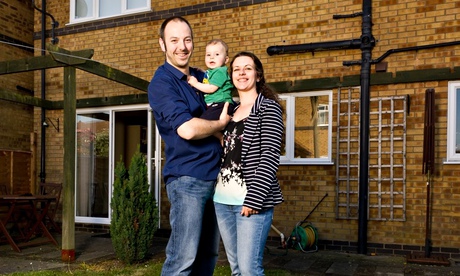
Homeowners Katy Spink and her husband Ian found themselves trapped as they knew they would not meet the affordability requirements post-MMR to qualify for a new mortgage deal. Katy had reduced her hours after the birth of her baby James around the same time Ian took a pay cut to move from his 15-year army career to train as a teacher.
They had never missed a mortgage repayment and had been overpaying with their lender, The One Account, so Ipswich building society, where Katy works, was able to offer them a loan using what are called transitional arrangements. These were written into the MMR by the financial regulator to allow lenders to waive affordability checks for trapped borrowers as long as the customer does not wish to borrow more money, there is no “material impact” on affordability, and they have a good payment history.
“We have reduced our monthly mortgage bill by £250,” said Katy. “And in two years, when this deal ends, we should be in a better position to pay more as Ian starts work as a teacher in September and I intend to increase my hours again.”
But only four small building societies – Ipswich, Melton Mowbray, National Counties and, as of last week, Saffron – apply those arrangements. Bigger lenders, who control the majority of the market, are not, even though they could.
“The key issues that could pose problems are if you are now deemed too old to borrow, if you have an interest-only mortgage you want to move or no longer meet a lender’s affordability requirements,” said David Hollingworth of mortgage brokers London & Country. “Sadly, most mortgage lenders are not applying the transitional rules that are there to protect those who struggle under the new regime.”
Paul Winter, chief executive of the Ipswich building society, said he had seen plenty of examples of “creditworthy borrowers who are quite stuck.”
“The one group clearly being very affected is older borrowers,” he said. “We are seeing rather ludicrous examples of people in their fifties, even their forties, who are being turned down because the term of their mortgage extends beyond the traditional retirement age of 65.”
The society recently dealt with a couple aged 58 and 64 who were refused a mortgage due to their ages and were faced with having to sell their home as their previous mortgage deal had ended. Ipswich used transitional arrangements to provide a new mortgage.
“Clearly there were some instances of very bad lending in the past, but we are talking about helping people who have been satisfactorily paying off their mortgage for a long time and have demonstrated that they can and will continue to pay off that loan,” says Winter.
For borrowers who find themselves unable to get a mortgage, aside from trying the building societies mentioned above for a loan, it may also be worth taking the case to the Financial Ombudsman Service.
The ombudsman says it has seen the fallout of MMR in the complaints coming to it in the past year, and now receives about 30 a week from people who are unable to port their mortgage (take their loan with them to a new property). This is particularly affecting older borrowers, it says.
“As a general rule, the ombudsman would not tell a business to change its lending criteria or force it to offer a loan or a mortgage,” says a spokeswoman. “However, we’re able to look at what’s ‘fair’ when sorting out a case. And if we feel a lender has not provided legitimate reasons for declining to remortgage or port when they previously offered to lend, we may tell them to reconsider.”