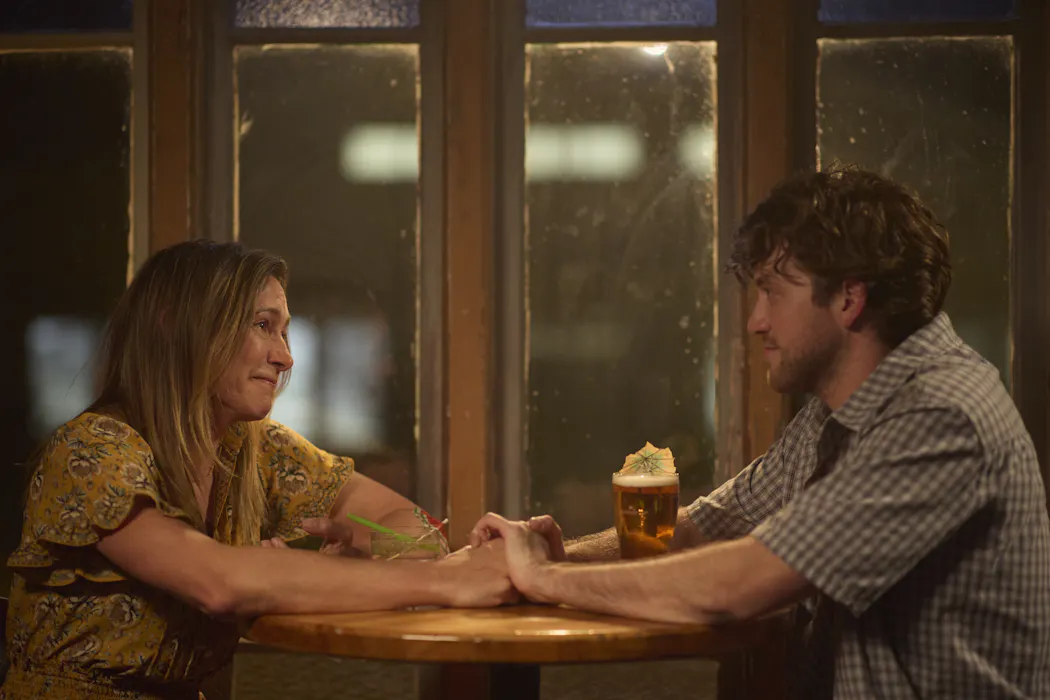
When Nora (Claudia Karvan) breaks her leg, her son Darcy (Luke Wiltshire) – a trans man – returns home to see her for the first time since he came out. It doesn’t take long before Darcy realises there’s another presence in his childhood home: a ghost of his younger pre-transition self, Dee (Jazi Hall).
Homebodies examines the rift between a trans man and his mother through a haunting that confronts them with the conversations they never had.
The series is created by AP Pobjoy, a transmasculine writer and director, as part of the SBS Digital Originals initiative, which seeks to support risk-taking, short-form projects and emerging talent both on- and off-screen.
Homebodies contributes a complex story rarely seen on our screens. It addresses one of the major gaps in LGBTQ+ stories in Australian television: representations of trans men. In a study I conducted with Whitney Monaghan, we identified just three representations of trans men in Australian television drama between 2000 and 2019.
The trans homecoming narrative
Darcy’s return home drops audiences into a story in which many questions seek to be answered. The themes of “journey” and “homecoming” are major features of the transition narrative. They provide the arc through which trans characters affirm identity and their sense of belonging.
Such narratives are seen in films such as Close to You (2023), starring Elliot Page, in which he portrays a trans man returning home to a family gathering. Ultimately, in this film a homecoming is found in the life he has made for himself.
Narratives of self-acceptance can disrupt the traditional ideas of homecoming. Homebodies explores elements of the literal returning home. But Darcy’s acceptance of himself is settled.
The story gives space for an exploration of the challenging, interpersonal relationship between him and his mother through the haunting of an unresolved rift.
Refreshingly, this is done without Darcy ever doubting his understanding and acceptance of himself.
Hauntings as catharsis
Homebodies takes on aspects of a specific mode of Australian gothic cinema, and takes on the gothic genre’s engagement with hauntology – the ways the past can haunt the present – as pivotal for this trans homecoming narrative.
Dee is a haunting of something left behind. This includes some obvious aspects: she uses Darcy’s deadname and she/her pronouns. But also, Dee represents a version of Darcy in which his existence was not yet a consideration. In the moments when he clashes with Nora, it seems Dee is a manifestation of what his mother wants him to be.
In some ways that feels true, but Dee is also part of a past Darcy is not acknowledging.

Such a story could feel too literal: having a trans man confront his pre-transition self. But Dee is not just a dramatic foil to allow for the exposition of how he came to this place in his life. Rather, he is sharing that journey with who he was before it started.
The value of such conversations stems from the authenticity behind the story. Pobjoy creates a story that is specific. While gender and sexually diverse stories continuously run the gamut of having to be representative to those who are underrepresented and seeking to see themselves onscreen, they can also end up being didactic by the nature of reaching beyond that community.
The value is that such stories create understanding – the risk is they lose their specificity if they try to serve too many interests.
Homebodies strikes an effective balance in its specificity, while feeling like a story audiences will be able to connect with in big or small ways.
One factor that might contribute to this success is that this short series is a product of SBS’s Digital Originals initiative.
Digital first for new and emerging voices
Homebodies is the latest example of the impact of digital-first initiatives for Australian television, following shows such as Latecomers (2023), a rom-com featuring two disabled leads, and Iggy & Ace (2021), which explores drug and alcohol addiction and mental health in queer communities.
These emerging talent programs have become a key site for screen industry development in Australia, and often tell complex stories about underrepresented communities.
Short episodes and online distribution are lower-risk investments for traditional broadcasters, and here underrepresented voices are getting opportunities not previously seen on Australian television.
Through such short series, public-service broadcasters are foregrounding centrally queer stories, investing in local content during the ongoing disruption of streaming.
Homebodies is a prime example of the value of such initiatives. An emerging original voice – in Pobjoy as creator – given the space to dive into a narrative rarely seen on Australian television. And Homebodies won’t just be online: it is also screening on SBS television.
But there are questions about where investment might scale. With the recent loss of Matchbox Pictures and Tony Ayres Productions, there are concerns about the challenges faced by other production houses, and the future of specific local stories in Australian television drama.
Read more: Why one of Australia’s most successful TV production companies is being shut down
While streaming quotas seem to promise new opportunities in the future, the reality of their impact remains theoretical. The number of hours, the variety of genres, the prominence of our local stories all remain unknowns.
Homebodies is a promising example of what is possible, when given the chance.
Homebodies is on SBS and SBS On Demand from Saturday.

Damien O'Meara does not work for, consult, own shares in or receive funding from any company or organisation that would benefit from this article, and has disclosed no relevant affiliations beyond their academic appointment.
This article was originally published on The Conversation. Read the original article.